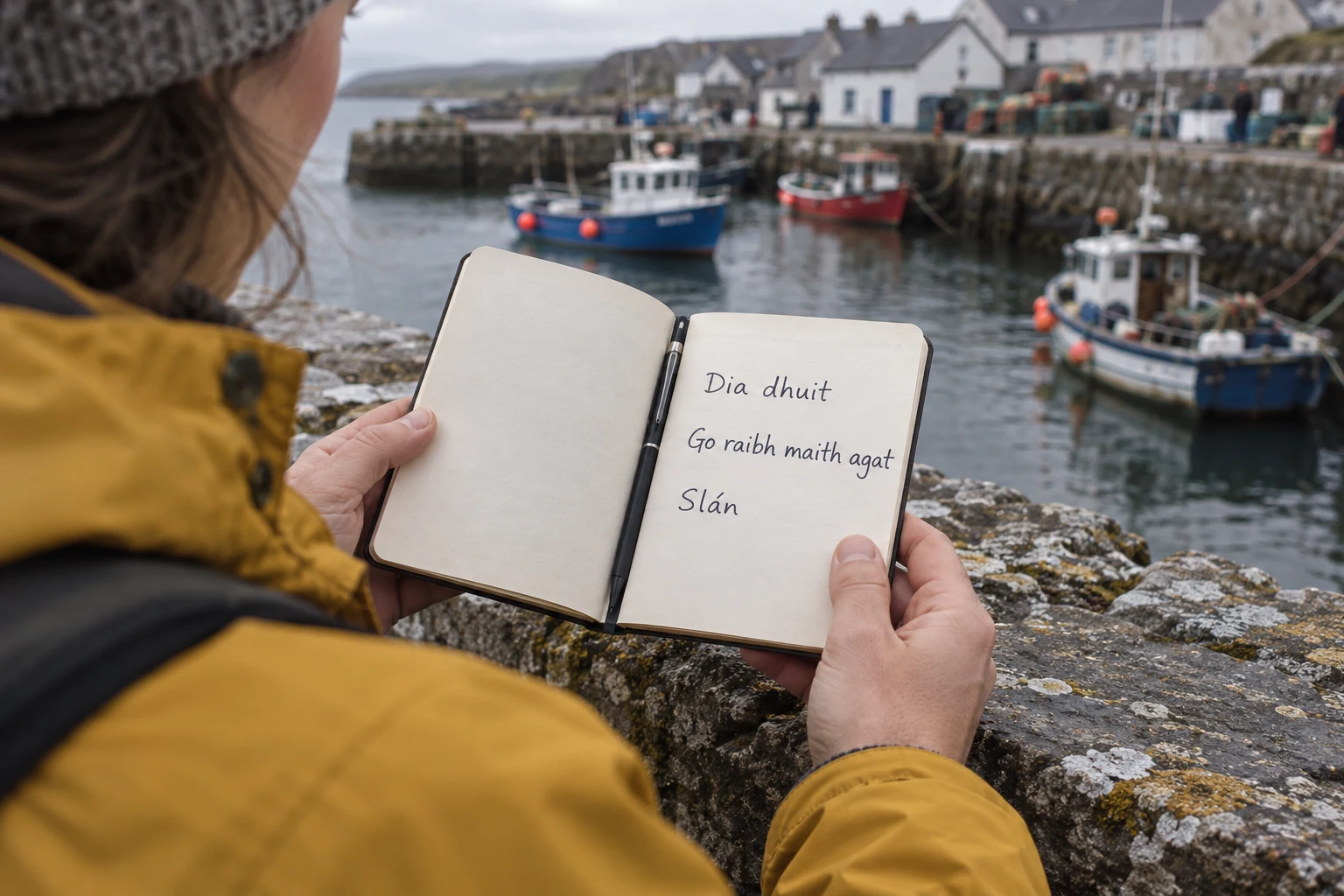
A few Irish words can give a visit another dimension: recognising a welcome, thanking someone for directions or understanding whether a door is open. You do not need to master a conversation before you try a short phrase.
This is a guide to Gaeilge, the Irish language, rather than English slang used in Ireland. Tourism Ireland’s language guide explains the place of English and Irish on the island. English will serve many visitors for everyday communication; learning a little Irish adds something to that experience.
The HSE’s everyday Irish phrase guide includes several of the greetings and expressions below.
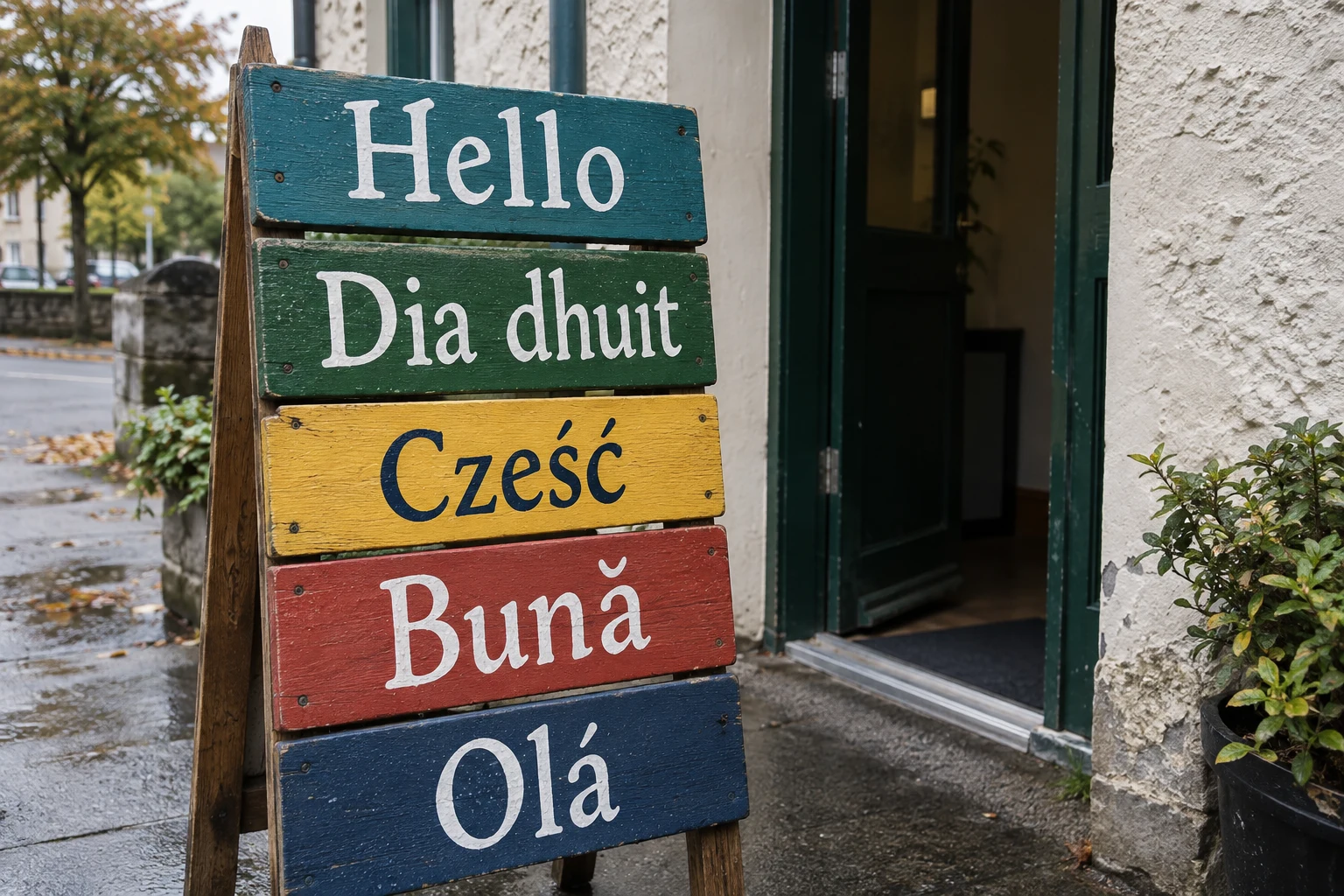
Dia dhuit — hello
Use Dia dhuit to greet one person. It is a short opening you might practise before entering a small shop or arriving at your accommodation. Its literal religious wording does not make it a request to discuss religion: in this setting, it is a greeting.
If somebody answers with more Irish than you know, simply explain that you are learning a few words. You can continue in English or another shared language.
Go raibh maith agat — thank you
This is a useful phrase to remember after someone helps you, hands over a purchase or explains a route. Learn it as a complete expression, rather than trying to pronounce every written letter as you would in English.
Le do thoil — please
Teanglann’s dictionary entry for toil confirms le do thoil as a polite expression meaning please. It fits a request; it is not a general greeting.
Gabh mo leithscéal — excuse me
The dictionary entry for leithscéal gives this expression for excuse me. It can help you politely get someone’s attention before a question or acknowledge an interruption.
Pair it with a clear explanation in a language you both understand. For a missed bus, an access requirement or an urgent problem, understanding the answer is more important than completing the exchange entirely in Irish.
Slán — goodbye
Slán is a straightforward farewell to put beside your greeting and thank-you phrase. Think of three separate moments in a visit: saying hello, expressing thanks and saying goodbye.
Fáilte — welcome
You may recognise fáilte in a welcome message. Teanglann’s fáilte entry explains its meaning and related expressions.
Sláinte — cheers
Tourism Ireland identifies sláinte as a toast, used when raising a glass. It refers to health and is often rendered as cheers in this setting. It is different from slán, the farewell.
Listen to Teanglann’s sláinte recordings before trying it. The written accent belongs in sláinte; keeping it when you save the word helps you recognise the correct spelling later.
Ní thuigim — I do not understand
This expression appears in the HSE guide and is worth learning alongside hello. It lets you be honest when the conversation moves beyond your vocabulary.
Follow it by explaining what would help: switching language, repeating a word or pointing to the relevant sign. Learning a phrase does not commit you to understanding every reply.
Oscailte and dúnta — open and closed
Oscail and its forms relate to opening, while dúnta means closed. Recognising oscailte and dúnta can help you make sense of simple notices on doors.
Still check the full notice for times, dates and other conditions. One familiar word is a clue, rather than a substitute for reading the opening arrangements.
Hear the words before you travel
Teanglann’s pronunciation database provides recordings labelled by dialect, including Connacht, Ulster and Munster. Start with one recording and repeat it, instead of relying entirely on an English-style spelling of the sound.
Save a small personal note with the Irish spelling, meaning and audio link. Try a phrase when the moment feels appropriate, listen to the reply and give the other person room to choose the language of the conversation. For background, our guide to the languages spoken in Ireland explains where Irish fits into everyday life.

Join the conversation
Keep it kind, relevant and constructive. Comments are reviewed before they appear.
Be the first to share a thought.