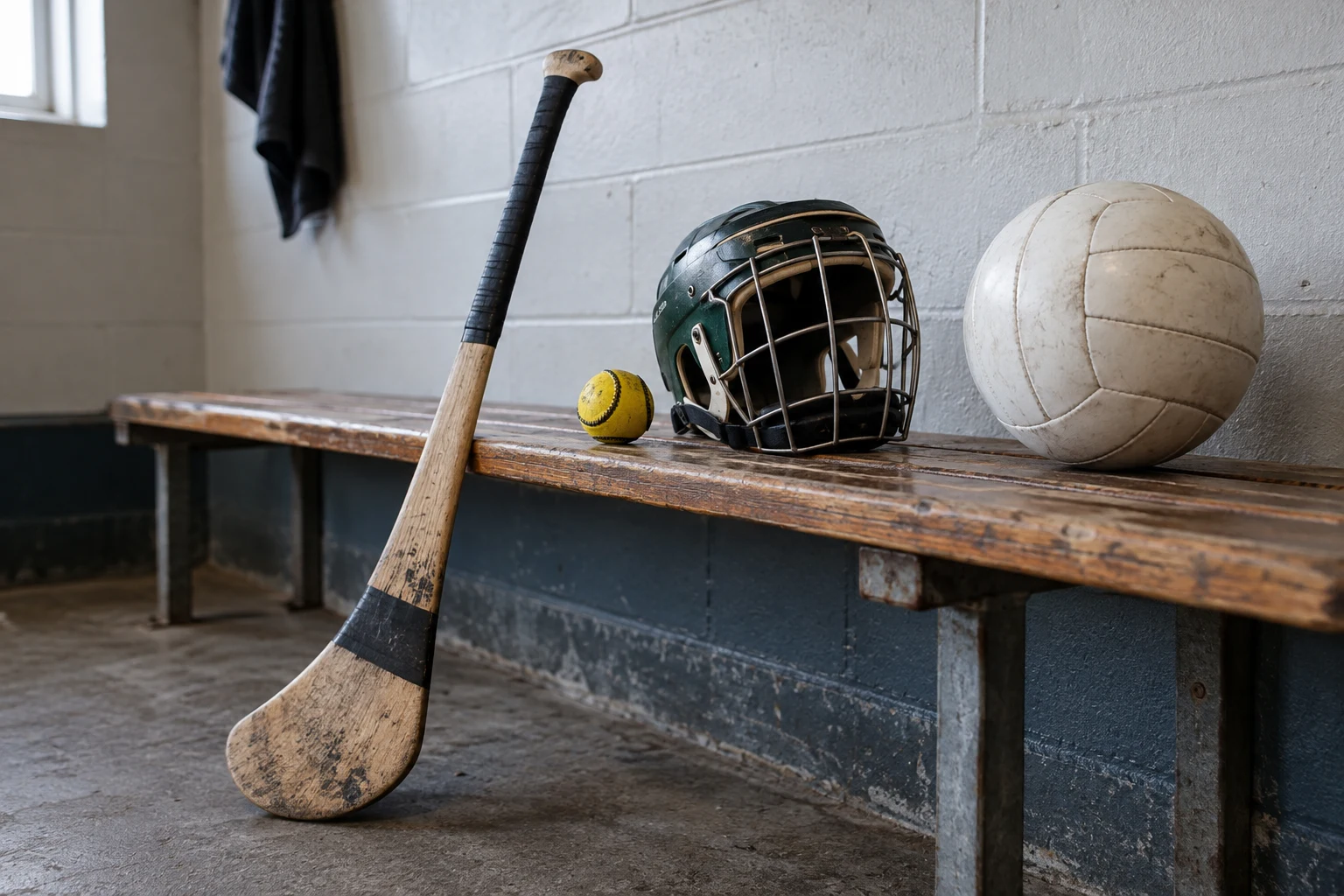
Hurling and Gaelic football are two different Irish field sports. Hurling uses a stick called a hurley or hurl and a small ball called a sliotar. Gaelic football uses a larger round ball, played with the feet and hands. Both are central to the Gaelic Athletic Association, usually shortened to GAA.
The GAA’s introduction to its games is a useful starting point. For a first viewing, identify the equipment and the scoring area before trying to understand every foul or restart. This guide focuses on GAA hurling and men’s Gaelic football; check the relevant competition’s rules for other codes and age groups.
Start with the equipment and the posts
A hurley has a long handle and a broader flattened end used to play the sliotar. The small ball can travel quickly through the air, while players also lift, catch and control it. In football, look for kicking, catching, bouncing and the solo, where a player drops the ball onto the foot and returns it to the hands.
The goalposts combine a net below a crossbar with upright posts extending above it. Watch whether a shot travels underneath or over the bar: that changes how the score is counted.
How the scoring works
Under the GAA’s April 2026 playing rules, a goal is worth three points. In ordinary hurling scoring, sending the sliotar between the posts above the crossbar earns one point.
Men’s Gaelic football also has qualifying two-point scores. A kicked shot over the bar can count for two when the kicker has at least one foot on or outside the 40-metre arc and meets the rule’s conditions, including the restriction on a subsequent touch by a teammate. A score directly from a 45 is an exception worth one point. Do not assume every shot over the bar has the same value.
A traditional goals-and-points score written 2–14 means two goals plus fourteen points: twenty points in total. Broadcast displays may provide extra detail, so look at the displayed total and competition format rather than treating the first number as the whole score.
Check whether a rule is a trial
The GAA announced controlled hurling rule trials for the Fitzgibbon Cup league format from mid-October 2026. Proposals include two points for a sideline struck cleanly over the bar. That announcement does not make the proposal a universal rule for every hurling match.
For a particular fixture, check the competition and the rule set being used. This avoids mixing an experimental college game with the standard rules in another competition.
Watching and trying the games are different steps
A first-time spectator can follow possession, shots and the scoreboard without mastering every technical decision. If something is unclear, note whether play restarted with a kick, a puck or a throw-in, then consult the relevant rule.
If you want to try hurling, begin through a club or supervised session with appropriate equipment. The GAA’s helmet guidance requires a compliant helmet with a facial guard in hurling games and practice. Watching a highlight clip is not a substitute for learning safe technique.

Join the conversation
Keep it kind, relevant and constructive. Comments are reviewed before they appear.
Be the first to share a thought.