How many people speak Gaeilge depends on what you mean by speak. Being able to use Irish, using it at school and holding an everyday conversation in it describe different things. A useful answer needs a date, a place and a clear definition.
The CSO’s Census 2022 summary counted 1,873,997 people who said they could speak Irish: about 40% of people aged three and over who answered that question in the Republic of Ireland. That was a statement of ability, not a count of fluent daily speakers or a worldwide total.
How often was Irish used?
The CSO’s detailed Irish-language profile separates people who reported Irish ability into frequency groups. In 2022:
There were 71,968 daily users outside the education system and 115,065 weekly speakers. Another 553,965 spoke Irish within the education system only.
A further 614,727 used it less often than weekly, while almost 473,000 said they never spoke it. Some respondents did not state a frequency.
Those figures explain why the nearly 1.9 million headline cannot be read as nearly 1.9 million everyday conversations. The daily-outside-education total was 1,835 lower than in 2016, even though reported ability had increased.
Is Gaeilge only spoken in the Gaeltacht?
No. The same profile recorded 20,261 daily speakers in the Gaeltacht, or 31% of its Irish-speaking population. That denominator matters: it is a percentage of people there who reported Irish ability, not of every resident.
Subtracting that count from the national daily-outside-education figure leaves 51,707 outside the Gaeltacht. More daily speakers therefore lived outside those designated areas in absolute numbers. That does not mean Irish was more concentrated outside them, or that every Gaeltacht community had the same pattern.
What does the newer research say?
Foras na Gaeilge launched the Irish Language Attitudes Survey 2025 on 19 May 2026. Trinity College Dublin and Ipsos B&A conducted face-to-face interviews with 1,498 adults during summer 2025: 1,000 in the Republic and 498 in Northern Ireland. Its publication year and fieldwork year are different.
In Table 14 of the full report, 9% of adults surveyed in the Republic reported daily Irish use and 7% weekly use. The Northern Ireland figures were 4% and 4%. These are survey estimates for adults, not census headcounts.
It would be misleading to set the Republic’s 9% beside the census’s 71,968 and announce a measured surge. The survey asks how often respondents speak Irish, without the census’s separate education categories; its adult population, sampling and questions also differ. The results provide another perspective, rather than a replacement total calculated on the same basis.
For an answer about “now”, the honest wording is that the latest evidence discussed here measures 2022 and 2025. Neither source counts every Irish speaker on the day this article is published.
Where can a learner hear and use Irish?
The Gaeilge.ie directory lists Irish-language organisations, adult-learning opportunities and media. Its listings include Dublin’s Raidió na Life and Belfast’s Raidió Fáilte, useful reminders that Irish-language life extends beyond a map of rural Gaeltacht areas.
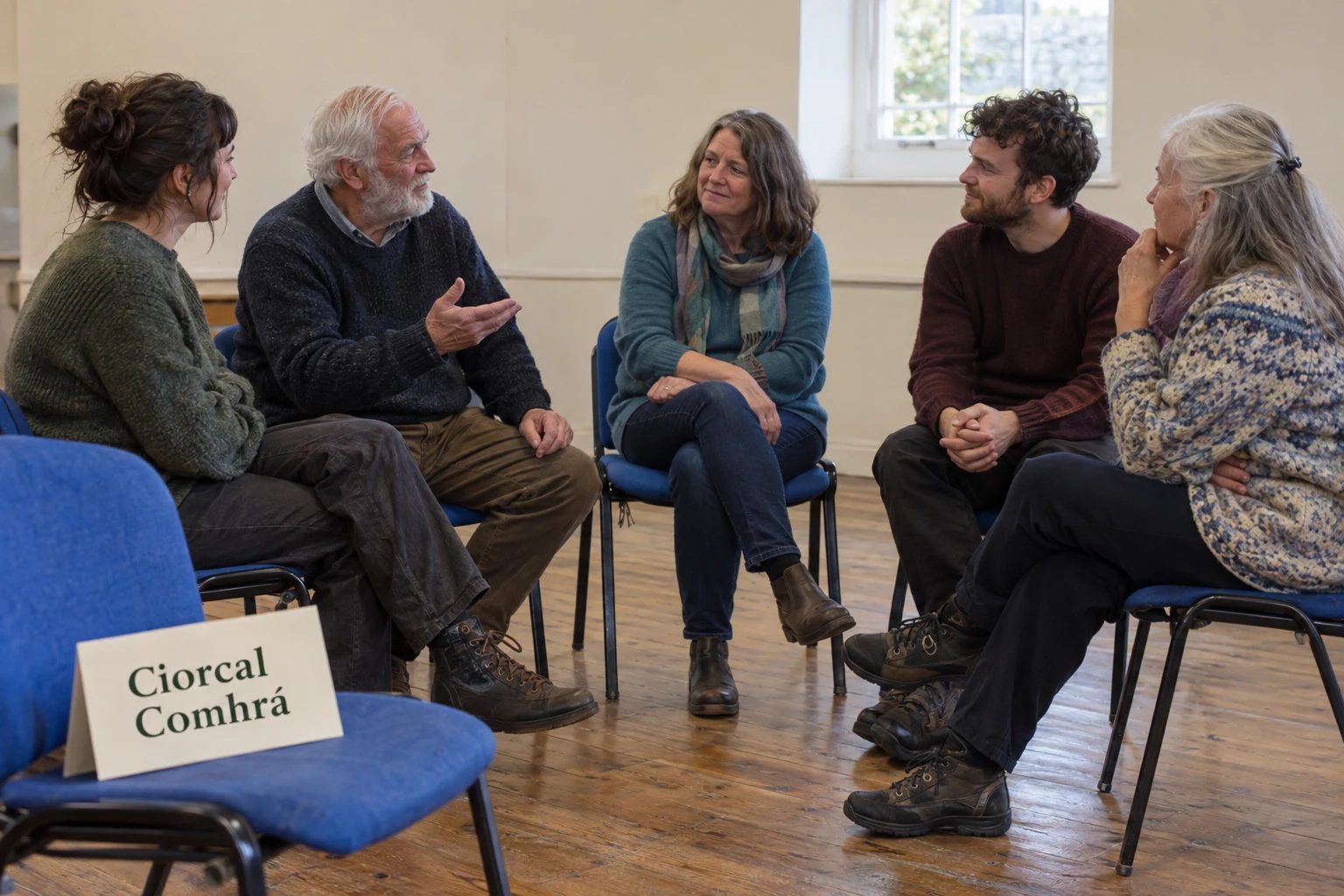
For someone returning to Irish, a practical next step is to look for a conversation group that welcomes their level, check the arrangements with its organiser, and choose something they can attend regularly. The question then becomes personal and manageable: where could you use the Irish you already have?
Join the conversation
Keep it kind, relevant and constructive. Comments are reviewed before they appear.
Be the first to share a thought.