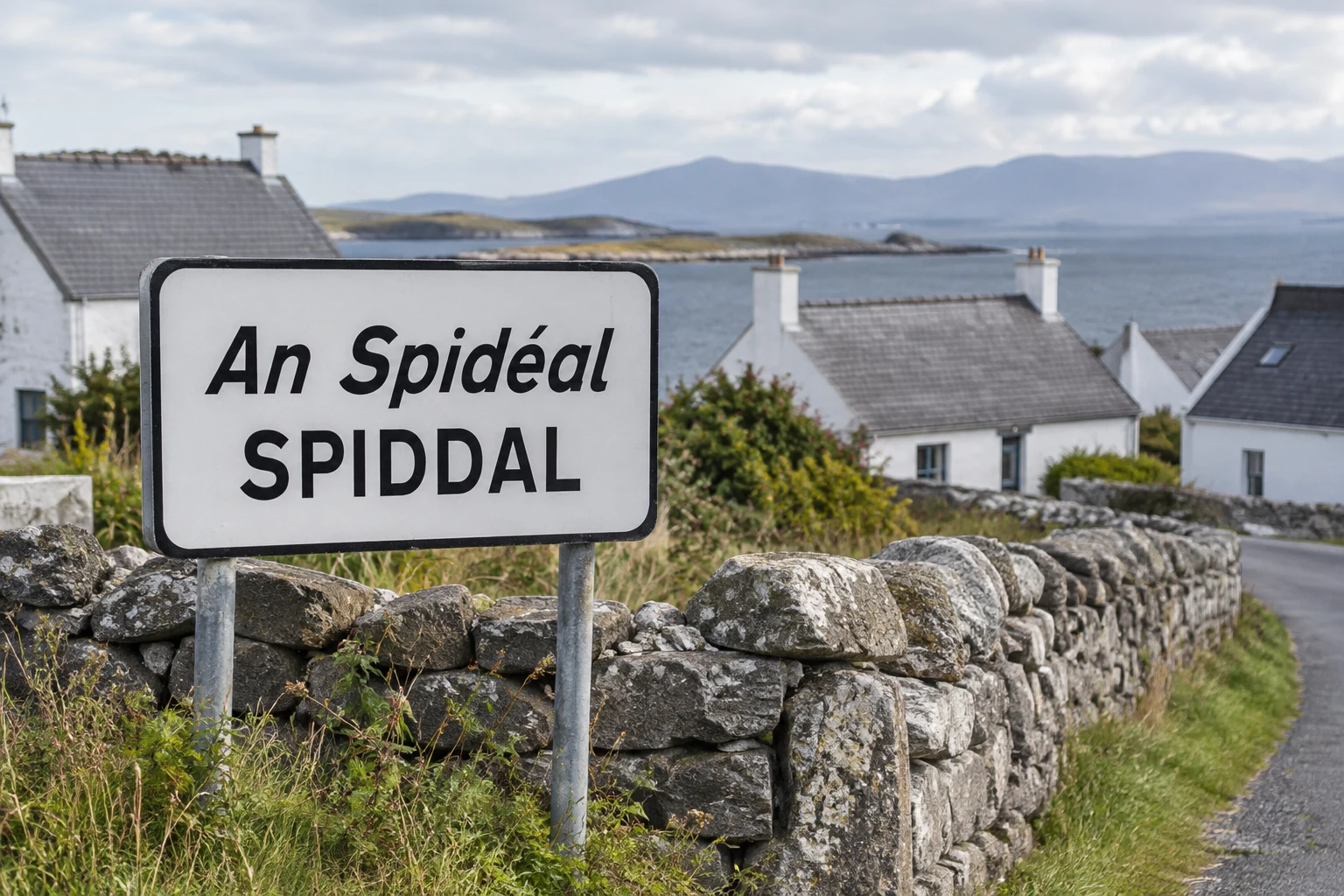
English is the main language used across the island of Ireland, according to Tourism Ireland’s visitor information. Irish is also a living language, used in communities, education, media and public life. A visitor can usually communicate in English without concluding that Irish is only ceremonial.
In the state of Ireland, Article 8 of the Constitution gives Irish the position of national and first official language and recognises English as a second official language. Constitutional status and the language someone uses most often at home are different questions.
Irish is a language, not an English accent
Gaeilge is the Irish-language name for Irish. Foras na Gaeilge’s language portal brings together learning, dictionary, community and cultural resources, reflecting the many ways the language is used.
Hearing English spoken with an Irish accent is not the same thing as hearing Irish. A visitor may encounter both in the same place, or hear someone switch between languages. Treat the person’s actual language choice as your cue rather than assuming that a familiar accent answers the question.
What is the Gaeltacht?
The Gaeltacht refers to regions where Irish has a particular role as a community language. Údarás na Gaeltachta’s regional guide covers areas in Donegal, Mayo, Galway, Kerry, Cork, Meath and Waterford. It is not the name of a single county or a description of every western village.
Irish is also spoken outside those regions. Equally, a Gaeltacht designation does not mean every person you meet has the same fluency or uses Irish in every situation. These are places where people live and work, rather than a performance arranged for visitors.
How many people speak Irish?
The CSO’s Census 2022 language results recorded 1,873,997 people who said they could speak Irish. That represented 40% of people aged three and over who answered the question. The same release recorded 71,968 daily speakers outside the education system.
Those figures describe different measures. Being able to speak a language, using it in school and using it daily outside education are not interchangeable. The figures are also from the 2022 census, not a new count of language use in 2026.
A useful approach for visitors
Learn a few words if you would enjoy using them, listen carefully and ask for help with pronunciation. Keeping accents in a name or place name matters; copying the full spelling is a better starting point than treating an unfamiliar letter as decoration.
If a conversation moves into English to help you, accept the help without making assumptions about the other person’s Irish. The useful distinction is between official status, language ability and everyday use. Understanding all three gives a much fuller picture than saying Ireland speaks only one language.
Join the conversation
Keep it kind, relevant and constructive. Comments are reviewed before they appear.
Be the first to share a thought.