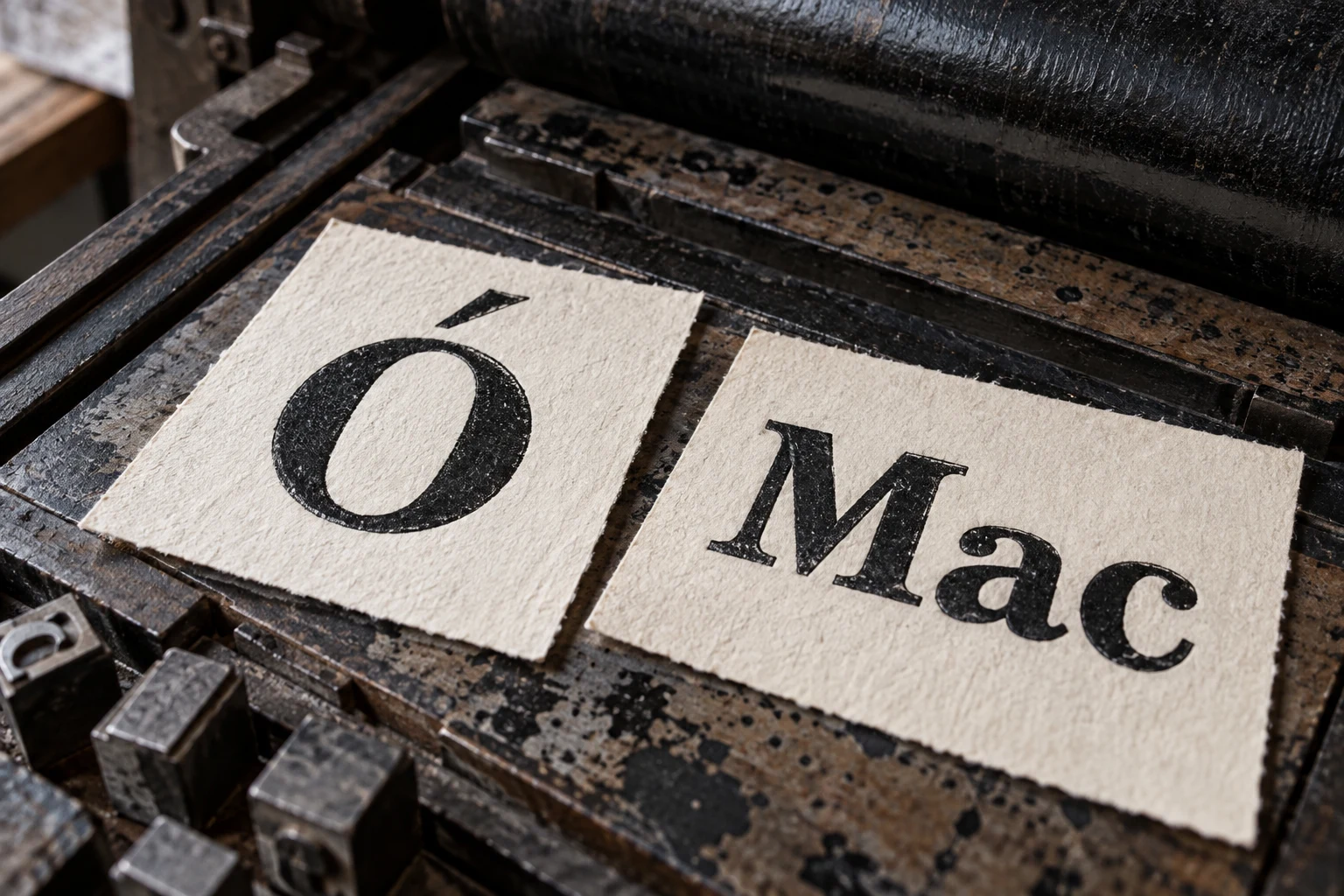
The beginnings of many Irish surnames preserve words about ancestry. Mac means son, while Ó is associated with a grandson or descendant. O’ is the familiar form seen in many English-language spellings. In a modern inherited surname, these elements connect a name with its history; they do not tell you the current bearer’s father’s first name.
The family-history workbook published on IrishGenealogy.ie explains the development of hereditary patronymic names—names built around a family relationship. It uses Mac for son of and Ó for grandson of, showing how family names could develop across generations.
A word becomes part of an inherited name
Teanglann’s dictionary entry for mac gives the ordinary meaning son and examples of its use in surnames, including Mac Mathúna and McMahon. An everyday relationship word and a hereditary surname therefore need to be read differently.
Someone inheriting such a surname today is not rebuilding it from their own parent’s name each generation. Think of the prefix as part of the inherited family name, rather than a form that changes automatically whenever a child is born.
The shortened spelling Mc is also encountered in these names. When researching a family, record the spelling people actually used, including the prefix, spacing and punctuation, rather than silently making every version match your preferred modern form.
Why can the same family appear under different spellings?
The workbook describes how names changed as they were written in English: prefixes could be omitted, sounds transcribed in different ways and names translated or replaced with familiar English forms. Later interest in Irish also encouraged people to restore prefixes.
That means a difference between a name with O’ and a similar name without it is a reason to investigate, rather than immediate proof of a different family. Equally, matching spellings do not prove that two people are related. A surname is a starting point for research, not a complete family tree.
How to investigate your own name
The National Library of Ireland’s family-history service provides help with research and access to relevant resources. Start with people and records you can identify, then work backwards through a documented connection.
Keep a record of the place, date and spelling attached to each person. If a search fails, try a plausible variant or a version without the prefix, and check the surrounding details before accepting a match. A familiar name on its own is weaker evidence than a name supported by the right relatives, place and period.
Respect the form someone uses
A person may use an Irish-language form, an English-language form or another established family spelling. Copy the name they provide rather than adding a prefix because it seems more Irish.
Understanding O’, Ó, Mac and Mc opens a useful door into language and family history. Establishing a particular line of descent still requires the records that connect one generation to the next.
Join the conversation
Keep it kind, relevant and constructive. Comments are reviewed before they appear.
Be the first to share a thought.