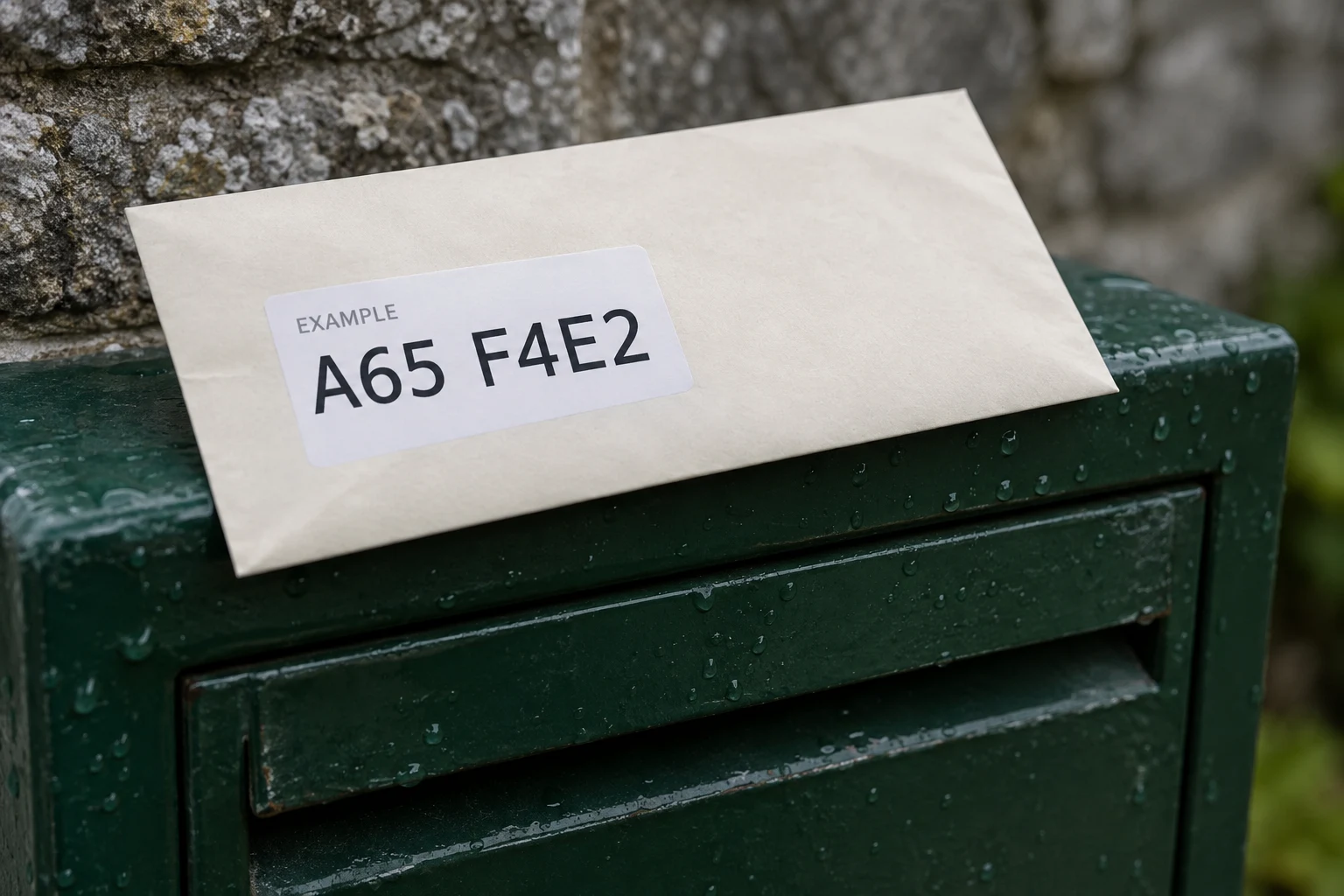
An Eircode is a seven-character postcode used for an Irish postal address and its location. The system was introduced in July 2015. Unlike a postcode shared by a whole street or group of properties, an Eircode distinguishes an individual address.
Eircode’s explanation of the system divides the code into a three-character routing key and a four-character unique identifier. Its published example is A65 F4E2: A65 is the routing key and F4E2 is the identifier.
What the two parts tell you
The routing key identifies the principal post town associated with the address’s postal area. It is not a reliable county abbreviation. Postal areas can cross county boundaries, so a code should not be used to settle which county a place belongs to.
The final four characters distinguish the address within that postal area. They are not arranged as a sequence along a road. Knowing the code for one house therefore does not let you calculate the code for the next house, or judge how close two properties are by comparing their final characters.
Keep all seven characters when copying a code. The system includes the number zero but does not use the letter O, a distinction intended to reduce confusion.
How to find the right code
The official Finder help describes searches by address and by map. For an address that clearly identifies one property, start by entering that address. Where several properties share similar wording, use the map to establish which location you actually need.
Before copying a result, check that it corresponds to the intended building. This is particularly useful when arranging a delivery, meeting at rural accommodation or sharing a service location. A plausible-looking code is less useful than a checked location.
On a smartphone, the Finder’s directions feature can help with the next stage of the journey. The postcode identifies a location; any separate instructions about a gate, entrance or meeting point should still come from the host or recipient.
Do you still need the address?
Yes: treat the code as an addition to the address. Eircode’s FAQs explain that existing addresses and place names were not replaced; an Eircode is added at the end. The same code applies to Irish- and English-language versions of the address.
For an order form, copy the recipient’s supplied address carefully, then add the checked code in the postcode field or as directed by the form. Do not remove a townland or other address detail merely because you have found an Eircode.
The FAQs also say use is not mandatory, although particular organisations may request a code to provide their products or services. If a form rejects it, recheck the characters and the organisation’s instructions before substituting another property’s code.
A useful habit is to save the full address, verified Eircode and any entrance instructions together in a trip or delivery note. They solve related problems, but none needs to replace the others.

Join the conversation
Keep it kind, relevant and constructive. Comments are reviewed before they appear.
Be the first to share a thought.