

Applying for social housing support and applying for the Housing Assistance Payment are connected steps, but they are not the same application. Being assessed for support also does not mean a council house is immediately available.
The useful distinction is between three decisions: whether a household qualifies for social housing support, whether a particular private tenancy can receive HAP, and what the household will have to pay. Keeping those questions separate helps avoid treating a place on a housing list as a rent-payment approval.
Start with the social housing assessment
The official HAP application guidance directs new applicants to their local authority’s Social Housing Support application form first. Submit that form with the evidence specified in its checklist. If approved, or already on the authority’s housing list, ask about the next HAP application step.
The assessment involves more than comparing a salary with an income ceiling. For example, Cork City Council’s social housing guidance describes eligibility checks and a separate assessment of housing need. It considers household income, access to alternative accommodation and the suitability of existing accommodation, alongside other criteria.
That council’s guidance also explains that applications are made to one authority, usually where the applicant lives or has a local connection. Ask the relevant council which authority should assess your household and which current income limit and evidence requirements apply. A threshold quoted for a different household or council is not an eligibility decision.
Who qualifies for HAP?
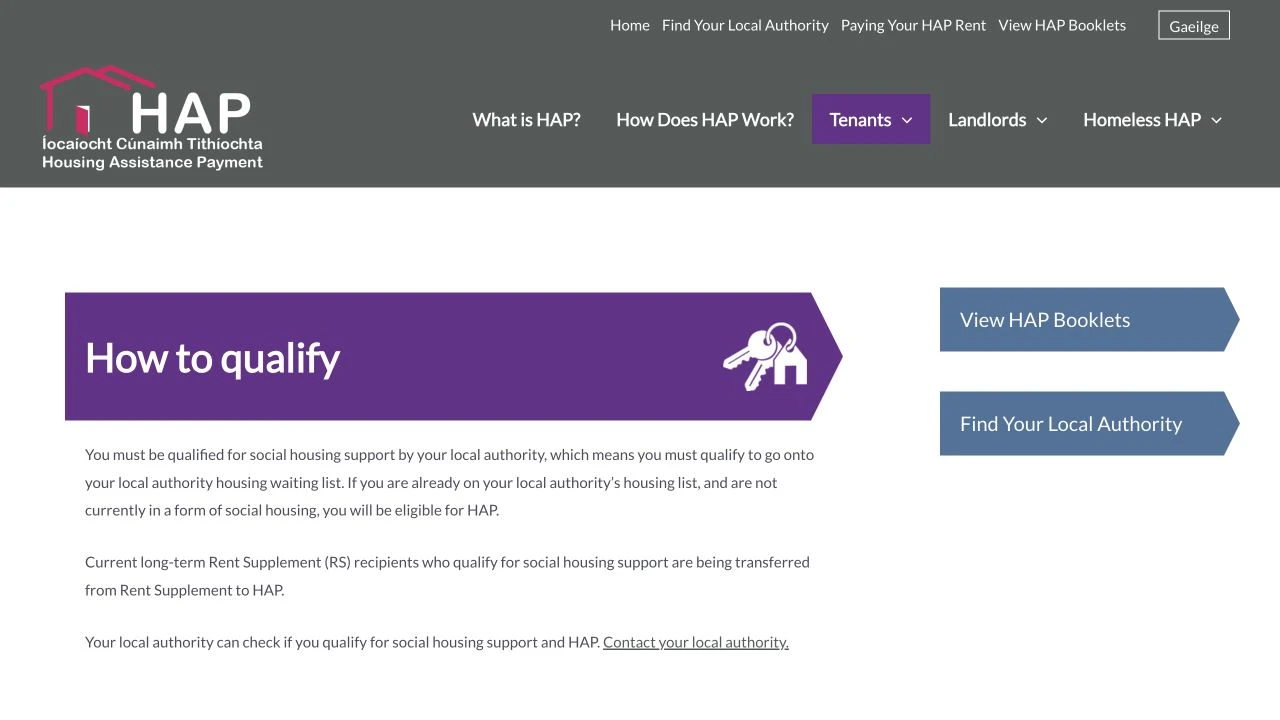
HAP’s qualification page says the household must first qualify for social housing support through its local authority. It explains that applicants already on the housing list and not currently receiving a form of social housing can qualify for HAP. The authority checks the household’s circumstances; this guide cannot decide an individual application.
HAP involves finding accommodation in the private rental market. The scheme’s explanation of how it works sets out the relationship: the tenant finds a property, the landlord agrees to the tenancy, and the authority makes a payment subject to the scheme’s conditions. HAP is therefore different from an offer of a council-owned home.
The property and landlord are part of the application
The official application sequence says to complete the HAP application after finding accommodation. Once a tenancy has been agreed, both tenant and landlord return their completed information to the authority promptly. Keep a copy and ask what remains outstanding rather than assuming that sending one part completes the process.
Application channels can differ. Cork City Council’s online HAP instructions describe a portal for its qualified housing applicants, requiring a valid social housing number. The council says household details on the housing file and HAP form must match. That is a local example: follow your own authority’s current instructions and update inaccurate household information through its official channel.
Work out both parts of the tenant payment
The official tenant-payment guidance explains that the household pays an income-related weekly contribution to the authority. The authority’s payment to the landlord is subject to rent limits that depend on household size and location, with limited flexibility in some cases.
If the agreed rent exceeds the approved HAP payment, the tenant pays that difference directly to the landlord as well. The authority must consider whether the overall tenancy is sustainable; an applicant cannot assume that an expensive property will be approved. HAP itself does not pay the rental deposit.
Before committing to an arrangement, ask the HAP team to explain the applicable limit, the weekly contribution, any separate rent difference and the deposit position. Compare the whole household outlay, including bills, rather than only the payment going to the landlord.
Check when payments can begin
HAP’s tenancy guidance says the local authority is not the landlord: the rental agreement is with the property’s landlord. It also says that a valid application from both tenant and landlord is needed for the authority’s HAP payment. Rent arising from moving in before that point remains the tenant’s responsibility. Do not assume earlier rent will be covered retrospectively.
Keep the dates of submission, requests for further information and the payment-start confirmation together. Ask the council how HAP will affect any other housing or transfer application you have.
For a council-property offer, an assessment deadline is not a move-in date. Cork City Council expressly says it cannot give applicants a timeframe for an offer because demand is exceptionally high. Keep changes in your circumstances updated with the relevant housing team, and send application evidence only through that authority’s official channels.


Join the conversation
Keep it kind, relevant and constructive. Comments are reviewed before they appear.
Be the first to share a thought.