

A salary, a payslip deduction and a tax refund answer different questions. Gross pay is the starting amount before deductions; the amount reaching a bank account depends on the applicable taxes, social insurance and other payroll items. A refund arises from a review of tax already paid, not simply from having an unused credit.
This guide describes the official PAYE routes checked on 19 October 2026. It does not calculate an individual tax bill or decide whether someone qualifies for a relief.
Read the correct tax-year column
Revenue’s rates and credits table gives the 2026 income-tax bands. For a single person without qualifying children, the first €44,000 is within the 20% band, with the balance at 40%. Different circumstances have different bands; the single-person example is not a universal threshold.
The same table lists a €2,000 Single Person Tax Credit and a €2,000 Employee PAYE Tax Credit for 2026. Those are credit values, not a promise that every reader receives both or a €4,000 cash payment. Revenue’s explanation of tax credits says credits reduce tax payable and that unused credits cannot be refunded or carried into another tax year.
The rates page also flags Budget 2027 announcements. Keep the effective tax year separate from the date of a budget speech: use the 2026 column when reviewing 2026 pay and the relevant earlier year when reviewing an older return.
Income Tax is only part of the payslip
Revenue’s standard USC table sets out separate 2026 bands: 0.5% on the first €12,012, 2% on the next €16,688, 3% on the next €41,344 and 8% on the balance. These are standard rates; exemptions and reduced-rate rules need their own checks. Do not add every rate together and apply the total to all pay.
PRSI is separate again. The Department of Social Protection’s Class A table distinguishes the period before 1 October 2026 from the period starting on that date. The employee rate where chargeable rose from 4.20% to 4.35%; weekly bands, a nil-rate band and a tapered credit still matter. This does not establish anyone’s PRSI class or liability.
Review a completed year through Revenue
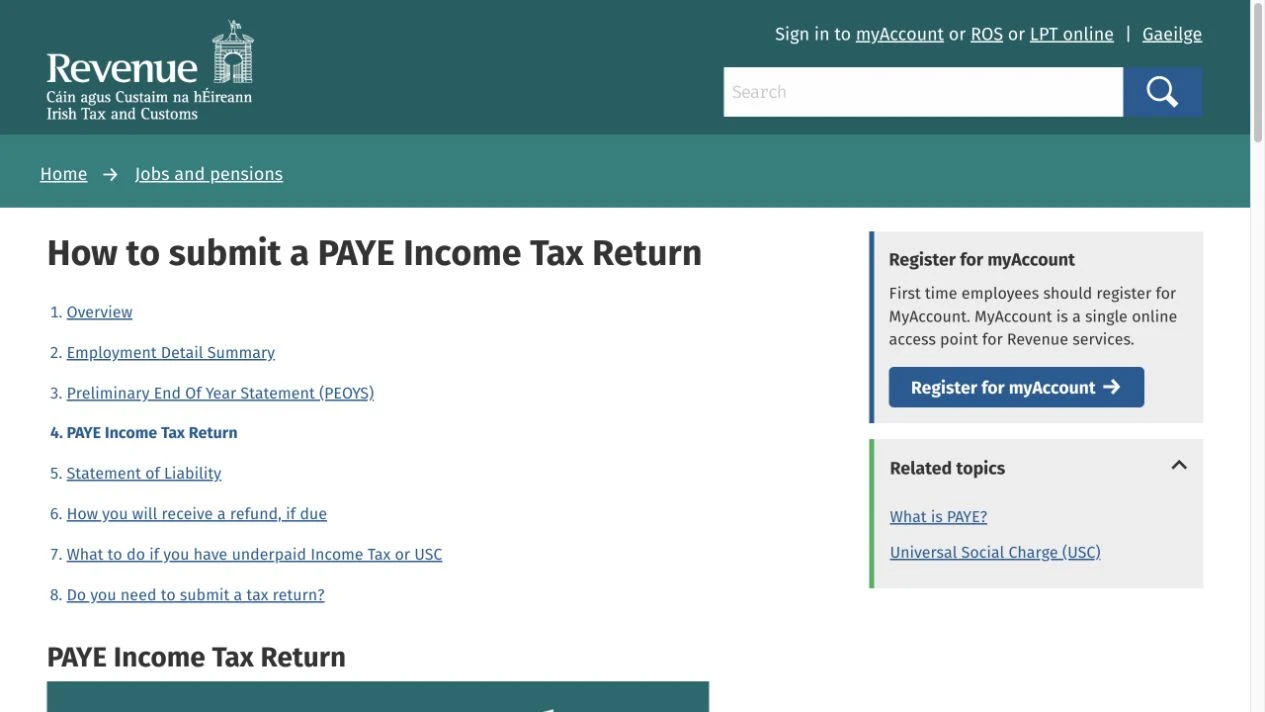
For PAYE customers, Revenue’s return instructions direct readers to myAccount, then “Review your tax for the previous 4 years” under PAYE Services, and the appropriate year. Completing the return can declare additional income, claim applicable credits or reliefs and establish an overpayment or underpayment through a Statement of Liability.
Check the year, the income information and the evidence for any claim before submitting. An initial indication of an overpayment is not a guarantee of the final result. The page directs self-assessed and self-employed customers to a separate filing route; the PAYE instructions should not be assumed to cover every business or income source.
Watch the four-year deadline
Revenue’s four-year rule explicitly says claims for 2022 must be made by 31 December 2026. Do not reuse an old article’s list of claimable years without checking the date.
If the Statement of Liability confirms an overpayment of Income Tax or USC, Revenue’s refund guidance explains payment using the bank details on its record, or a cheque where applicable. Check those details inside the genuine service. Keep tax documents, identifiers and account credentials private; The Press does not process returns or need those details.
Join the conversation
Keep it kind, relevant and constructive. Comments are reviewed before they appear.
Be the first to share a thought.