

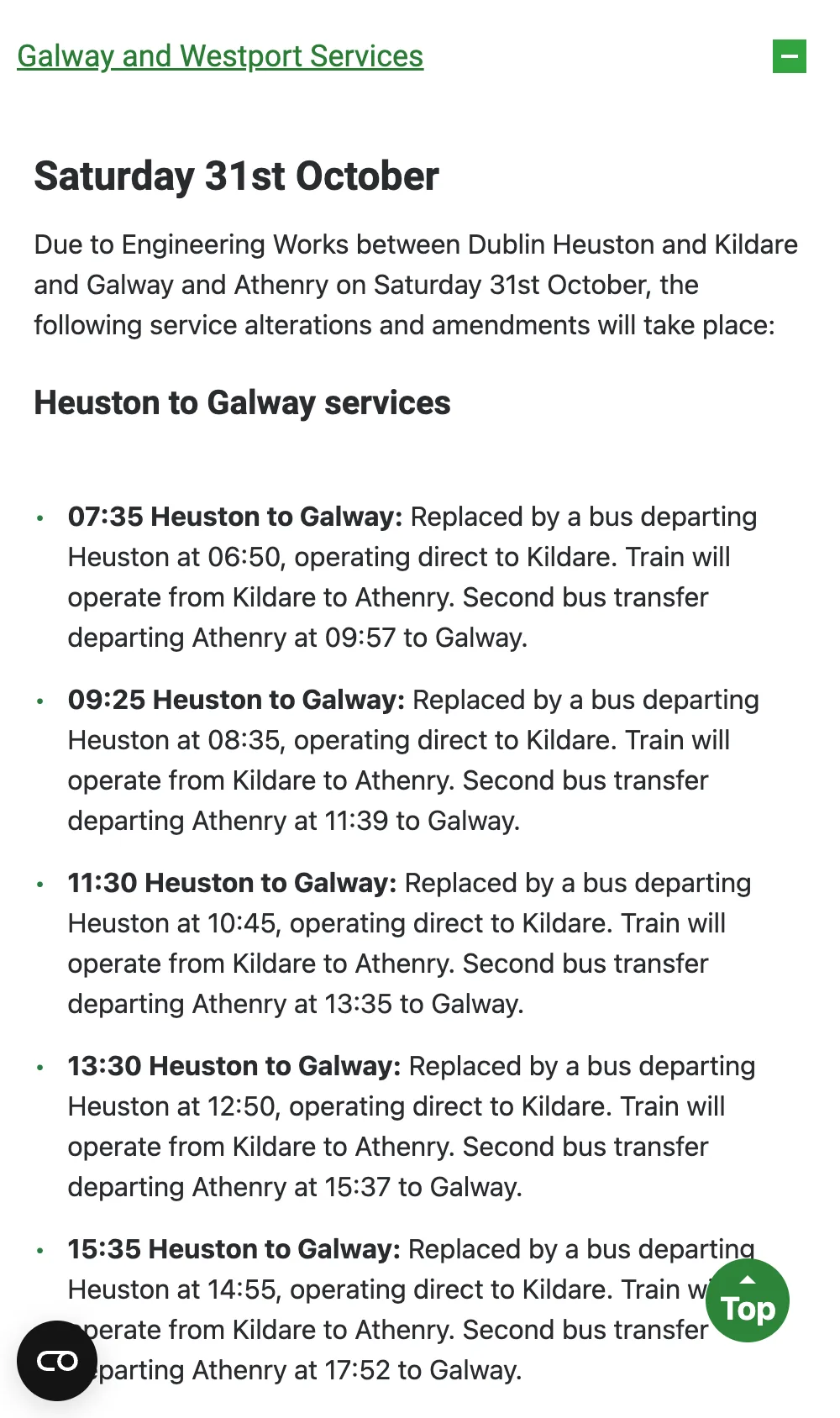
Galway passengers travelling to or from Dublin on Saturday 31 October face journeys combining buses and trains, with some replacement buses leaving earlier than the advertised train time. Works affect both the Heuston end of the route and the line between Galway and Athenry. Later services include full-length bus replacements.
The arrangements were checked against Iarnród Éireann and Transport for Ireland on Thursday evening, 29 October. They are planned changes for Saturday, not a report that the railway is closed tonight. Passengers should check the revised journey for their precise departure, destination and return date before travelling.
Earlier buses can change the start of the whole journey
Iarnród Éireann's detailed engineering notice gives a clear example: the service normally described as the 07:35 Heuston–Galway journey starts with a bus from Heuston at 06:50. It continues by train from Kildare to Athenry, followed by another bus to Galway. In the other direction, the advertised 06:25 Galway–Heuston service starts with a bus at 05:55.
That difference matters before a passenger reaches a station. A lift, local bus or taxi organised around the usual rail departure could arrive after the replacement has left. Work backwards from the first departure in the revised itinerary, then allow time to find the boarding point and identify the correct vehicle.
The operator's later Heuston departures include full bus replacements. Its 17:31 listing includes a bus via Athlone and a separate stopping arrangement serving intermediate places, including Oranmore. Check the service that serves your actual stop rather than boarding solely by the final destination displayed.
Why the overview and the individual service both matter
TFI's current service update describes Galway journeys as having bus transfers between Heuston and Kildare and between Athenry and Galway, with full Heuston–Galway bus replacement after approximately 17:00. That is an overview: the detailed operator notice lists the individual services and their revised departure times.
Use the approximate evening changeover to understand the pattern, then use the specific itinerary to decide when to leave home. Do not apply a single cutoff to every bus, train or intermediate departure. A journey that begins earlier can still have a later transfer at its far end.
The Heuston works also affect other routes. TFI lists transfers through Portarlington for Cork, Limerick and Tralee, through Athy for Waterford, and through Kildare for Westport and Ballina. Anyone arranging to meet a passenger arriving from another county should check that person's route separately rather than assuming all Heuston replacements share the same transfer point.
Search the full outward and return journeys
Write down the actual station you need, the travel date and the latest useful arrival time before opening the planner. Search the return separately, especially if it falls on Sunday 1 November. A Saturday arrangement does not establish what will operate the next day.
Open the journey details rather than relying on the search result's first line. Identify the first departure, every change of vehicle, the intermediate stops and the final arrival. Save the complete itinerary so the person collecting you can see the expected arrival as well as the original train label.
For a journey involving a local connection, leave room between the replacement's arrival and the next independently booked service. A coach leg changes the journey's practical shape: there may be luggage to retrieve, a boarding point to find or assistance to coordinate. These are planning considerations, not a prediction of how many minutes Saturday's journey will be delayed.
A booking message is not always a capacity report
The operator's explanation of unavailable online tickets identifies several different reasons a search may not produce a bookable journey. Planned engineering work can cause a service to be blocked from sale while the revised schedule is finalised. Other reasons include how close the query is to departure, unavailable wheelchair or bicycle inventory, and technical issues.
Do not assume that every unavailable result means all seats have been purchased. Equally, that general explanation does not establish that any particular Saturday service has capacity. Recheck the current booking result and ask the operator about the specific journey if the message remains unclear.
Keep a distinction between three questions: whether a service operates, whether it is currently bookable online and whether the accommodation you need is available. A result answering one does not necessarily answer the other two. Record the date and service when raising a query so the operator can identify the correct revised itinerary.
Existing ticket holders should choose the correct booking option
Iarnród Éireann's reservation guide distinguishes a new fare purchase from the options for Free Travel Pass holders and passengers who already hold eligible tickets. Its Reservation Only option covers listed ticket types such as returns and season tickets.
When using that process, check the passenger selection carefully. The guide warns that an adult fare is included by default and should be removed if it is not required. It also explains that free reservation allocations are limited and that a charge can apply after that allocation has been used.
A reservation does not replace the underlying ticket or required identification. Keep the relevant documents together and check which services the booking actually covers. For Saturday's mixed bus-and-train itinerary, confirm any question about the replacement section with the operator; a rail-seat selection should not be taken as a promise about the layout or boarding arrangements of a third-party coach.
Arrange assistance around every transfer
Passengers needing boarding or other assistance should describe the complete itinerary, including the bus legs and intermediate changes. Explain which parts require help: reaching the boarding point, getting between vehicles and completing the final arrival can be separate tasks.
The operator's accessibility contact page provides a form for assistance queries and says that mailbox is monitored Monday to Friday, 09:00–17:00. An online form should therefore not be treated as a continuously monitored departure-day channel. Make arrangements in advance and retain the response.
Ask specifically how the replacement vehicle and transfer point will accommodate the passenger's requirements. An accessible train or familiar station does not, by itself, establish the arrangements for every other part of the trip. If travelling with a companion or meeting someone at the destination, give both people the confirmed handover details so assistance is coordinated around the revised journey rather than the usual timetable.
Check a bicycle before relying on its rail reservation
The rail bicycle guide says Intercity bicycle spaces must be booked in advance. It also sets out conditions on size, available space and safe storage, and explains the separate rules for folded bicycles and commuter services.
Those are rail arrangements. The existence of a bicycle booking on a train does not confirm that a replacement coach can carry the same bicycle. Ask about each bus leg before planning to bring one on Saturday, including a folded bicycle where relevant. Do not infer coach permission from the normal weekend commuter rule.
If carriage cannot be confirmed for the whole journey, settle an alternative before leaving home. That might mean changing the travel plan or arranging suitable storage independently. The article is not confirming spare bicycle space or a particular operator's coach policy; the practical point is to check the part of the journey that has changed.
Pack for repeated changes of vehicle
Iarnród Éireann's luggage guidance requires bags to be kept clear of passages, platforms, entrances and exits. It identifies train storage spaces and says prams and buggies must be folded and stored appropriately. It also says a luggage-handling assistance service is not provided.
For a journey with several transfers, take a manageable number of bags and keep tickets, essential items and the itinerary accessible. Count bags when leaving each vehicle rather than waiting until the final destination to discover that one was left behind. Ask in advance about any large or unusual item instead of assuming train storage arrangements are available on a bus.
The usual rail journey may involve placing a case on a rack once. A replacement itinerary can require taking it off, finding the next vehicle and loading it again. That is worth considering for family travel, passengers managing mobility needs and anyone carrying equipment for work or study.
If the revised journey no longer suits the booking
Use the operator's amendment and cancellation guide before cancelling or buying another ticket. It explains how to access the existing reservation through an account or Manage My Booking and says available changes depend on the fare and ticket status.
The guide distinguishes Low, Medium and Full fares, with different cutoffs, and explains that printed or already validated tickets can restrict online changes. Keep the booking reference, the fare type and the revised service information together when asking for help.
These ordinary self-service rules should not be mistaken for a complete statement of a passenger's options in every disruption. If an alteration affects an existing booking and the online choices do not resolve it, contact the operator about that booking. This report does not promise an automatic refund, compensation payment or reimbursement for independently arranged transport.
Oranmore's longer-term work is a separate timetable
The Oranmore station project page describes a one-kilometre double-track section and a second, 185-metre platform. The operator says the additional passing opportunity is intended to support more frequent services between Galway and Athenry.
The plan also includes access infrastructure connecting the platforms. These are project objectives and construction arrangements, not a new half-hourly passenger timetable beginning after this weekend. The project page gives an overall planned completion by the end of 2027; that programme should not be presented as a guarantee of a particular future departure.
For this Saturday, the immediate decision is simpler: find the revised service for the exact journey, check where the buses stop and use its first departure time. Recheck the official notice before setting out. This article records the information checked on 29 October; it is not continuous live monitoring of the works or the services.
Join the conversation
Keep it kind, relevant and constructive. Comments are reviewed before they appear.
Be the first to share a thought.