

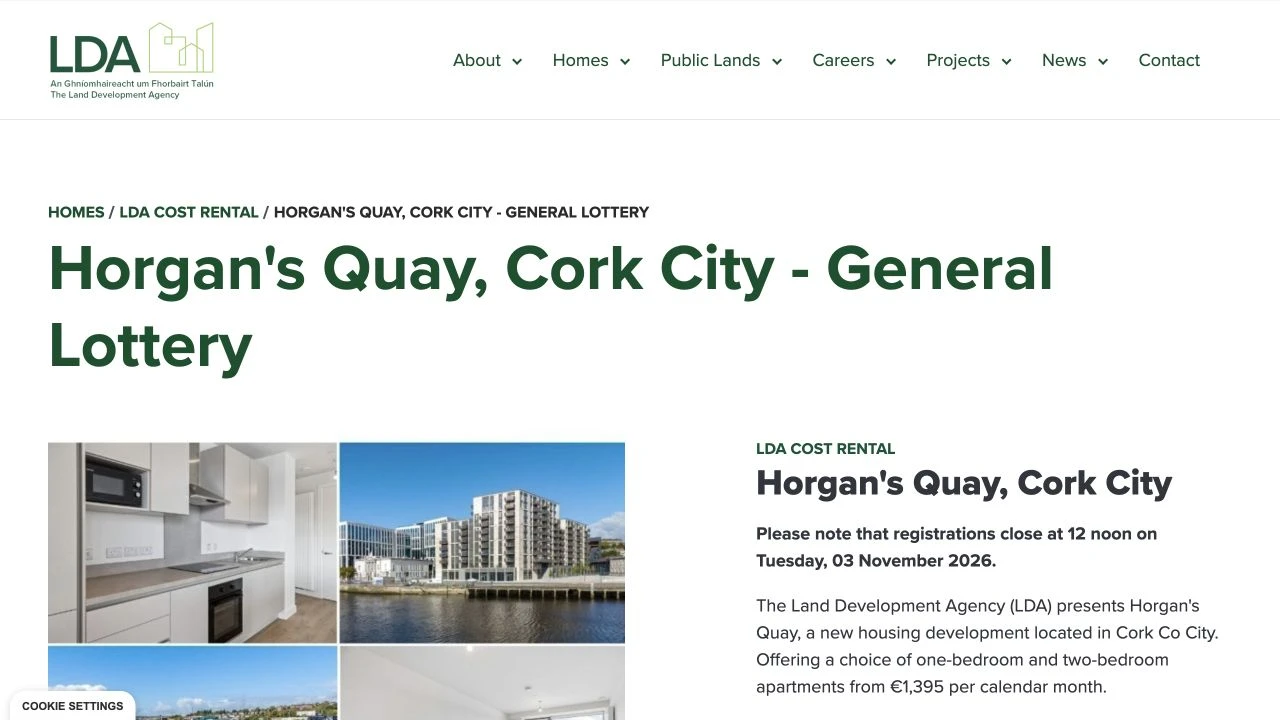
Applications have opened for the Land Development Agency’s first cost-rental homes in Cork city, with two separate lotteries for apartments at Horgan’s Quay. The agency says registration closes at 12 noon on Tuesday, 3 November 2026.
The LDA’s live scheme listing shows both the general lottery and a local-employment lottery as open. The agency previously said applications would begin at noon on 27 October. The first 192 homes are being made available as cost rental, with 70 initially prioritised for people whose workplace is within 5km of the development, according to the Cork City Council announcement.
The general lottery page lists rents from €1,395 per month for a one-bedroom apartment and €1,520 for a two-bedroom apartment. It also lists a two-bedroom-plus option at €1,600. Limited parking is available at an additional monthly charge, subject to availability.
The opening gives Cork households a one-week window to review the published conditions and register interest. A lottery entry is not an offer of a home, and the LDA says selected applicants must then demonstrate that they meet its requirements. Applicants should check the agency’s own current pages before applying; this report cannot decide whether any individual household qualifies.
What has opened at Horgan’s Quay?
The LDA says its Horgan’s Quay development is beside Kent railway station in Cork city. In its announcement on 20 October, the agency described a development of 302 apartments overall, comprising one- and two-bedroom homes. It said the first 192 would be offered as cost rental, with remaining apartments to be made available later this year.
The announcement described a wider development that includes a crèche, shops and offices, alongside refurbishment of the historic Station Master’s House. Those components are context for the scheme; the agency’s announcement does not make each one part of the current lottery.
The current step is registration for the rental lotteries, not a general sale of the apartments. The LDA says applicants selected through its process will be asked for supporting documentation and will be assessed against the applicable criteria. A registration does not guarantee that an applicant will be selected or that an apartment will be offered.
How do the general and local-employment lotteries differ?
The local-employment lottery page says applicants must have a place of employment within a 5km radius of Horgan’s Quay, in addition to meeting the standard cost-rental requirements. For a joint application, the LDA says at least one applicant must meet the employment-location criterion.
The LDA says applicants registering for the local-employment lottery are automatically entered into the general lottery as well. Its announcement says 70 of the first 192 apartments will initially be prioritised for people working within the specified radius. It does not mean a person who works nearby receives a guaranteed home.
The general lottery is a separate route on the LDA site. People considering an application should read the agency’s description of the correct route and its rules on duplicate applications. The LDA states that a household should only enter one application for a specific cost-rental property; applicants should ask the agency if they are uncertain how that condition applies to their circumstances.
For the employment lottery, the agency assesses proximity using the address of the place of employment. It lists evidence such as recent payslips together with an employer’s letter or employment contract showing the workplace address. It also describes evidence for self-employed applicants. These are the LDA’s published requirements; they should be checked directly because documentation rules and individual circumstances can differ.
What are the advertised rents?
The general scheme page lists a one-bedroom apartment at €1,395 per calendar month, a two-bedroom apartment at €1,520 and a two-bedroom-plus apartment at €1,600. These are advertised monthly figures for the categories shown on the LDA page, not a calculation of a particular household’s total living costs.
The agency says parking is limited, subject to availability and costs extra each month. Someone comparing the scheme with another rental home should therefore check whether parking is needed, whether a space is available and what the additional charge would be. Other regular costs should be checked with the provider before making a commitment; the quoted rent alone does not establish every household expense.
The LDA’s earlier launch announcement described starting rents for the one- and two-bedroom categories. The live application page adds the two-bedroom-plus figure. If the listing changes or a detail appears inconsistent, the current LDA scheme page and direct contact with the agency are the appropriate places to check.
What does the LDA say about income?
The general lottery page publishes minimum net household income figures of €47,829 for the one-bedroom category, €52,114 for a two-bedroom apartment and €54,857 for the two-bedroom-plus option. It lists a maximum of €59,000, while its accompanying criteria say net household income must be below €59,000. Because the wording matters at the boundary, applicants close to that figure should ask the LDA directly rather than assume that the printed maximum establishes an individual outcome.
The agency defines net household income by reference to the combined income of household members aged 18 or older after specified deductions. Its page also explains how particular income types may be assessed and links to a calculator. The LDA says affordability is assessed on the basis that rent is no more than 35% of net household income.
The figures are scheme-specific. A reader should not assume that the same minimum, maximum, property categories or assessment method will automatically apply to another development. The LDA’s detailed questions and answers are more useful than a rough calculation based only on a headline salary, and the agency is responsible for assessing applications.
What other conditions are published?
The LDA’s scheme page sets out conditions concerning property ownership, residence and tax domicile, existing social housing supports, household size and affordability. It says the applicant’s household must match the occupancy criteria for the apartment category. The page gives examples for the one- and two-bedroom properties, including different adult and family combinations.
The information is detailed enough that an applicant should read the whole set of conditions rather than rely on one condition in isolation. Being within the stated income range, for example, does not by itself establish that the household meets the other criteria. Similarly, a workplace within 5km addresses only the additional location requirement for the local-employment lottery.
Questions about an unusual household, income source, residence status or employment arrangement should go to the LDA. The agency’s FAQ explains the evidence it seeks and may request additional information. This article provides general information about the published scheme; it does not offer a personal eligibility determination.
When must people register?
Both scheme pages state that registrations close at 12 noon on Tuesday, 3 November 2026. The LDA’s earlier announcement gave the opening time as 12 noon on Tuesday, 27 October. Its current listing identifies both lotteries as open, checked on 27 October.
A person interested in registering should follow the link on the relevant LDA scheme page, review the conditions and allow enough time to complete the process before the stated deadline. The LDA may update its pages, and applicants should use the time and status displayed by the official service when they apply.
The LDA describes selection by lottery. Its general cost-rental information says applicants selected at random are then asked for documentation. Registration, selection for verification and a final offer are distinct stages; being able to access the registration link should not be confused with being approved for a tenancy.
What happens after selection?
The LDA says applicants selected through the lottery will be contacted to begin verification. Its published guidance says they must upload the required supporting documents within 72 hours, and that an offer can be revoked if the deadline is missed. The local-employment FAQ describes the verification step and warns that being asked for documents is not itself an offer letter.
The agency lists a range of possible documents, including evidence relevant to household income, address and tenancy history. Those applying through the local-employment route should also read the specific workplace-evidence requirements. The full list and its qualifications are on the LDA pages; applicants should check those directly rather than assume a short article contains every requirement.
Because the verification window is short, it is sensible to understand the LDA’s requirements before registering and to watch for a message from the agency after the draw. Keep personal documents secure and use the official LDA process. The Press is not collecting applications or personal information.
Where are the apartments and what is cost rental?
The scheme page places Horgan’s Quay in Cork’s Victorian Quarter, near Kent station and the River Lee. The location may be relevant to people comparing travel to work, rail and bus connections, or access to local services. The local-employment criterion is based on a workplace address within a radius, not simply on whether someone lives in the city centre.
The LDA describes cost rental as a form of long-term rental designed to make homes available at rents below comparable market levels. Its 20 October announcement says the scheme is intended for households that do not qualify for other state supports and are finding private rents difficult to afford. That is the agency’s description of the policy; it is not a finding that any particular advertised apartment is affordable for every household.
The advertised monthly amounts remain significant commitments. Potential applicants should review the exact property category, all published conditions and the agency’s affordability assessment before deciding whether to register. There is no need to submit financial information to this publication.
What is the next practical step?
The immediate choice is which LDA lottery page is relevant, followed by a careful reading of the criteria and deadline. The local-employment page explains that its applicants also enter the general draw; the general page sets out the rent categories and occupancy examples. Both link to their own registration process.
The LDA’s published closing time is noon on 3 November. Anyone encountering an unclear condition or a technical problem should use the LDA’s official contact information. Future allocation, verification and move-in arrangements should be checked with the agency rather than inferred from the opening of registration.
Join the conversation
Keep it kind, relevant and constructive. Comments are reviewed before they appear.
Be the first to share a thought.