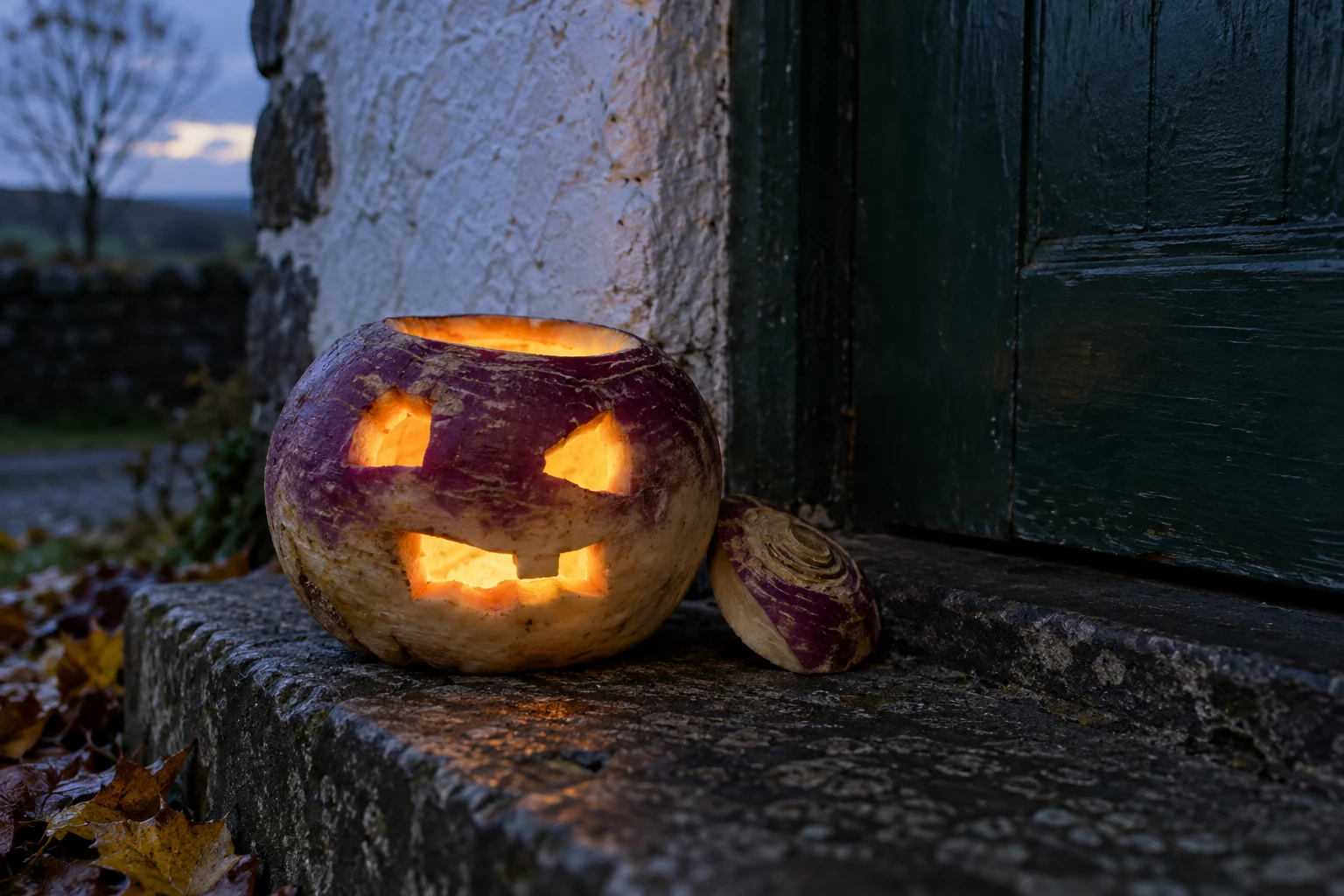
Halloween has deep Irish roots, including the seasonal festival of Samhain and traditions recorded in Irish folklore. That does not mean the entire modern celebration was invented at one moment, or that every costume and custom has survived unchanged from antiquity.
Heritage Ireland’s account of Samhain places it at the transition towards the darker part of the year. It also describes the folklore of a boundary between the human and supernatural worlds becoming less secure. That is an account of traditional belief, not a claim that supernatural events took place.
A seasonal turning point
The National Museum’s guide to Irish country life places Samhain on 1 November, the first day of winter in the traditional calendar, with Oíche Shamhna—Halloween—on the preceding evening. The date also sits beside the Christian feast of All Saints.
For someone reading about the festival today, it helps to separate the seasonal calendar, religious observances and the particular games or objects remembered in a household. Their histories overlap, but one does not automatically establish the age or meaning of another.
Why an Irish lantern could be a turnip
The National Museum’s Ghost Turnip record offers a particularly tangible example. In 1943, a teacher working near Fintown in Donegal sent the museum a turnip lantern of a kind she said was made locally around 1900. Museum artist Eileen Barnes created and painted a plaster-cast model.
That detail matters when looking at the museum object: it is a model preserving evidence of a tradition, rather than an ancient vegetable that somehow survived intact. The museum associates the lantern with frightening people on 31 October and explains the link between Jack-o’-lanterns and the folktale of Jack wandering with a light.
It identifies the now-familiar pumpkin lantern as an American development of the Irish turnip tradition. A change of material is part of the history, rather than proof that one version is authentic and every later version is meaningless.
A tradition can change as it travels
Tourism Ireland’s Halloween traditions guide connects present celebrations with older stories, food, lanterns and games. The useful question is which element a source is describing, and where and when it was recorded.
A twentieth-century account of a local custom gives valuable evidence about that community. It does not, on its own, prove that exactly the same activity was performed thousands of years earlier. Likewise, a modern festival can draw creatively on folklore without being a literal reconstruction of an ancient ceremony.
Ireland’s contribution to Halloween is substantial and worth exploring through objects and recorded traditions. Samhain provides a historical and cultural foundation; the celebration familiar around the world reflects the changes that followed as people kept, adapted and shared those traditions.
Join the conversation
Keep it kind, relevant and constructive. Comments are reviewed before they appear.
Be the first to share a thought.