

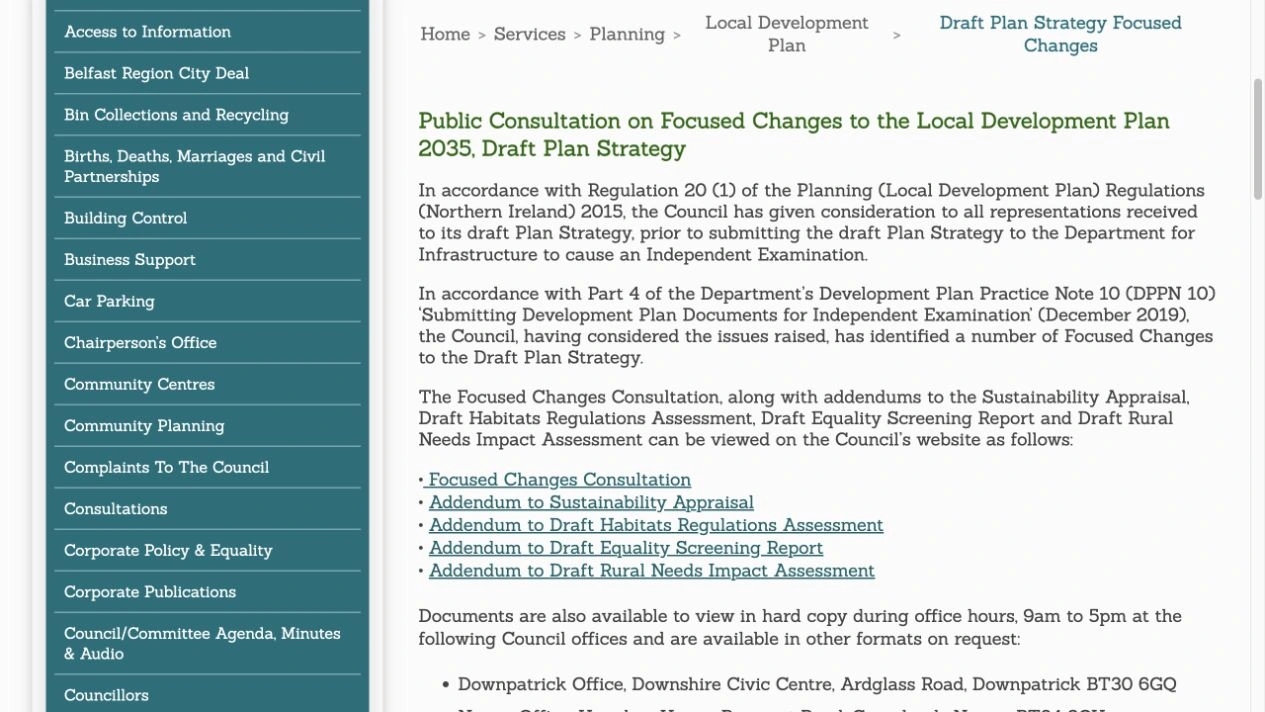
An eight-week public consultation on changes to housing and planning policies in Newry, Mourne and Down opened at 9am on Monday 26 October 2026. Residents, businesses and community groups have until 5pm on 21 December to comment on the specified changes before the draft strategy moves towards independent examination.
The opening creates a new opportunity to respond to particular amendments, including housing allocations, housing-land phasing, convenience shops and wind-energy wording. It does not reopen every part of the original draft plan, grant permission for development or mean that the revised policies have already been adopted.
The district is in Northern Ireland and includes areas of County Down and south Armagh. This consultation follows Northern Ireland's local-development-plan process. The dates, documents and submission route below were checked against the council's published material on 26 October.
What has opened today?
The council's focused-changes consultation page gives the opening and closing times and links to the amendment schedule and supporting assessments. The eight-week period runs from 26 October to 21 December 2026. The change on Monday is the opening of that response window, rather than a new decision approving all the proposals.
A council public notice carried by the Newry Reporter, published on 21 October, announced the consultation in advance. The council page supplies the precise 9am opening and 5pm closing times. Readers should use the council's current instructions when making a submission, including any later correction or update.
Why is the council revisiting the draft strategy?
The council’s consultation report and change schedule, supplied as a Word document, says the draft Plan Strategy was published on 27 June 2025 and received 102 representations during its original consultation. Having considered those responses, the council is proposing focused amendments intended to address the strategy's soundness before independent examination.
The report distinguishes those amendments from minor corrections, such as typographical changes. It identifies each focused change by a reference number, the relevant policy or paragraph and the council's explanation. That structure lets a reader trace a proposed alteration back to its context, instead of relying on an isolated quotation or a general description of the plan.
What is changing in the housing figures?
Focused Change FC1 proposes an indicative strategic housing allocation of 11,722 to 12,758 units for the plan period, allowing for non-implementation. The report says the calculation takes account of completions, existing commitments and allowances for urban capacity and windfall development. The council has updated the housing information using its 2025 monitoring evidence.
Those figures should not be described as thousands of additional homes approved on Monday. They concern the strategy's overall housing framework and include different components over the 2020–2035 period. They are neither a list of building contracts nor a guarantee that a particular home will be available to buy or rent by a particular date.
The council also says Newcastle's allocation has been increased following representations about local housing provision. The detailed revised table and housing-strategy addendum are the appropriate documents for checking how an individual settlement contributes to the district-wide figures. Keep the allocation, its assumptions and the period it covers together when comparing numbers.
What does housing-land phasing mean for Downpatrick and Ballynahinch?
FC2 revisits the explanation of Phase 1 and Phase 2 housing lands. The report discusses sites in Downpatrick and Ballynahinch and the circumstances in which later-phase land may come forward. It links those questions to matters including infrastructure, housing need and the available supply, rather than treating every identified site as immediately ready for construction.
The housing addendum says the issue with strategic Phase 2 sites is principally timing. It does not rely on those sites coming forward in full to achieve the identified housing target. For a resident, this is a reason to distinguish a strategic allocation from a development programme. A reference to a site in the consultation does not establish that work has started or that all necessary approvals are in place.
What should local retailers look at?
FC7 proposes changes to Policy RET4, concerning small-scale convenience shops outside city and town centres but within settlement limits. The change schedule removes the policy's 200-square-metre wording in favour of an appropriate-scale approach, while retaining tests concerning local need and the effect on existing centres.
The council's explanation also refers to retail-impact and need assessments under Policy RET3. A business should therefore read the policies together. Removing a numerical reference from this proposed wording is not the same as removing every planning test, and the consultation itself does not authorise a new shop or an extension. Anyone considering a particular application should use the relevant planning service for case-specific requirements.
Are community facilities and specialist housing included?
Yes. FC5 addresses specialist residential accommodation, including the approach to a countryside location where an identified need is demonstrated. FC6 adds detail to the sequence for considering countryside sites for community facilities. The schedule discusses the relationship with settlement limits and the use of sites with existing buildings or opportunities to improve degraded land.
For a community organisation, the practical starting point is to identify the actual policy change that could affect its proposal. A general statement that a village needs more facilities may provide context, but the council has limited this consultation to the soundness of the focused changes. Read the proposed text and the council's reasoning before deciding what evidence or question to raise.
What about accessible housing and biodiversity?
FC4 revises wording under Policy HOU7 concerning a range of dwellings capable of providing wheelchair-accessible accommodation and relevant access standards. The council explains the intended flexibility in the policy. Readers interested in accessibility should compare the existing wording, proposed amendment and supporting assessment, rather than assume that one short sentence describes every future building requirement.
FC3 changes biodiversity-net-gain wording under the general policy. The council says the intention is to promote biodiversity net gain and clarifies that the policy does not set a particular percentage. These are proposed policy amendments open for comment. This report does not establish the effect on an individual development or replace the technical assessments needed for a planning application.
Why is wind-energy wording part of the consultation?
FC13 updates Policy RE1 to reflect revised regional policy wording on wind-farm separation distances. The council's explanation says the regional policy no longer contains a requirement based on ten times rotor diameter and instead provides for assessment on a case-by-case basis. Readers should inspect the complete marked-up text and the distinction it draws between different turbine developments.
That amendment is not an announcement of a wind farm at a named location. Nor does the opening of the consultation decide whether an existing application will succeed. It is a change to proposed strategy wording, with its own reference and explanation, that can be examined within this particular response window.
What do the accompanying assessments say?
The council has published an addendum to the Sustainability Appraisal. It says the screening found that the proposed focused changes would not materially change what the original appraisal assessed or assumed about implementation. That is the council's assessment conclusion, rather than an independent finding by The Press that no development could have an environmental effect.
A separate Habitats Regulations Assessment addendum revisits the changes against the earlier habitats assessment. The equality-screening addendum and rural-needs addendum say their reassessments leave the previously identified outcomes unchanged. Comments are invited on these addenda as well as the focused changes themselves.
How can residents read the documents and respond?
The documents are available through the council's consultation page. It also says hard copies can be inspected during office hours, 9am to 5pm, at Downshire Civic Centre on Ardglass Road in Downpatrick and Haughey House on Rampart Road, Greenbank, in Newry. Other formats are available on request. Confirm practical access arrangements with the council before making a journey.
Written comments can be emailed directly to ldp@nmandd.org or posted to the Local Development Plan Team, Downshire Civic Centre, Ardglass Road, Downpatrick, BT30 6GQ. The deadline is 5pm on 21 December 2026. The Press is not collecting submissions or personal information for the council and cannot confirm receipt of a response sent elsewhere.
What is within the scope of a comment?
The council says responses must address the soundness of the focused changes. This is not an opportunity to add to previous representations or make new comments on unchanged parts of the original draft strategy. A useful first check is whether the issue you want to raise corresponds to a numbered focused change or an accompanying addendum.
Keep that reference with any explanation and supporting evidence. The council's report directs readers to Northern Ireland's soundness guidance for the relevant tests. This article explains the published process; it does not decide whether a particular submission will be accepted or provide individual planning or legal advice. Ask the council's plan team about an unclear procedural requirement.
What happens to comments, and what comes next?
The council says comments received will be published for public inspection on its website and forwarded to the Department for Infrastructure as part of the independent-examination process. Read its LDP privacy information before sending a response, and use the official route. Do not assume that a consultation submission is a private conversation with a journalist or a confidential message to the council.
After the consultation closes, the council intends to submit the draft strategy and associated documents to the Department for Infrastructure as soon as reasonably practicable. Its report says the department will determine whether changes recommended through independent examination should be implemented. The council’s wider Local Development Plan information explains the distinction between the Plan Strategy and the later Local Policies Plan. Monday's opening is a defined stage in that process, with a current response opportunity and a stated deadline.

Join the conversation
Keep it kind, relevant and constructive. Comments are reviewed before they appear.
Be the first to share a thought.