

The Climate Change Advisory Council has criticised the Government’s failure to commit sufficient dedicated funding for nature restoration in Budget 2027, calling on Wednesday, 4 November, for a programme that farmers, landowners and communities can rely on over several years.
Its new Biodiversity Annual Review links Ireland’s deteriorating protected habitats to decisions about public spending, flood resilience, land management and the specialist workforce needed to deliver restoration. The Council wants nature treated as infrastructure whose condition affects the economy and public services.
For people in Ireland, the immediate development is a set of recommendations to Government. The review does not open a grant scheme, award contracts or change the status of individual properties. It does, however, identify decisions that would affect how restoration is paid for, where it happens and how its results are checked.
The Council’s announcement published on 4 November accompanies a report submitted to the Minister on 2 November. Its findings draw on existing conservation assessments and the draft National Restoration Plan; they are not the results of a new nationwide wildlife survey conducted this week.
The funding dispute is about sustained delivery
The Council acknowledges increased funding and staffing for the National Parks and Wildlife Service. It also welcomes the Minister’s commitment to establish a Nature Restoration Fund. Its criticism concerns whether Ireland has made the dedicated, continuing financial commitments needed to turn restoration plans into work on the ground.
In the full biodiversity chapter, the Council calls for financing that supports restoration across departments, rather than treating it as the responsibility of a single agency. It says specific nature-restoration allocations have not been made through the Infrastructure, Climate and Nature Fund.
This distinction matters when assessing the political argument. Increasing an agency’s overall resources and setting aside money for a long-term restoration programme are different decisions. The Council is seeking the latter alongside the former. Its review should not be read as saying that Government currently spends nothing on biodiversity.
For a participating landowner, continuity would mean being able to assess the costs of changing management, maintaining a restored habitat and supplying monitoring information. For an organisation delivering projects, it would mean planning staff and work beyond an individual short funding round. These are practical consequences of the Council’s proposed approach, rather than payment commitments already made to applicants.
What the 90% habitat figure actually measures
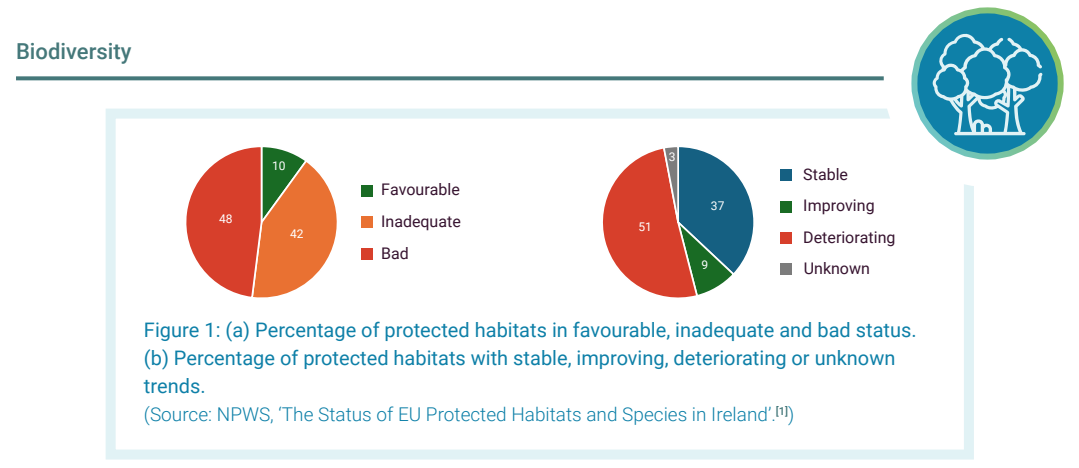
The review’s headline conservation figure needs a careful denominator. The National Parks and Wildlife Service’s 2025 assessment examined 59 habitat types protected under the EU Habitats Directive. It found 90% in an unfavourable condition: 42% inadequate and 48% bad, with 10% favourable.
Those percentages describe protected habitat types. They do not mean that 90% of Ireland’s land area has been classified as damaged, or that nine out of every ten species in Ireland are declining.
Condition and direction of change are also separate measures. In the same assessment, 51% of the protected habitat types had deteriorating trends, 37% were stable, 9% improving and 3% unknown. A habitat can remain in poor condition even if its trend has stabilised.
NPWS cautions that changes between assessment rounds can reflect better knowledge, dedicated surveys and assessment thresholds, as well as real ecological change. That makes it important to read the condition categories alongside the trends and the individual habitat evidence. The Council’s new funding argument rests on that existing evidence of widespread poor condition and continuing deterioration.
Why an EU restoration plan matters in Ireland
The recommendations sit within the EU Nature Restoration Regulation, which entered into force in August 2024. The European Commission describes binding targets covering habitats and species, with measures intended to cover at least 20% of the EU’s land and sea areas by 2030 and ultimately all ecosystems needing restoration by 2050.
The 20% objective is expressed at EU level. It should not be casually translated into a claim that every Irish county must restore exactly one fifth of its area, or that an individual farm faces an identical requirement.
According to the Council, Ireland submitted its draft National Restoration Plan to the Commission on 1 September 2026, with the final plan expected by 1 September 2027. The Council explains that its assessment uses the draft issued for public consultation in June, because the version submitted in September was not publicly available when it prepared the review.
That limitation is relevant to anyone comparing documents or looking for final commitments. The June document supplies evidence about the proposed approach and its assumptions. It is not a final, fully funded delivery programme. The Council wants funding, implementation priorities and monitoring arrangements developed into a coherent plan.
The economic estimates are benefits, not a cash windfall
The public draft restoration plan estimates a present value of €32.9 billion in socioeconomic benefits from restoring and re-establishing degraded terrestrial, coastal and freshwater habitats over 2024–2050. It puts the corresponding central cost estimate at just under €5.8 billion.
The figures describe a modelled economic appraisal. They are not money that has arrived in the Exchequer, a guaranteed return to investors or a new annual spending allocation. The analysis discounts future costs and benefits to present values, using a central discount rate of 4%.
Its benefits include services such as water regulation, improved water and soil quality, habitat connectivity, recreation and reduced erosion. Carbon sequestration is assessed separately in the draft. It would therefore be misleading to describe the entire headline benefit estimate as a carbon-credit revenue forecast.
The uncertainty is substantial. The draft’s scenarios put restoration and re-establishment costs between €2.6 billion and €11 billion, and ecosystem-service benefits between €16.9 billion and €45.7 billion. It also identifies data gaps and the difficulty of quantifying costs and benefits across different habitats.
The useful conclusion is that the draft presents an economic case for restoration while leaving major implementation choices to be resolved. The figures do not establish what a particular project, county or landowner will receive. They also include maintenance and monitoring, underlining that restoration involves continuing work after an initial intervention.
Farm payments and specialist skills remain policy choices
The Council calls for stronger support for results-based agri-environment schemes in the next Common Agricultural Policy period. It identifies uncertainty about funding beyond the current 2023–2027 CAP Strategic Plan and wants accessible schemes, national co-funding and incentives that help farmers voluntarily contribute to restoration.
This is a recommendation about future policy. It does not establish a new payment rate, application deadline or individual farmer’s eligibility. A scheme’s actual terms would have to specify the work being supported, how results are measured and the conditions attached to payment.
The review also argues that finance alone will not deliver restoration if the necessary expertise is unavailable. It recommends adding ecologists and other biodiversity professions to the Critical Skills Occupations List, alongside measures to build domestic capacity and training.
That signals a workforce issue for public authorities, environmental consultancies and organisations undertaking restoration. It is not an announcement of a recruitment campaign, a guaranteed number of jobs or an employment-permit change already in force. The Government would have to act on the recommendation before it changed the relevant arrangements.
County effects extend from towns to river catchments
Local authorities feature prominently in the review because they manage public space, prepare plans and help deliver projects. The Council recommends national mapping of urban green space and tree canopy by the third quarter of 2027. Better baseline information would allow changes to be assessed consistently, rather than assuming every new planting compensates for the loss of established habitat elsewhere.
It also wants nature-based measures supported across rural, urban and coastal areas. For towns, the issues include the location and condition of green spaces. In river catchments, they include slowing runoff and retaining water in suitable places. On the coast, they include restoring habitats that can contribute to resilience alongside engineered protection.
There is Irish research behind part of that argument. The EPA’s published account of the SloWaters project describes demonstration sites in Wexford and Cork testing measures including temporary water storage and woodland swales. It reports potential benefits for runoff and nitrate concentrations.
The same account sets out important limits: evidence remains concentrated on frequent, lower-magnitude floods in small catchments, with more work needed on larger catchments and extreme events. One measure occasionally acted as a phosphorus source, showing why design and monitoring must reflect local conditions. Restoration is not a promise that a particular home will be protected from flooding.
What would demonstrate progress after this review
The next test is whether the recommendations lead to identifiable funding decisions, delivery responsibilities and published evidence of results. The Council seeks a national implementation plan for nature-based measures by the first quarter of 2028, including spatial priorities and financing.
It also wants stronger reporting by public bodies and better long-term ecological monitoring. Counting projects or announcing expenditure would not, on its own, establish that habitat condition, water regulation or biodiversity had improved. Those outcomes require baseline measurements and follow-up information.
For readers assessing future announcements, three details will be particularly useful: whether money is actually allocated, which organisation is responsible for delivery, and what measure will show that the intervention worked. Wednesday’s review puts those questions to Government while Ireland develops its final restoration plan. It does not settle them in advance.

Join the conversation
Keep it kind, relevant and constructive. Comments are reviewed before they appear.
Be the first to share a thought.