

The European Commission published a new tourism strategy on Wednesday, 4 November, setting out plans for business support, worker training and better management of visitor pressures. Its first major Irish discussion is due in Mullingar on Thursday, when EU tourism ministers meet under Ireland's presidency of the Council of the European Union.
For people in Ireland, the strategy matters in several practical ways: tourism employers could gain new training and digital support, communities could receive better tools for managing busy destinations, and travellers could eventually benefit from proposed improvements to transport connections and cross-border car hire.
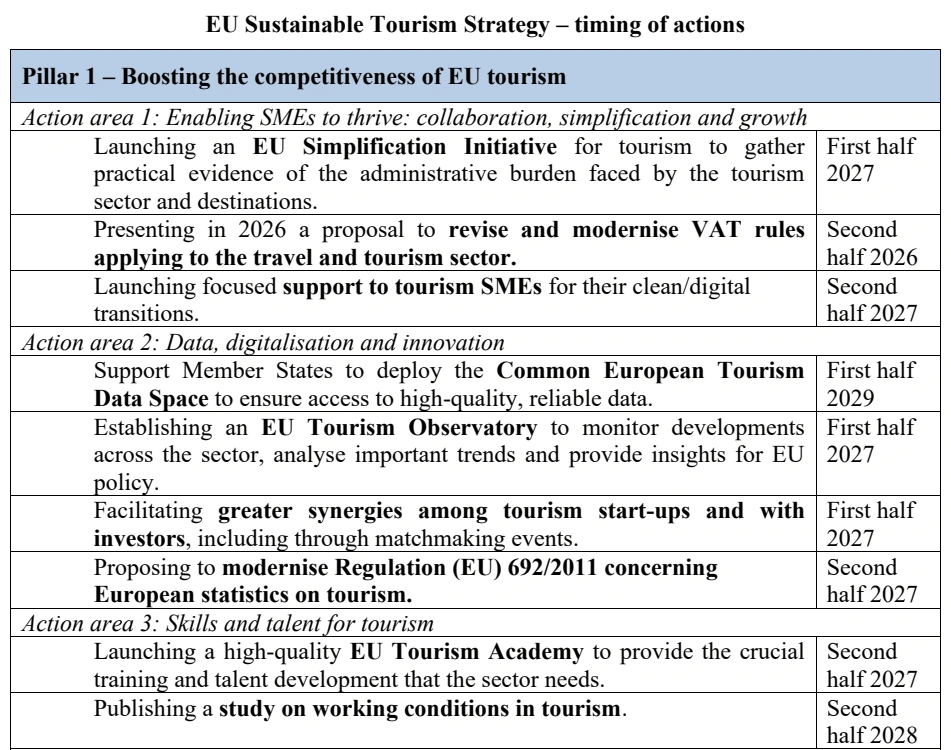
Most of those measures are future commitments. The EU Sustainable Tourism Strategy does not itself open a new grant competition, guarantee cheaper holidays or change an Irish business's tax obligations today. The Commission's timetable places many actions in 2027, with some work continuing into 2028 and 2029.
The Irish relevance extends beyond hosting a ministerial meeting. In the Department of Enterprise, Tourism and Employment's announcement, Minister Peter Burke said tourism supports more than 270,000 jobs across Ireland. That is the minister's sector-wide assessment, rather than a count of jobs created by this strategy.
What is happening in Mullingar
Commissioner for Sustainable Transport and Tourism Apostolos Tzitzikostas is due to present the newly published strategy at the EU Tourism Ministers' Summit in Mullingar on 5 November. Burke is hosting the gathering as part of Ireland's presidency programme.
It follows a meeting of senior tourism officials in Dublin on 3 November and the European Tourism Forum scheduled in County Westmeath on 4 November. The official presidency event record identifies the forum as a discussion of innovation, digital transformation, competitiveness and resilience.
The distinction between publication and implementation is important. The Commission has now set out its approach; the Irish ministerial gathering is intended to discuss how that approach becomes practical action. No outcome from Thursday's meeting can yet be reported as agreed.
For Irish tourism businesses and local authorities, the immediate development is therefore a published policy framework and a near-term opportunity to influence its delivery. Specific national schemes, training arrangements and local investments will need their own decisions and details.
Small businesses: support is planned, but there is no automatic award
The full Commission communication and action timetable plan focused support for tourism SMEs' clean and digital transitions in the second half of 2027. They also envisage an EU simplification initiative in the first half of that year.
The simplification work is intended to gather evidence of administrative burdens affecting tourism businesses and destinations. It can feed recommendations for reducing unnecessary complexity. It is not an announcement that Irish licensing, planning or other requirements have been removed.
For a small Irish accommodation provider, visitor attraction or activity company, the potential value lies in making technology and sustainability improvements easier to understand and implement. Technical assistance, training and capacity-building are among the forms of support described. Their usefulness will depend on the eventual delivery arrangements and whether small operators can access them without disproportionate effort.
An illustrative example is an activity business trying to coordinate bookings, understand quieter trading periods and provide clearer visitor information. Training and better data could help it make decisions. That example explains a possible use of the policy; it is not a named Irish project, a confirmed grant or a claim of measured savings.
What the funding figures mean for Irish companies
The strategy estimates that tourism will have benefited from about €18 billion in EU support over the 2021–2027 funding period. That is a multi-year, EU-wide estimate covering existing programmes. It is not a new €18 billion fund announced for Irish applicants on 4 November.
The communication identifies programmes including regional funding, Horizon Europe, the Single Market Programme, Digital Europe, LEADER and Erasmus+. It also discusses the Commission's proposed 2028–2034 EU budget, while explicitly noting that the scope and availability of future support depend on the budget negotiations.
That qualification matters for a company deciding whether to develop a project. A broad policy commitment to support tourism does not establish an applicant's eligibility, an application deadline, an eligible cost or a contribution rate. Those details belong to the particular programme and call.
The Commission's official questions and answers point businesses towards its tourism funding guide and toolkit, and advice through the Enterprise Europe Network. The practical next step is to match a defined project to a verified programme, rather than treating the strategy headline as an application invitation.
Tourism jobs: skills are part of the answer
An EU Tourism Academy is scheduled for the second half of 2027. It is intended to bring together national tourism institutes, universities, vocational training bodies and other organisations to develop and share learning programmes. The strategy includes the possibility of digital micro-credentials.
For Irish workers and employers, this could offer a route to relevant training and a wider pool of learning material. However, the publication does not provide an Irish enrolment process, course timetable or individual entitlement to funded training. Those operational details remain to be established.
The Commission also recognises that staffing problems are not solely a matter of qualifications. Its Q&A identifies working conditions, career progression and relatively low wages as factors behind shortages. A study of working conditions is planned for 2028.
That creates an important test of implementation: training can improve skills, but it does not automatically make a job more attractive or resolve accommodation and retention problems. The strategy offers no basis for predicting a particular increase in Irish tourism employment or assuming that a course will guarantee a job.
AI and visitor data: a business opportunity with limits
The digital measures are relevant to the wider question of how AI may change work in Ireland. The strategy envisages tourism applications such as more personalised visitor information and better destination management, alongside training in responsible and safe adoption.
Its timetable puts an EU Tourism Observatory in the first half of 2027 and support for deployment of the Common European Tourism Data Space in the first half of 2029. The aim is to improve access to reliable information and help businesses and destinations understand changing conditions.
In practical terms, an Irish operator could benefit from a clearer picture of demand across seasons, rather than relying entirely on its own booking history. That is a potential application, not evidence that a particular dataset or AI service is already available to every business.
The strategy also acknowledges the importance of fair relationships with online platforms. Better digital tools will not, by themselves, guarantee bookings, reduce commission charges or establish how many Irish jobs AI will replace. This announcement supplies a policy direction for technology and training, not a forecast of job losses.
Residents and regions: more visitors is not the only objective
A central part of the strategy concerns balancing visitor numbers with a destination's capacity. The Commission plans a draft Council recommendation and a common toolbox for balanced tourism in the second half of 2027, alongside work on a voluntary EU model for tourism management.
For communities in Ireland, that could mean better approaches to seasonal pressures, transport access, public facilities and the relationship between tourism and everyday life. For less-visited places, the opportunity is a greater share of tourism activity across the year.
These are related but different problems. A destination coping with a concentrated peak may need visitor-management measures, while another area may need improved connections and a stronger reason for people to stay. A single national arrival total cannot show whether either local problem has been solved.
The Commission's proposed tools include approaches to short-term rentals, but this strategy does not itself introduce a new Irish rental permission or restriction. Local and national decisions still matter. The Commission's explanation of responsibilities says the strategy does not harmonise national tourism laws or frameworks.
What could change for people travelling from Ireland
Connectivity is especially relevant to an island economy. The strategy plans a proposal to revise the Air Services Regulation in the second half of 2027, and proposed legislation on easier cross-border use of rental cars in the same period.
It also envisages work on the compatibility of local transport ticketing systems in the first half of 2028. The underlying aim is to make journeys involving different services and destinations easier to organise.
For an Irish resident planning a multi-country trip, cross-border car-hire arrangements or better connections between transport services could eventually make a difference. For a visitor coming to Ireland, the quality of onward connections can affect which areas are practical to reach.
The announcement does not establish a new right to take a rental car across a border today, remove an existing charge or guarantee a cheaper airfare. Proposed legislation must be distinguished from adopted, applicable rules and the terms of an individual booking.
Accessibility is also included. The timetable plans an accessible-tourism information point in the first half of 2028 and a proposed targeted revision of passenger-rights legislation later that year. Those are future actions, rather than a complete statement of travellers' current rights.
The next decisions to watch
The Commission plans an EU Tourism Alliance in the second half of 2027 to help coordinate implementation with national, regional and local authorities, businesses and other stakeholders. A tourism crisis-coordination network is also planned for that period.
The Irish test will be how these European commitments connect to actual programmes, training and destination decisions. Evidence of progress would include published access arrangements, clear programme conditions, delivery dates and decisions showing how communities and small businesses participate.
Thursday's Mullingar summit is the next scheduled policy discussion. Today's verified development is the publication of the strategy and its timetable. Its potential effects on Ireland are substantial, but the results will depend on the decisions and implementation that follow.
Join the conversation
Keep it kind, relevant and constructive. Comments are reviewed before they appear.
Be the first to share a thought.