

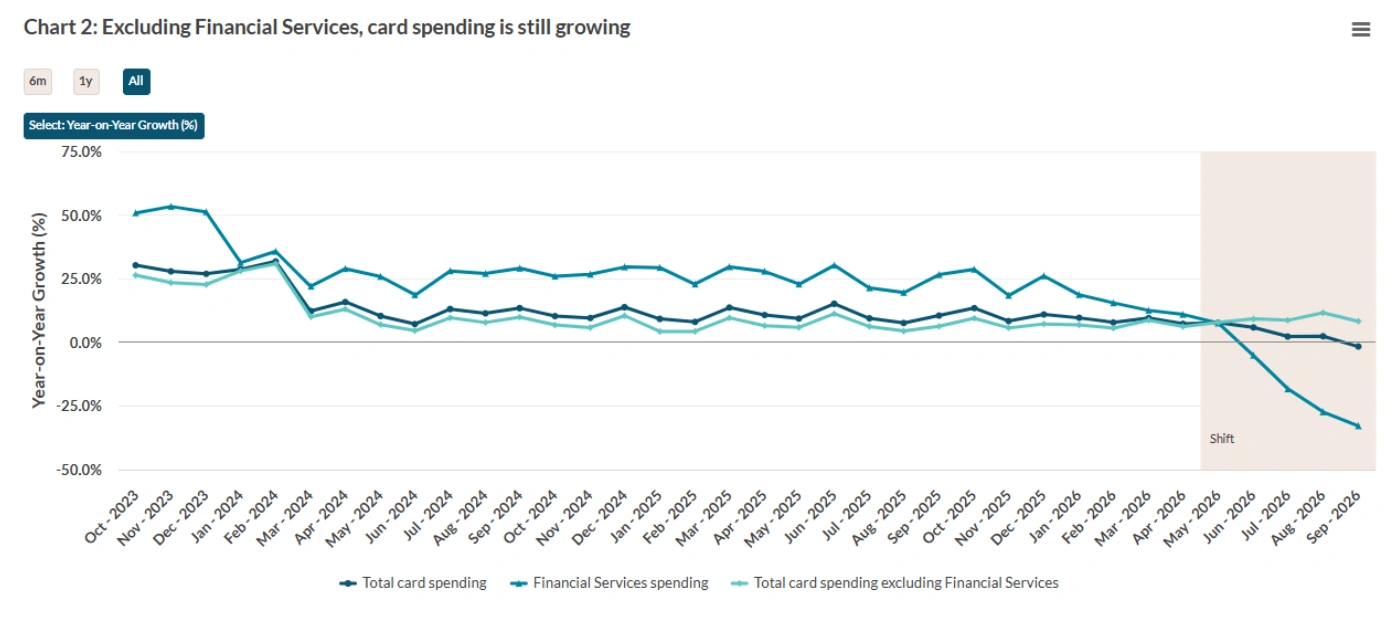
Irish household card payments fell to €9.31 billion in September, according to figures published by the Central Bank on Wednesday, 4 November. But the annual decline comes with a substantial qualification: spending was 8.3% higher than a year earlier when payments classified as financial services were excluded.
The Bank attributes the weakness in financial-services card payments primarily to households changing how they move money between accounts. Transfers increasingly use open banking and consequently disappear from the card-payment measure. The headline fall therefore cannot, by itself, establish that people in Ireland bought fewer goods and services.
The September Monthly Card Payment Statistics put total card-payment value 4.2% below August and 1.64% below September 2025. The number of transactions moved differently: at 250.17 million, it was 5.86% higher than a year earlier, although down 5.5% over the month.
For Irish households, retailers and employers, the useful message is a mixed picture of payment habits and spending categories. Education payments reached a record monthly total, ticket-agency spending increased sharply, and mobile wallets accounted for a larger share of payments at domestic points of sale. These September figures describe activity before the current November trading period.
Why a change in transfers matters to the headline
Financial-services card spending was down almost one-third compared with September 2025. In its full statistical release, the Central Bank describes a continuing structural shift towards open-banking transfers when households move funds between their accounts.
This distinction matters because funding an account and buying something are different activities. A person can move the same amount of money between accounts using a different payment method without reducing the amount available for subsequent purchases. If a transfer previously appeared as a card payment and now takes another route, the card total falls even though the underlying movement of money may continue.
That is an explanation of the measurement issue, rather than evidence that every missing financial-services transaction was replaced one for one. The Bank supplies the explanation for the aggregate trend; this release does not trace individual households or quantify how much each person switched.
Its alternative comparison, excluding financial services, is therefore especially useful. The 8.3% annual increase shows that the negative headline is not representative of all the other payment categories combined. Equally, that increase is measured in euro payments. It does not mean households purchased 8.3% more physical goods, or that every business experienced growth.
Domestic payments: more transactions, lower average value
Payments classified as domestic totalled €7.56 billion in September. Their value was 3.46% below August and 3.31% below the same month last year. Domestic transaction numbers nevertheless increased 5.26% annually, reaching 208.78 million.
The average domestic transaction was €36.19. That was above August's €35.77 but below the €39.40 recorded in September 2025. More transactions alongside a lower total value can look contradictory until the size and composition of those payments are considered.
For example, several small purchases create more transactions than one larger purchase of the same combined value. A change in account-funding methods can also remove some payments from the dataset. These are reasons to examine the mix of activity; the published averages do not reveal precisely how every household behaved.
Nor is €36.19 an average shopping bill for a family or a measure of prices. The composition of payments changes between months. A lower average transaction cannot establish that groceries, fuel or other household essentials became cheaper.
Online spending and shop-terminal spending moved differently
Domestic point-of-sale payments were worth €4.06 billion, down 8.19% from August but up 6.23% compared with September 2025. Domestic online payments totalled €3.49 billion, rising 2.7% over the month while falling 12.47% annually.
That online annual decline needs the same caution as the overall total. The Bank's broader online-payment measure includes activities beyond ordinary internet shopping. Its explanation of changing financial-services transfers means the figure should not be read as a 12.47% collapse in sales by Irish online retailers.
A business comparing its September performance with the national release needs a relevant benchmark. A retailer's own sales, customer numbers and average purchase values answer different questions from an aggregate that also includes education, entertainment and financial-services activity. The national card total is useful context, but it does not establish that an individual company's customers became more or less willing to spend.
Mobile wallets accounted for 61% of domestic point-of-sale transactions
Mobile-wallet payments made up roughly 61% of the number of domestic point-of-sale transactions in September, compared with 54% a year earlier. The Bank reports annual growth of 24.43% in the number of these payments.
In value terms, domestic contactless payments amounted to €2.76 billion, of which €2.02 billion came through mobile wallets. Wallet payments are a subset of contactless payments, so those two values should not be added together.
For businesses accepting payments at a terminal, the figures indicate the growing importance of wallet transactions within that channel. They do not show that 61% of Irish people use a mobile wallet, that wallets account for 61% of every kind of payment, or that each wallet transaction represents a different customer.
The distinction also matters for households. An increasingly common payment method does not automatically mean a household is spending more. A phone replacing a physical card can change the method used at the till without changing the purchase itself.
Education spending reached €212 million as fees fell due
Education-related card payments reached €212 million, the highest monthly total in the series. The increase from August was 58.9% in value and 61.5% in transaction numbers. Compared with September 2025, however, value was up a much smaller 2.2%.
The Central Bank links the September peak to college tuition and other school costs falling due at the start of the academic year. Payments made online to Irish providers accounted for 88% of education card spending.
For families, the timing helps explain why September can place particular demands on available money even when a monthly national total falls. Large scheduled payments in one category can coincide with lower spending elsewhere. The figures do not establish the circumstances of any particular student or family.
They also do not show that education fees rose 58.9%. That is the change in total card payments from August to September, affected by when payments are due and how many are made. It is not a comparison of the same course's fee between academic years.
Ticket purchases created another concentrated spending peak
Ticket agencies recorded €130.5 million in total card expenditure during September. Of that, €124.2 million, or 95%, was online. Total expenditure was 114.7% above August and 28.7% above September 2025.
The Bank attributes the surge to high-profile ticket sales for events taking place in 2027. The important timing distinction is that the payment occurs when tickets are bought; the associated event can be months away. September's rise therefore does not measure attendance at September concerts or festivals.
The average ticket-agency transaction was €110, up 4.8% annually. This is an average payment, not an average price for one ticket. A transaction may cover several tickets and associated charges, so it cannot establish what a typical individual admission cost.
Education and ticket-agency payments are already included within the wider card totals and channels. Adding these category totals to domestic or online spending would count the same payments again.
What the CSO's separate retail figures tell us
The CSO's September Retail Sales Index, published on 28 October, offers another perspective. Seasonally adjusted retail-sales volume fell 0.4% over the month but increased 2.9% annually. Excluding motor trades, volume was unchanged from August and 2.2% higher than a year earlier.
Retail-sales value fell 0.1% monthly and increased 4.8% annually. The distinction between value and volume is important: the CSO adjusts its volume measure for price changes, while the Central Bank reports euro card-payment values and transaction counts.
These releases cannot be matched as if they were competing estimates of exactly the same activity. The CSO's methodology describes a survey of retail businesses and other covered retail activity. Its September reference period ran for five weeks, from 30 August to 3 October, rather than simply the calendar month.
The card release covers a different range of payments and highlights normal post-summer seasonality in its monthly decline. Comparing its 4.2% monthly fall directly with the CSO's seasonally adjusted 0.4% volume fall would mix different measures, periods and adjustments.
Read together, the releases support a more careful assessment than a single spending headline: retail volumes were higher annually, while the broader card series was affected by payment-method changes and pronounced seasonal category movements.
Foreign payments and cash have their own limits
Non-domestic card payments totalled €1.75 billion, down 7.23% from August but up 6.32% annually. They included €1.18 billion online and €572.12 million at points of sale. Consequently, the full non-domestic figure should not be described as spending on overseas holidays: online payments are a substantial part of it.
Cash withdrawals totalled €1.02 billion across 6.59 million transactions. Withdrawal value was 6.33% lower than a year earlier, while transaction numbers fell 8.73%. The average withdrawal increased to €154.44. The collection includes both ATM withdrawals and cashback at terminals.
Withdrawing money is not the same as spending it during that month. Some cash may be retained and previously withdrawn cash may be used later. Adding withdrawals to card payments would therefore not produce a reliable total for household consumption.
The Bank also specifies that these statistics concern cards issued to Irish-resident households, with no separate breakdown between debit and credit cards. Changes in the reporting population can affect the collection. It is not a complete record of every payment made in Ireland, including spending by visitors using cards issued elsewhere. The accompanying chart is reproduced from the Bank's release under its public-sector information re-use licence.
For households and businesses assessing Ireland's economy, the next useful comparison is whether these patterns persist in subsequent releases and across separate retail and price measures. Today's figures provide evidence about September payments. They do not, on their own, predict November sales, future prices or employment decisions.

Join the conversation
Keep it kind, relevant and constructive. Comments are reviewed before they appear.
Be the first to share a thought.