

Irish companies can apply for European research and innovation funding, but the correct route depends on what they are developing and whether they need to work alone or with international partners. EIC Accelerator, collaborative Horizon Europe projects and Eurostars serve different purposes; they are not interchangeable pots of start-up cash.
For a business in the Republic of Ireland, the practical questions are: does a particular call support this project, does the company meet its conditions, and can it finance and deliver its share? An Irish address provides access to programmes open to EU Member States, but does not guarantee selection or payment.
This guide uses official information checked on 4 November 2026. Programme rules, application batches and national funding arrangements can change. Use the current call documents when deciding whether to prepare a submission.
Choose the route that matches the work
The European Commission’s Horizon Europe overview sets out a research and innovation programme covering areas including health, digital technologies, industry, energy, mobility and food. Funding opportunities are developed through work programmes and specific calls.
Start with an explanation of the proposed work rather than a list of attractive grant amounts. Developing a technical innovation, testing it with overseas partners and buying an ordinary business software package are different activities. The fact that all three might improve productivity does not put them in the same funding category.
For a hypothetical Irish engineering company, write down the unresolved technical problem, the evidence already available and the next development milestone. Then ask whether the project needs specialist partners, a demonstration site or investment to reach the market. This short description makes a discussion with a funding adviser more productive.
Check what SME status means
The Commission’s SME definition uses staff numbers and financial thresholds. A medium-sized enterprise has fewer than 250 staff and either turnover of no more than €50 million or a balance-sheet total of no more than €43 million. Smaller categories have lower thresholds.
The calculation may include partner or linked businesses. A small Irish subsidiary cannot necessarily assess its size using only its own payroll. Ownership and group structure matter when checking eligibility for an SME-specific programme.
Prepare the relevant company and group information before selecting a route that depends on SME status. Meeting the definition answers one question; it does not establish that the proposed activity, project stage or expenditure qualifies under a particular call. Larger organisations can participate in some programmes, but must check the conditions applying to their role.
EIC Accelerator: a route for high-risk innovation
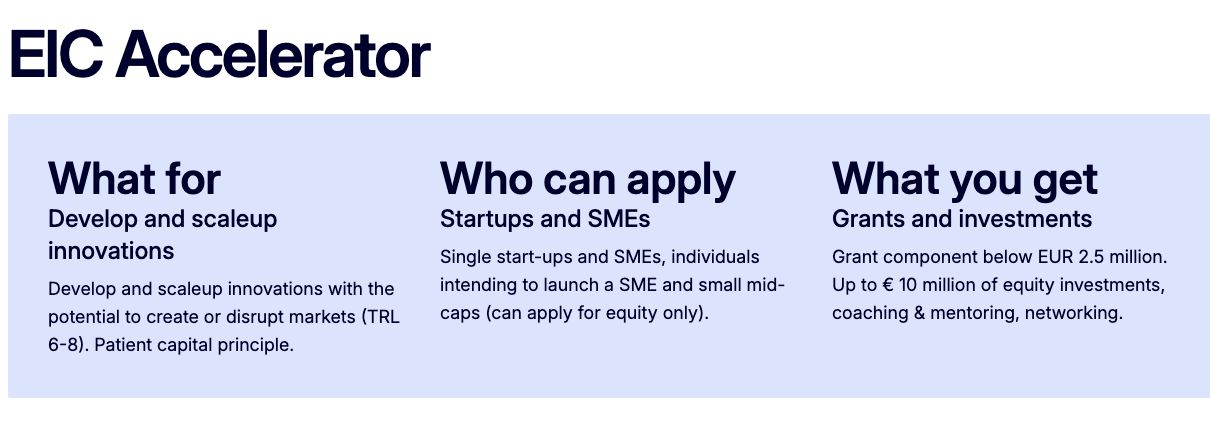
The EIC Accelerator overview describes support for start-ups and SMEs developing innovations with potential to create or disrupt markets and a need for finance that private investors alone cannot readily meet. It allows a single eligible company to apply.
Under the published 2026 terms, the grant component is below €2.5 million for innovation activities at technology readiness levels 6–8. The investment component is €1 million to €10 million. Grant-only, investment-only and blended forms have different conditions. The investment component has its own terms and is separate from the grant component.
The programme’s 2026 page lists 4 November at 5pm Brussels time, equivalent to 4pm in Ireland, as its final full-proposal batching date that year. That is a dated application stage, not a standing annual deadline. Anyone reading this after the batch should check the next published work programme and call rather than assume the same dates continue.
An EIC short proposal is not an award
The EIC’s application FAQs distinguish the initial proposal from the fuller business and financial case. Applicants must explain their innovation, market, team and funding need; a successful first stage does not mean the project has secured finance.
Before choosing this route, consider what evidence would support each claim. A prototype result should be distinguishable from a development target. Customer interest should be distinguishable from a signed commercial commitment. A forecast should state the assumptions behind it.
The FAQs also explain submission limits, so repeated attempts are not an unlimited free trial. Read the rules that apply to the company’s previous outcomes before resubmitting. Where investment is involved, grant selection and the investment process also need to be understood separately. Do not build a cash plan around an assumption that every requested component will be paid immediately.
Collaborative Horizon projects: define your contribution
Many Horizon opportunities involve a consortium rather than a single company. The Funding & Tenders Portal’s Online Manual explains that call conditions determine eligible participants, project activities and any minimum consortium composition. Check the actual topic; there is no single partner rule covering every EU programme.
A company considering a consortium should be able to explain the work it will perform, the resources it will contribute and how its tasks connect with the other participants. Joining only to add another country to a list leaves basic delivery questions unanswered.
For example, a hypothetical Irish sensor developer might contribute prototype development while a research organisation supplies specialist testing and another partner evaluates the technology in use. That is an illustration of complementary roles, not a real project or a finding that such a consortium qualifies. The call’s scope and conditions still determine whether the proposed arrangement fits.
Eurostars combines international collaboration with national funding
Eureka’s original Eurostars guidance describes international R&D projects led by an innovative SME. The consortium needs at least two independent entities from at least two Eurostars countries, with at least one country in the EU or associated to Horizon Europe.
Its international criteria also cover the SME share of the budget, limits on concentration in one participant or country, a maximum 36-month duration and an exclusively civil focus. Check all the criteria together; finding one overseas partner does not complete the eligibility assessment.
Funding is decentralised. National funding bodies determine available support, rates and eligible activities under their own rules. This means two partners on the same project should not assume they will receive the same percentage of their costs.
On the Irish side, Enterprise Ireland’s Eurostars overview says eligible clients of Enterprise Ireland, Local Enterprise Offices, Údarás na Gaeltachta or IDA Ireland trading internationally in manufacturing or eligible services may access grant funding. It also stresses that participants need adequate cash resources and may have to self-fund.
Discuss the Irish funding route before agreeing a project budget with partners. A positive international project assessment and an approved national financing arrangement are separate matters. Check the current call window as well: a programme description remaining online does not establish that applications are presently open.
Use Irish support before committing to an application
Ireland’s Horizon Europe support network is led by Enterprise Ireland and includes advisers who can discuss calls and participation. The official National Contact Point directory provides a way to identify the appropriate contact by country and subject.
Bring a concise outline and a specific question. An adviser can respond more usefully to “does this technical demonstration fit this topic?” than to “what EU money can we get?” Include the project stage, likely partners, proposed budget and any previous funding relevant to the same work.
Do not assume that every proposal-preparation support advertised on an Irish website is available to every company. Some schemes target researchers or particular coordinating roles. Confirm the applicant conditions and eligible preparation costs before hiring outside assistance on the expectation of reimbursement.
Build a budget the company can actually deliver
A project budget and a company cash forecast answer different questions. The first describes the resources needed for the work. The second shows whether the company can pay staff and suppliers when bills fall due.
As a hypothetical planning exercise, imagine a project requiring substantial staff time before an experimental milestone. Identify when those wages would be paid, what funding the company already controls and what would happen if an expected receipt arrived later. The purpose is to expose timing gaps, not to forecast an actual grant payment schedule.
Keep the company’s requested contribution separate from the total consortium budget and from the overall programme budget. A large EU call allocation is shared across selected projects; it is not the amount an individual Irish applicant can expect.
Discuss ownership of existing technology, access to partners’ results and the intended commercial use of new work before finalising the collaboration. Record questions that require specialist advice. A successful funding bid should leave the business with a project it understands, including its obligations after selection.
Make a shortlist before writing the full proposal
For each possible route, prepare a short comparison containing the project objective, eligible applicant, required partners, relevant development stage, funding form and current deadline. Add the documents or evidence still missing and name the person responsible for obtaining each item.
Keep uncertainty visible. If the national funding rate has not been confirmed, mark it as unresolved instead of inserting the best rate found in another country. If a partner has not agreed its tasks, record that before building the delivery plan around its contribution.
The most useful next step is a focused conversation with the correct Irish programme adviser, supported by the current call documents and a clear project outline. That helps a company decide whether to apply now, develop the project further or pursue a different support. It also avoids treating the largest advertised funding amount as the best match for the business.
Join the conversation
Keep it kind, relevant and constructive. Comments are reviewed before they appear.
Be the first to share a thought.