

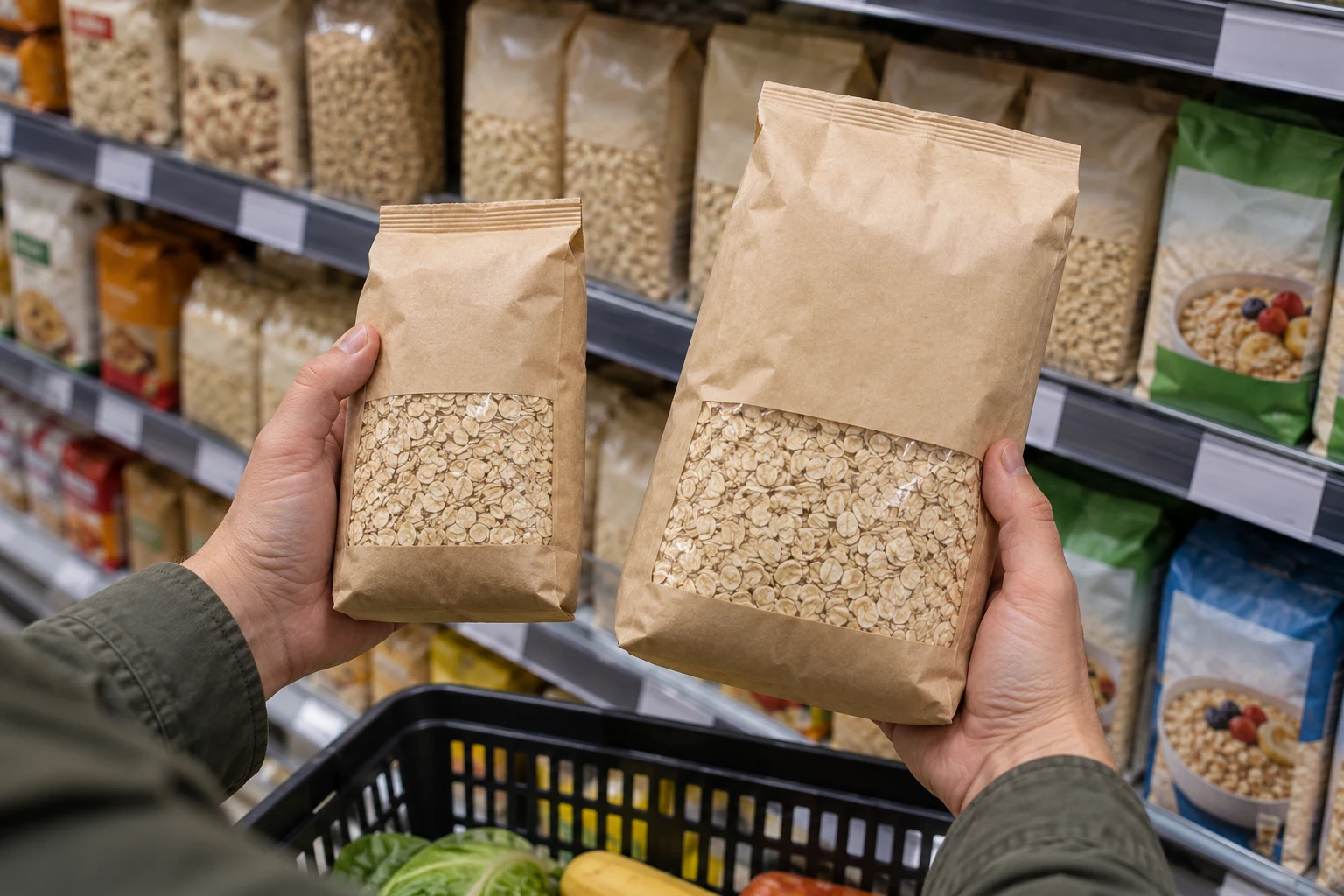
The cheapest pack on the shelf is not always the cheapest amount of food. A larger bag can cost more at the till while costing less per kilogram. It can also be poor value for a household that will not use it.
The fair comparison has two stages: put equivalent products into the same unit, then decide how much will actually be used. The calculations below are illustrative scenarios created for this guide, not a price survey or quotes from Irish retailers.
Use one denominator
The CCPC’s pricing guidance explains unit prices for goods measured by weight, volume or length. They help compare similar products sold in different quantities. The selling price and unit price answer different questions; the deposit on an eligible drinks container is displayed separately and is excluded from the unit-price calculation.
For a weight comparison, divide the pack price by its weight in kilograms. For a volume comparison, use litres. Converting one pack to 100 grams while leaving another at a kilogram makes the numbers look different even when they represent the same value.
Worked comparison: two bags of oats
Suppose a 500 gram bag costs €1.80 and a 750 gram bag costs €2.55. The smaller bag costs €3.60 per kilogram:€1.80 divided by 0.5. The larger costs €3.40 per kilogram:€2.55 divided by 0.75.
The larger bag therefore costs €0.75 more upfront but €0.20 less per kilogram. Its unit price is about 5.6% lower. That does not mean every shopper saves €0.20 by buying that particular bag: the quantities differ, and the saving must be compared over the same amount purchased and used.
Worked comparison: a multibuy
Suppose one 400 gram pack costs €2.20, while two identical packs cost €4. The single-pack unit price is €5.50 per kilogram; the offer is €5 per kilogram. Buying two at the single price would cost €4.40, so the offer saves €0.40 if both packs are needed.
If only one pack will be used, spending €4 instead of €2.20 increases the immediate bill by €1.80. A good unit price does not make unused food free. Compare storage, use-by information and the household’s actual requirements before treating a promotion as a saving.
Check that the products are comparable
A price per kilogram is a consistent denominator, not a quality score. Ingredients, drained weight, concentration and serving instructions can change what is being bought. A concentrated product should not be compared with a ready-to-use product solely by the size of the bottle.
A useful shopping note records the exact product description, quantity, pack price, calculated unit price and date. Photograph the shelf label where appropriate, and check the till total before leaving if something differs.
This method can be reused by community budgeting groups without relying on a quickly outdated supermarket ranking. Change the inputs when prices change, keep the units consistent and label any example clearly. The calculation remains useful even when the particular offer has ended.

Join the conversation
Keep it kind, relevant and constructive. Comments are reviewed before they appear.
Be the first to share a thought.