

A bike-share price has at least three parts: access to the scheme, the charge for that particular hire and any security requirement. “First half-hour free” does not answer all three, and it does not describe every bike type on the current tariff.
We compared the operator’s pricing and return instructions for TFI Bikes, which serves Cork, Galway, Limerick and Waterford. The practical result is a journey-cost record that includes the moment the hire actually ends.
Membership is separate from a trip
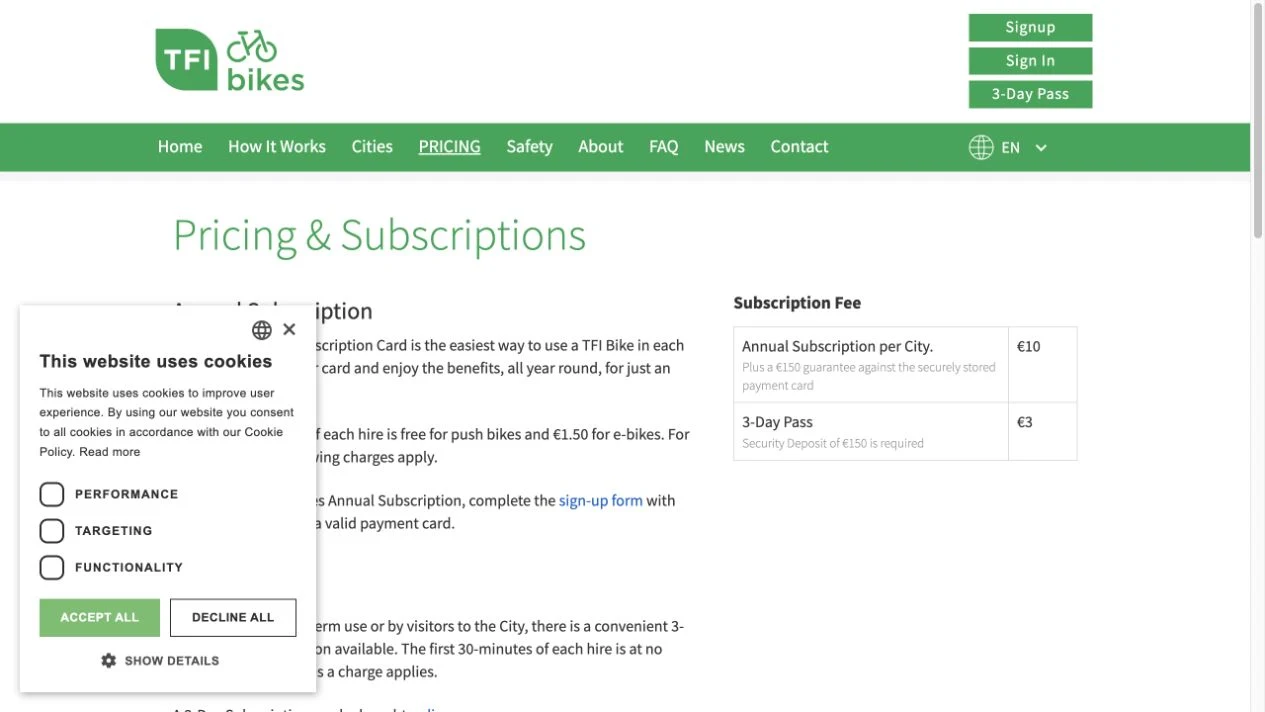
The operator’s pricing page, checked on 22 October 2026, lists an annual subscription per city at €10 and a three-day pass at €3. It also lists a €150 guarantee or security deposit, depending on the option. A security requirement is different from the subscription fee or the amount charged for a completed ordinary trip.
Check the selected city and the terms before signing up. A list of four cities does not mean one membership automatically covers every scheme. Live bike and stand availability also matters more than the existence of a station on a static map.
Push bikes and e-bikes have different hire charges
For annual membership, the tariff states that the first 30 minutes of each push-bike hire are free, while the first half-hour on an e-bike costs €1.50. Its hire table gives different prices for longer use and says the full new time band applies when a hire extends into it.
As a worked comparison using that table, one 45-minute hire falls in the up-to-one-hour band: €0.50 for a push bike or €3.50 for an e-bike. Those are trip charges, before the subscription and any applicable security requirement. They are not a quote for another city’s separate bike scheme.
The page’s three-day-pass description uses general first-half-hour wording, while the table distinguishes bike types. Confirm how the selected pass applies to the intended bike rather than assuming every electric hire is free. Retain the terms shown at purchase.
The clock stops at a successful return
The hire-and-return instructions describe pushing the bike into an available stand and checking for an audible beep, flashing lights and then a steady green light. Leaving a bicycle beside a station is not the same as terminating the hire.
If the return does not confirm, try another stand and use the operator’s assistance route. Record the station, stand and time, and retain any contact reference. Do not leave the problem to the next rider.
Make a complete journey comparison
Before departure, record the city, membership/pass, bike type, expected duration and destination stand options. Afterwards, add the return confirmation and actual charge. Budget a margin for finding an available stand rather than treating a planned 29-minute ride as a guaranteed free hire.
Use current operator notices for disrupted stations and check the tariff again before a future trip. This method remains useful when a price changes because the membership, time band and completed return remain separate checks.
Join the conversation
Keep it kind, relevant and constructive. Comments are reviewed before they appear.
Be the first to share a thought.