

“Is Ireland safe?” is too broad to answer with a single crime figure. A national trend, an account of one incident and a practical plan for tonight’s journey describe different things. None should be turned into a guarantee about an individual’s safety.
We compared the latest CSO recorded-crime release with its methodology and Garda contact guidance. The useful approach is to keep statistical context, local planning and help routes separate, without inventing neighbourhood league tables.
Check which period a statistic describes
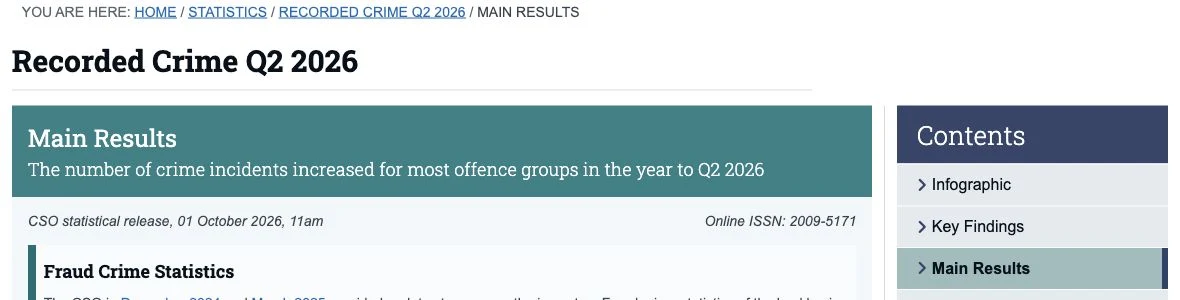
The CSO’s Recorded Crime Q2 2026 main results, published on 1 October, contain both annualised and quarterly comparisons. “The year to Q2” means the twelve months ending with that quarter; it is not a count for October or just three months.
Burglary illustrates why the label matters. Recorded incidents fell from 9,165 to 8,587 in the annualised comparison, while the Q2-only figures rose from 2,099 to 2,182. Those are different time windows. Selecting one without naming its period can produce an incomplete impression.
The release also cautions that published fraud figures exclude referrals from financial institutions under Section 19 while recording-backlog work continues. Comparisons need to respect that coverage limitation.
Recorded incidents are not a personal forecast
The CSO’s methodology page describes provisional figures based on crime incidents recorded by An Garda Síochána. These are administrative records, with offence types and Garda areas; they are not a survey of every visitor’s experience or every unreported incident.
A raw total alone does not account for the number of residents, visitors, journeys or time spent in an area. It cannot establish the risk on a particular street at a particular hour. An offence recorded in an area also does not justify generalisations about the people living there.
For a useful comparison, keep the offence definition, geographical unit and period consistent. Avoid treating a changing boundary or reporting pattern as proof of a change in underlying personal risk.
Make a practical plan for the actual journey
Before an unfamiliar evening trip, confirm the route home, the final transport service, the accommodation contact and a way to communicate if plans change. Keep information from the actual provider or relevant local authority with its date. A national crime chart cannot answer whether the last bus has departed or a particular route is closed.
Garda contact guidance says to call 999 or 112 if a crime or incident is happening now or anyone is in immediate danger. For non-emergency or general enquiries, use the local Garda station and the official station directory.
Save those routes before they are needed. The balanced answer is specific preparation and correctly read evidence, rather than a blanket claim that every place is either safe or unsafe.
Join the conversation
Keep it kind, relevant and constructive. Comments are reviewed before they appear.
Be the first to share a thought.