

Ryanair has forecast about €2 billion in extra fuel costs for its next financial year and warned that European short-haul airfares could rise substantially in 2027, bringing the Middle East energy shock into focus for people travelling to and from Ireland.
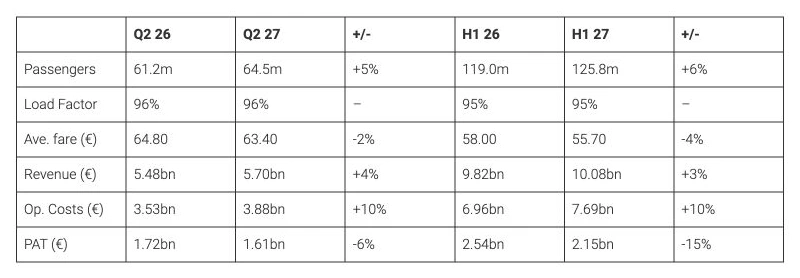
The warning accompanied the airline’s half-year results published on Monday, 2 November. Ryanair reported a 15% fall in profit after tax to €2.15 billion for the six months ending 30 September, despite carrying more passengers. It is also examining costs, including possible greater use of artificial intelligence in support functions.
For Irish households, the immediate message is a risk to future travel budgets, rather than a confirmed percentage increase on every flight. For workers, the announcement identifies areas under review; it does not provide an Irish redundancy total. Both distinctions matter when translating a European company’s warning into its practical consequences here.
Why this matters beyond the airline’s results
Ireland’s links with the rest of Europe make changes in air travel particularly relevant. The CSO’s second-quarter aviation release, published in September, recorded 12.3 million passenger movements through the five main Irish airports between April and June 2026. Some 85% of passengers on international flights were travelling to or from Europe.
These are airport passenger counts, not a count of individual Irish residents or Ryanair customers. Nevertheless, they show the scale of exposure to European aviation conditions. The CSO identified the UK and Spain as the most popular countries of origin or destination, underlining the importance of both nearby connections and holiday travel.
The consequences of a more expensive or less convenient journey can reach beyond a leisure booking. Family visits, work travel and the cost of bringing visitors to Ireland all depend on the particular services available. Higher fares would affect those journeys differently: a traveller able to change dates has different options from someone who needs a specific flight.
The reported summer fares actually fell
Ryanair’s published table shows its average fare falling 4% to €55.70 in the half-year, while passenger numbers rose 6% to 125.8 million. Operating costs increased 10% to €7.69 billion. These are group figures covering its network, not an Ireland-only fare index.
The combination is important. An airline can face higher costs while charging less on average during a particular period. It can carry more people and still earn less profit. The company’s future pricing warning therefore should not be confused with what every passenger paid last summer, or with the price available for a particular flight today.
An average fare is also a narrower measure than the entire cost of a trip. A useful comparison for a family is the full price of the journey they need, including their chosen baggage and other extras, rather than a network-wide average or the lowest advertised ticket. Accommodation and getting to the airport are additional parts of the household budget.
The relevant half-year was April to September 2026. Ryanair labels it H1 FY27 because its financial year ends in March 2027. That accounting label does not mean these are results for travel that has already happened in calendar 2027.
Why fuel bought in advance changes the timing
The airline says about 80% of its current financial year’s jet fuel is hedged at roughly $67 a barrel, compared with 25% cover at about $95 for the following financial year. Hedging fixes exposure to a price in advance; it means an airline’s effective fuel cost is not simply today’s market quote multiplied by the amount it flies.
This is why a fuel shock can reach company accounts and passenger prices at different times. Earlier protection can soften the immediate effect, while later purchases expose a business to different prices. The amount protected, the price secured and the period covered all matter.
Business Travel News Europe’s report on the results describes Ryanair’s estimate of around €2 billion in additional fuel costs for its 2027–28 financial year. That estimate is based on forward prices and is a company forecast, not a bill whose final amount is already known.
The financial year in question begins in April 2027. Readers should therefore distinguish the airline’s next-year cost exposure from the current winter, and a forecast for European short-haul fares from a price announcement for a named Irish route.
Oil can fall while the longer-term risk remains
There is no sound basis for saying that energy prices must rise continuously. Reuters’ Monday evening market report, carried by Euronext, said crude prices fell about 7% as talks involving Iranian and Qatari officials encouraged hopes of less disruption to Middle Eastern supply.
That was a report about the market’s reaction on 2 November, not confirmation that the conflict had ended. It illustrates how quickly expectations can change. A price move based on hopes for an agreement is different from a sustained improvement in actual supply.
Jet fuel is also a separate refined product. The IATA fuel monitor, checked on 3 November, displayed a prior-week global average of $191.54 a barrel, down 2.6% from the week before. Its figures describe average refinery prices for the reported week, using Platts data; they are not Ryanair’s hedged purchase price or a quote for Irish petrol.
Those measures should not be substituted for one another. A daily crude-market fall, a weekly global jet-fuel average and a company’s contracts covering a future financial year describe different things. Comparing them without their dates and scope can give a misleading impression that the figures contradict each other.
For someone asking whether oil-related costs will increase in Ireland, the responsible answer is that further increases remain a risk, but this announcement cannot settle the direction or size of Irish pump prices, heating-oil quotes or electricity bills. It offers evidence of one transmission channel: fuel costs feeding into a European airline’s decisions.
Capacity matters as well as the price of fuel
Some of the airline’s response predates Monday’s results. The Irish Times reported the winter capacity decision in September: the group reduced its financial-year passenger target from 216 million to 214 million to limit exposure to expensive unhedged fuel, with winter traffic expected to be broadly flat.
It would be misleading to present that earlier decision as a newly announced cancellation of two million Irish bookings. The target concerns the group’s traffic, and a lower growth plan is not a list of individual flights being cancelled.
For Irish travellers, the practical issue is the combination of fare, frequency, departure airport and destination. A cheaper ticket at a less convenient time or airport may not reduce the total cost of a journey. Likewise, a general forecast for fewer seats in a market does not establish that a particular service from Dublin, Cork, Shannon, Knock or Kerry will disappear.
The evidence needed for that conclusion would be a confirmed schedule or route announcement. People with bookings should follow communications about their actual flight, rather than assume that a company-wide financial forecast changes their reservation.
What the AI review says about jobs
The cost review includes potential temporary pay freezes, changes to crewing ratios and greater use of AI for operational and back-office productivity. These are proposals described by the company, not a published assessment of how many Irish jobs will be removed or created.
The wider Irish labour-market context is also more complicated than a single company announcement. In its August account of the Expert Group on Future Skills Needs report, the Department of Enterprise described strong demand for AI-related skills and an uneven spread of adoption across businesses and individuals.
That earlier research is context, rather than a new November employment result. It supports taking skills and adoption seriously, but it does not establish what will happen to a particular airline employee, graduate or support team.
For workers following this development, the meaningful next information would be a specific implementation plan: which tasks change, what training is offered, where work is located and whether staffing or contractual changes are proposed. A productivity ambition alone cannot answer those questions. Nor can it be used as evidence that AI has already caused a measured fall in employment across Ireland.
What passengers can check now
For future purchases, compare the complete itinerary and the conditions attached to it. The CCPC’s flight guidance explains that baggage, check-in, fees and add-ons are commonly governed by the booking terms, which passengers should check before paying. A broad warning about future prices is not a guarantee that booking today will be cheaper than waiting.
If an airline actually cancels a covered flight, the situation is different. The Irish Aviation Authority’s cancellation guidance sets out the choice between a refund and re-routing, including travel close to the original departure or at a later date. Additional compensation depends on the circumstances and notice given; it is not automatic in every case.
The EU’s passenger-rights guidance also distinguishes those options from compensation and assistance. These existing protections do not depend on accepting an airline’s explanation of its general cost pressures. Individual disputes require the relevant booking and flight details.
The development to watch is how the fuel forecast becomes actual fares, schedules and workplace decisions. Ryanair has supplied new evidence of financial pressure and its proposed response. The effects for people in Ireland will become clearer through those concrete decisions, rather than through treating every warning as an outcome already reached.


Join the conversation
Keep it kind, relevant and constructive. Comments are reviewed before they appear.
Be the first to share a thought.