

Thirty-three council-led climate projects across the wider Midlands have been selected for more than €36 million in support, with the finalisation of grant agreements still to come. The package includes upgrades to public buildings and amenities alongside studies preparing possible future infrastructure.
Minister for Climate, Energy and the Environment Darragh O’Brien announced the selection on Monday, 2 November. His published announcement and project list says Pobal has invited selected applicants to begin grant-agreement negotiations under the EU Just Transition Fund’s START scheme.
For people using libraries, leisure centres, walking routes and other local facilities, this is a material funding development. It is not an announcement that all 33 projects have started on site or that each proposed facility is ready to use. The next steps depend on the particular project and the conditions attached to its agreement.
What the funding decision changes
The scheme originally had €30 million available. The minister said a further €6 million in Government funding was being added because of the quality of the applications. The projects were selected through a competitive process linked to councils’ Climate Action Plans.
The selection gives councils a basis to take their proposals into the contracting stage. It also gives residents a more concrete set of projects to follow than a general commitment to future climate investment. However, the amount announced should not be described as money already spent, or as a completed improvement to a local service.
Pobal’s scheme guidance explains that successful applicants receive a grant agreement once pre-contract conditions are met. It identifies the Department of Climate, Energy and the Environment as the national funding body, the Eastern and Midland Regional Assembly as managing authority, and Pobal as administrator.
Those roles provide a useful distinction between selecting projects, administering the grants and delivering the local work. The council must lead and remain accountable for an approved project, even where it works with community organisations or other eligible partners.
Kildare: buildings, training and a conservation plan
Kfm’s report on the Kildare allocations identifies support for the RegenTEC Circular Economy Hub in Athy, energy work at Athy Leisure Centre and Library, and a conservation masterplan for Carton Avenue near Maynooth. The schemes also appear in the minister’s published list.
The RegenTEC allocation is €4,961,051 for phases two and three, involving the reuse of a former school for education and training connected with sustainable construction. The Carton Avenue allocation is €299,600 for a conservation masterplan incorporating biodiversity measures.
These are different types of intervention. Retrofitting a building for training has a different immediate purpose from preparing a masterplan for an existing amenity. In Maynooth, the announcement does not itself settle every design choice or announce the completion of park improvements.
For Athy residents, the public-building projects concern facilities already used locally. Their eventual value will depend on the works delivered, how the buildings operate afterwards and how people can access the services. A funding figure alone does not establish the size of a future energy saving or a change in admission charges.
Offaly: a major leisure-centre upgrade and preparatory work
The Offaly Independent’s account highlights approximately €4.9 million for Tullamore Leisure Centre and €324,664 for Tullamore Library. The minister’s list confirms energy-efficiency work at both facilities.
The leisure-centre proposal covers the building’s systems and fabric. The library project includes heating, lighting and solar-power improvements. These are intended investments in the facilities, rather than a promise that individual households will receive a payment from the scheme.
The local report also describes feasibility work on geothermal heating and the proposed Church Hill Climate Park. A study can establish options, constraints and what would be needed to advance a proposal. It does not mean a particular technical solution has already been proved suitable, approved for construction or installed.
That distinction is especially important for residents reading about possible heating improvements around social housing. Funding an investigation into an option is not the same as notifying a household that its heating system will be replaced. Any such practical change would require further, specific information from the responsible bodies.
The designated territory is wider than a single county
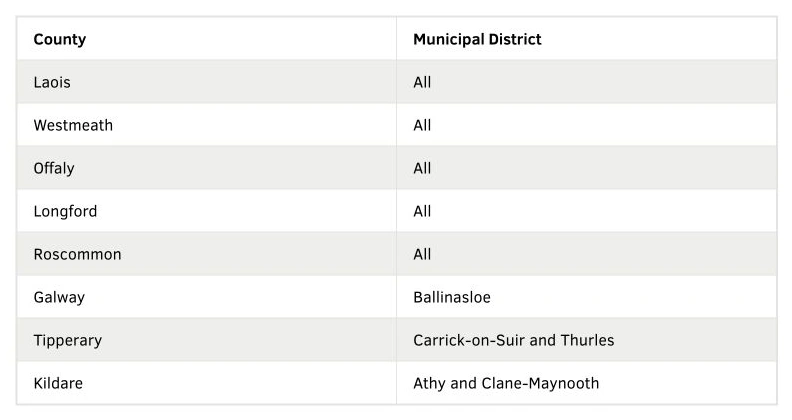
The Eastern and Midland Regional Assembly’s START overview identifies five entire counties within the designated territory: Laois, Longford, Offaly, Roscommon and Westmeath. In Galway, Kildare and Tipperary, the designation applies to particular municipal districts rather than the whole county.
Those districts are Ballinasloe in Galway; Athy and Clane-Maynooth in Kildare; and Carrick-on-Suir and Thurles in Tipperary. The regional assembly describes support for energy efficiency, renewable energy, land rehabilitation, sustainable mobility, circular-economy activity and infrastructure with a social purpose.
This explains why the package can include public buildings, paths and future-project assessments across a broad region. It is not a nationwide grant with identical availability in every council area. Nor should someone living elsewhere in one of the three partly designated counties assume that the whole county is covered.
The selected list includes a 1.35km active-travel scheme along the R446 in Ballinasloe, with cycle paths, footpath and crossing improvements and accessible bus stops. In Longford, support for the proposed Clondra–Termonbarry greenway connection covers design and tender preparation for a 1.6km link. These examples show why the stage matters to potential users: an allocation towards designing a connection is different from an announcement that a new walking or cycling route has opened. The funding notice alone is not a current route-access or traffic-management notice.
The scheme page sets out a delivery window from October 2026 to March 2028. That is the programme framework, not a separate opening date for each selected project. Residents will need project-specific notices to know when work is scheduled and whether it affects access to a building or route.
Why this is called a just transition
The regional assembly’s explanation of the wider EU Just Transition Fund links its Irish focus to communities affected by the move away from peat production and peat-fired electricity generation. Its purpose includes economic diversification, opportunities for workers and communities, regeneration and sustainable mobility.
That background matters when assessing the selection. Climate transition is not only a question of replacing one fuel or technology with another. In a region where an industry supported local livelihoods, the public-policy question also concerns what takes its place and who benefits from the investment.
Buildings that cost less energy to operate, accessible amenities and training infrastructure can serve different parts of that response. Their benefits should still be assessed against what is actually delivered. A lower-carbon building and a permanent new job are different outcomes; evidence of one does not automatically demonstrate the other.
EU Funds Ireland’s programme overview describes up to €84.5 million in EU support, matched by Government funding to provide up to €169 million for the wider programme. The new START selection is one part of that broader framework, not an additional €169 million announcement.
The jobs question remains important
RTÉ’s report from Monday’s launch in Athy records the minister acknowledging that job creation had not progressed at the rate communities wanted and that more work was needed. He also argued that the fund’s purpose extends to issues such as dereliction, active travel and new enterprises.
RTÉ questioned him about an assessment of the earlier National Just Transition Fund. That earlier programme should not be treated as interchangeable with the new EU-funded START selection. Equally, announcing this new package does not by itself answer questions about past delivery or establish how many lasting jobs the selected projects will create.
For affected communities, the meaningful evidence will include projects reaching operation, participation in training, access to services and any employment outcomes that can be demonstrated. It is reasonable to follow those measures separately, rather than turn the value of announced grants into an assumed jobs total.
This also avoids overstating what a feasibility allocation can achieve immediately. Preparatory work may help a council make a better decision about a future investment, while employment or service benefits from a completed development would arise at a different stage.
This is a selection announcement, not a new application window
Pobal’s current page says the START call is closed. It was a council-led funding process with separate infrastructure and feasibility strands, not a direct application scheme for householders or private businesses.
The practical action for a resident is therefore to follow the relevant council’s updates on a selected project, rather than try to apply for a personal share of the announced package. Community organisations interested in a local scheme can examine what role the council has proposed for them; selection does not itself establish an open invitation for new partners.
For transparency, the regional assembly’s beneficiary information page is another record to watch as the programme develops. At this check, its downloadable operations list was labelled as being current to 30 September 2026, before Monday’s announcement. A dated earlier list should not be mistaken for a definitive record of the new selections or completed grant agreements.
The next substantive developments will be those agreements, confirmed project timetables and delivery updates. The new package identifies real proposals selected for support across the Midlands. Its practical effects will become clearer as councils turn those selections into completed work and report the results for the communities the fund is intended to serve.

Join the conversation
Keep it kind, relevant and constructive. Comments are reviewed before they appear.
Be the first to share a thought.