

An employee’s right to ask for a different working arrangement does not, by itself, establish the right to work from home on chosen days. Ireland’s code also distinguishes remote working from the statutory flexible-working route for caring purposes.
We compared the two procedures and turned the code into a request-and-response record. It helps employees and small employers identify what is being proposed before debating whether it can work.
Choose the correct route
The WRC’s explanation of the code directs readers to the rules for both requests. The remote-working route covers employees generally. The statutory flexible-working route is for specified caring purposes, including care of a child under 12, or under 16 in the relevant disability or long-term illness circumstances, and certain other serious medical care needs.
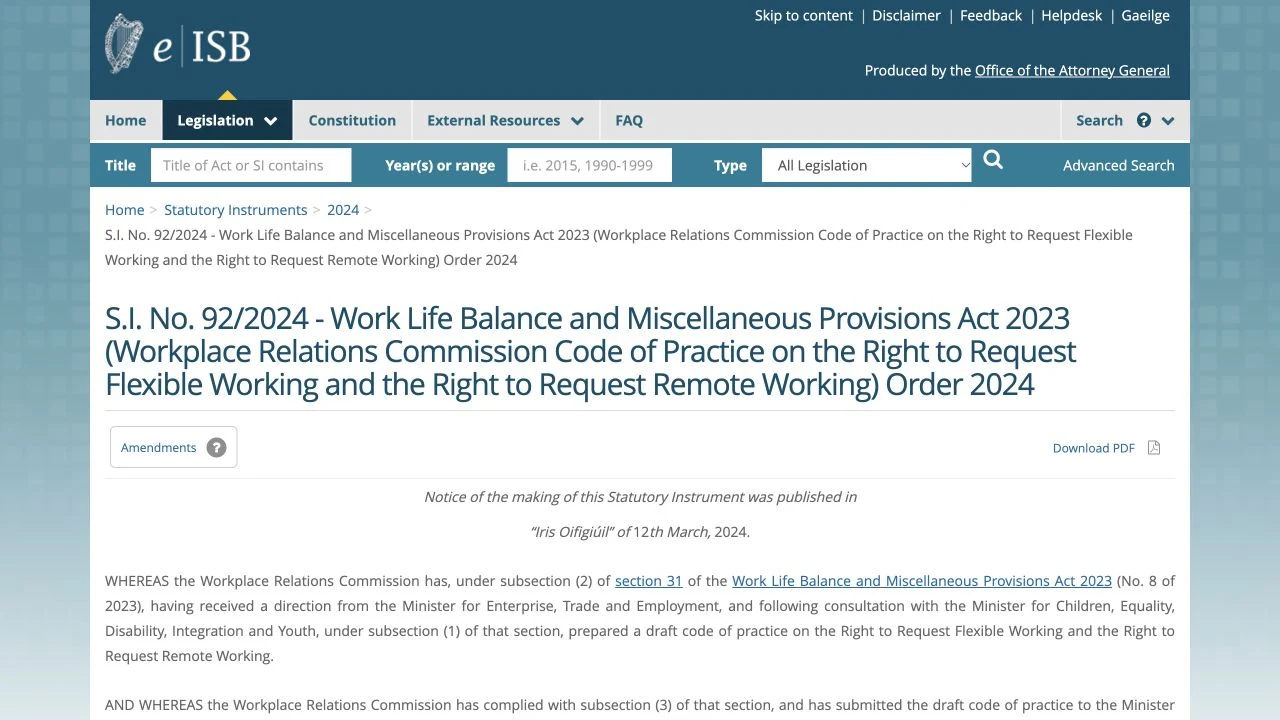
The official code in S.I. 92 of 2024 explains that a request can be made from the start of employment, but an approved arrangement cannot start until six months’ continuous service has been completed. Submit a written, signed request at least eight weeks before the proposed start; an online application is possible.
Do not assume that an informal agreement to swap a shift is the same thing as a completed statutory request.
Four things to put in writing
First describe the arrangement: which days, hours or remote location are proposed? Second give the start date and duration. Third explain the relevant reasons and how the work could be delivered. Fourth identify practical constraints and a possible review point.
For remote work, the code includes information about the proposed location and its suitability, such as privacy, equipment, connectivity and data security. A vague promise to “be available” leaves important operational questions unanswered. Keep unnecessary personal details out of a wider team discussion; use the employer’s appropriate confidential process for supporting information.
Record the response clock
The code provides a four-week response period. Where assessment is difficult, an extension of up to eight additional weeks can be used, with notification within the initial period. A diary should distinguish an extension notice from approval of the arrangement itself.
The employer must consider the request, taking account of business and employee needs and following the code’s approach. The process is not an automatic entitlement to the requested outcome.
If there is a disagreement, keep the original request, acknowledgement, any extension and the written decision. The code distinguishes complaints about the statutory process from a review of the merits of an employer’s decision. Do not assume that a complaint will result in an order granting particular work-from-home days. Start by asking which procedural step is disputed.
Join the conversation
Keep it kind, relevant and constructive. Comments are reviewed before they appear.
Be the first to share a thought.