

A part-time worker’s four weeks of annual leave are four of their normal working weeks. Converting that immediately into “20 days” can be misleading when the working pattern is different.
We checked the Workplace Relations Commission’s three statutory calculation methods and worked through how to keep the units consistent. These examples explain the arithmetic; they do not determine anyone’s final entitlement.
Start with the three methods
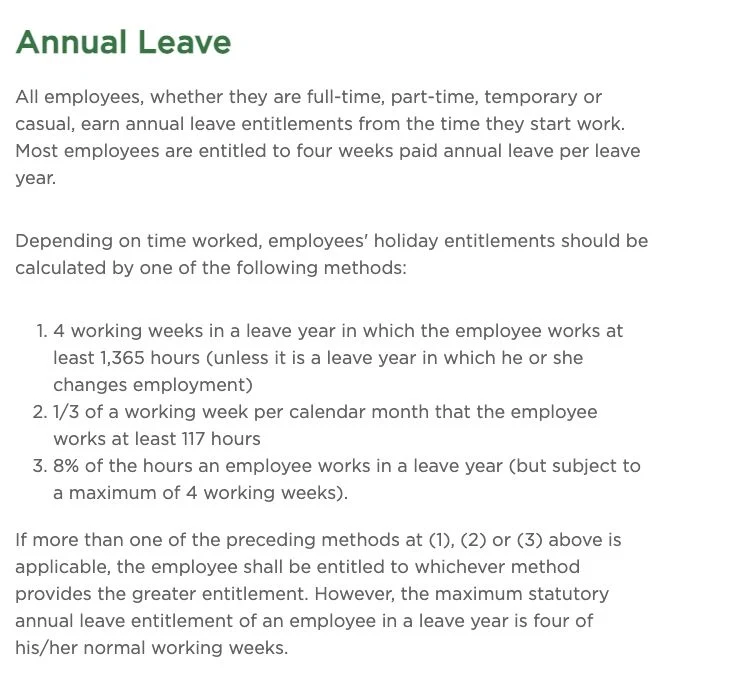
The WRC’s annual leave guidance sets out four working weeks where at least 1,365 hours are worked in a leave year, except a leave year in which employment changes.
A second method gives one-third of a working week for each calendar month with at least 117 hours worked. A third gives 8% of hours worked during the leave year, capped at four normal working weeks.
Where more than one method applies, the employee receives the greater entitlement, subject to the statutory maximum of four normal working weeks. A contract can provide more. The 8% calculation should therefore not be the only line on the worksheet.
Two examples that answer different questions
For a hypothetical total of 600 hours worked, 600 multiplied by 0.08 gives 48 hours under the percentage method. That figure alone is not a completed entitlement calculation: check whether another method applies, the relevant normal working week and any contractual enhancement.
For someone whose normal week is 20 hours, four such weeks equal 80 hours. This is a conversion of the cap into hours, not a claim that every person working 20 hours automatically earns 80 hours regardless of service or time worked.
If those 20 hours are spread across five four-hour days, one normal week represents five of those days. If spread across two ten-hour days, it represents two. The hours can be the same while the number of workdays differs.
A worksheet to give payroll
Record the leave-year dates, normal weekly pattern, total hours and hours in each calendar month. Calculate each applicable method using the same unit, identify the greater statutory result, then show contractual leave separately. Ask payroll to explain how variable hours or a changed pattern have been treated.
Do not erase periods of other statutory leave from the calculation without checking the rules. The WRC identifies several types, including certified sick leave and family leave, during which annual leave continues to accrue.
Entitlement and permission to take particular dates are also separate. The employer determines timing while considering work and personal requirements and consulting in advance. Keep the calculation and the agreed booking together, so a correct balance is not confused with approval for a particular holiday.
Join the conversation
Keep it kind, relevant and constructive. Comments are reviewed before they appear.
Be the first to share a thought.