

November is not a month for putting an Irish garden completely on hold. It can be a useful time to plant tulips, plan fruit and hedging, manage fallen leaves and protect containers. The important qualification is the condition of your own patch: a mild, sheltered courtyard and an exposed garden with saturated soil do not need the same weekend job list.
This guide brings together Irish horticultural advice and relevant temperate-climate guidance, then turns it into practical choices for a garden, allotment or a few pots. The aim is to have something worthwhile to do without damaging wet ground or buying plants that have nowhere suitable to go.
What should I do first in November?
Walk around before taking out tools. Look at where water collects, which pots remain wet, what the wind moves and which paths become slippery. Then choose a job that matches the conditions. Planting into ground that is unworkable today is not made sensible by the fact that a calendar calls November “planting time”.
Divide the list into three groups: work that needs workable soil, small tasks that can be done from a path or patio, and indoor planning. On a wet weekend, the second and third groups can be the better use of time. Ordering the right plant after measuring a space is often more useful than bringing home a bargain tree and looking for a place to put it.
For a small garden, start with one outcome: a pot of spring colour, a tidier usable path, or a properly planned fruit plant. You do not need to complete every seasonal task at once.
Is November too late to plant spring bulbs?
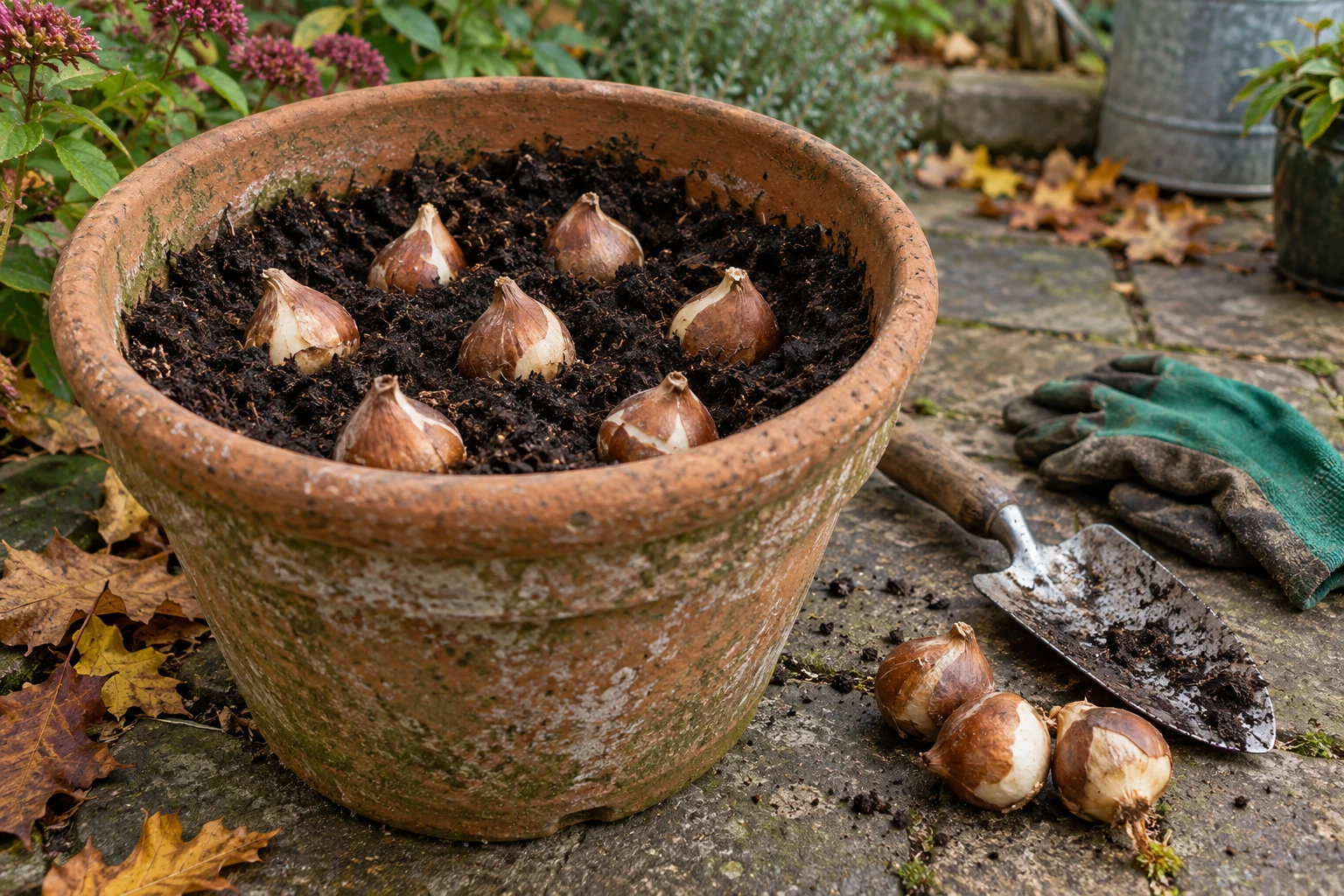
Not for tulips. In Teagasc’s winter-gardening advice, horticultural lecturer James Brady identifies November as a good bulb-planting time and recommends firm bulbs and free-draining conditions. For tulips, the suggested depth is two to three times the bulb’s height.
Use that as a starting point alongside the instructions for the particular bulb. Different bulbs and growing conditions should not be treated as one interchangeable recipe. Inspect what you are buying: a labelled variety, its eventual size and its flowering season are more useful than a bag chosen only for a photograph.
A container can make sense where the bed is too wet or the garden is small. Choose one with drainage, a suitable growing medium and enough depth for the bulb and roots. The point is to give the plant appropriate conditions, not to fit the largest possible number into a decorative pot.
Label the pot and keep the packaging information. An empty-looking container is easy to forget or accidentally disturb over winter. A simple note of what is planted and when it should flower prevents the spring question, “Was there anything in this one?”
Can I plant trees, roses or a hedge now?
The RHS November tree and shrub guidance describes the arrival of bare-root deciduous planting stock and the importance of preventing roots from drying out. Planting should wait when soil is frozen or waterlogged; the guidance also describes temporary heeling-in where planting must be delayed.
Before ordering, check the mature height and spread, soil preference and exposure tolerance of the actual plant. A small bare-root tree is not a promise that it will remain small. Consider access, nearby structures and the space it will eventually occupy.
Plan delivery for a time when you can deal with the plants. “They arrived on Friday” is not a reason to leave exposed roots unattended all weekend. If you cannot provide suitable temporary care or a planting position, postponing the order can be the better decision.
For a boundary, establish ownership and the agreed location before spending money. If choosing a plant primarily for privacy, compare its eventual width and maintenance needs as carefully as its advertised height. A hedge that blocks your own route around a tiny garden creates a different problem from the one you intended to solve.
What can I grow to eat in November?
The RHS November grow-your-own advice includes overwintering broad beans in suitable mild, well-drained conditions and garlic in appropriate outdoor conditions or modules under protection. These are conditional options, not a direction to sow into every wet Irish vegetable bed.
Choose varieties intended for the season and follow their instructions. Match the plan to the space and light you actually have. A packet intended for a different sowing window does not become suitable because a general article mentions the crop.
For a beginner, one labelled tray or a small, prepared growing area is easier to learn from than several unlabelled sowings scattered around the garden. Record the variety and date so you can connect spring results with the decision made now.
If you already grow vegetables, harvesting and checking stored produce may matter more than sowing. Look through what is ready, what needs support and what is deteriorating. A November garden can be productive without any new planting at all.
Should I cut the lawn one last time?
There is no universal final-mow date. The RHS November lawn guidance allows mowing when needed in mild conditions, with a higher cut than in summer, while warning against inappropriate work on wet or frosty ground. It also explains why fallen leaves should not be left to smother grass.
Use the condition of the lawn as the decision point. If ordinary walking already leaves deep marks, adding more traffic to complete a cosmetic job is unlikely to improve the result. A calendar deadline is a poor reason to force a mower across unsuitable ground.
Make access part of the plan too. If the same line across the grass is becoming a muddy route to a shed, think about how the household uses the garden. A usable path can be a more useful long-term improvement than repeatedly repairing the same worn strip.
Do I need to remove every fallen leaf?
No: where the leaf lies matters. Clear the places that need to remain usable, and deal with leaves covering lawn areas. Elsewhere, think about how leaf material can be retained and allowed to break down rather than treating the entire garden as a surface that must look swept.
Choose a manageable collection area before filling bags. A compact garden might have room for a modest leafmould arrangement; a balcony might need the local garden-waste route instead. Do not block drainage openings or access while waiting to deal with a pile.
Distinguish routine leaves from diseased plant material. The horticultural guidance discusses different handling for infected growth, so do not assume that everything removed from a plant belongs in the same home-compost pile. Check the condition and the receiving service’s rules when using a collection scheme.
Can I prune everything once the leaves have fallen?
No. Identify the plant first. Teagasc’s winter advice explicitly says to check individual pruning times, and the RHS notes exceptions to general dormant-season pruning, including Prunus species such as plums and ornamental cherries.
Make a list of unknown plants and identify them before cutting. A photograph taken when a plant is in flower can be useful later; an unlabelled bare shrub in November may be harder to recognise. If you cannot establish what it is, postpone a major cut.
Keep any work within your skill and safe reach. Large trees and substantial branches are a job to assess with a suitably qualified professional. A general seasonal guide cannot judge the condition of a particular tree or make work at height safe.
What can I do with only a balcony or patio?
Start with the container, drainage and exposure, then choose the plant. A small set of pots that can be maintained and checked is more useful than a crowded collection bought without a plan. Keep the walking route clear and consider how water leaves the area.
A practical November project is to prepare one bulb container, label it and decide where it can remain through winter. Another is to review existing plants: which are hardy, which need protection, and which have outgrown their pots? Check the actual species and container instructions rather than relying on a general label such as “outdoor plant”.
Do not place pots where they could fall from a height or obstruct shared access. If the balcony belongs to a rented or managed building, establish the relevant rules before adding large containers or attachments.
A realistic plan for four November weekends
For the first suitable weekend, inspect the garden and choose priorities. For the next, complete a small planting job if conditions allow. Use another to deal with leaves and review containers. Reserve a wet-weather session for identifying plants, checking seed varieties and planning spring.
These are flexible stages, not dates that override the weather. If the ground remains unsuitable, a successful November may consist of preparation and a few carefully managed pots. That still leaves the garden in a better position than hurried work done only to complete a checklist.
For garden birds, use The Press’s separate Irish feeding and hygiene guide rather than importing a generic feeding instruction from a gardening calendar. Seasonal planting advice and current wildlife-health advice need to be considered together.


Join the conversation
Keep it kind, relevant and constructive. Comments are reviewed before they appear.
Be the first to share a thought.