

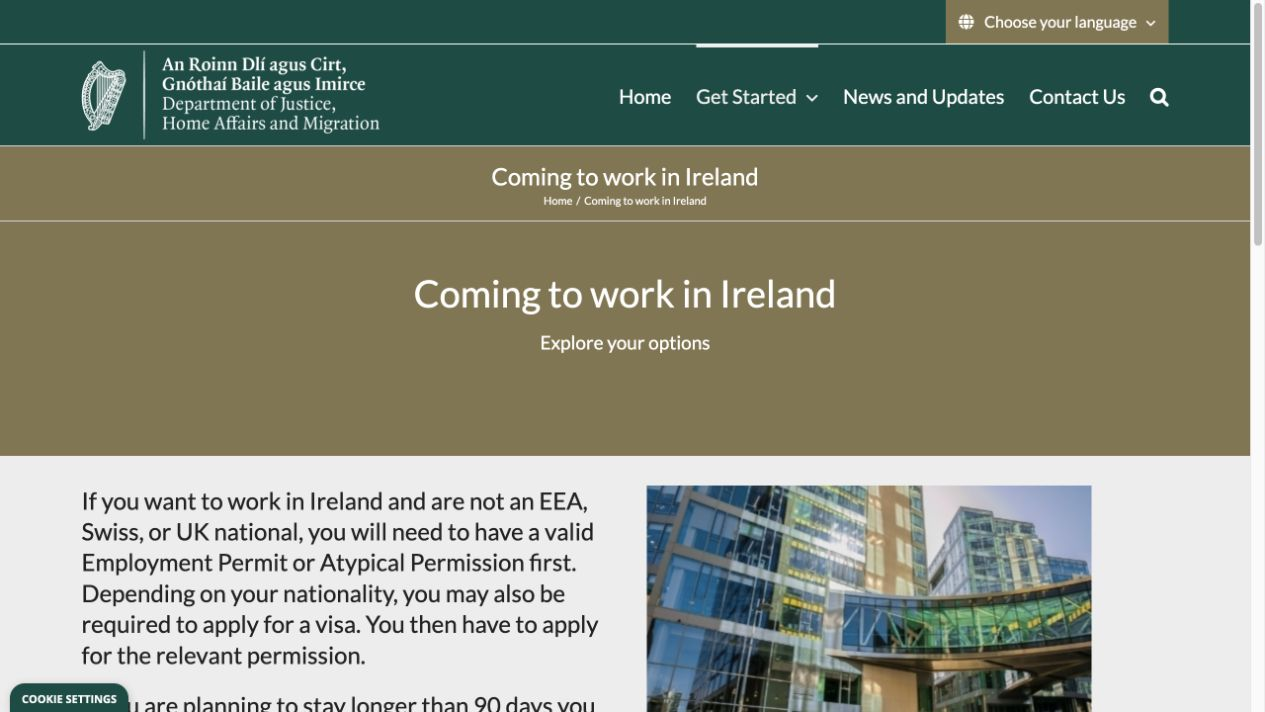
Before planning a move to Ireland for work, establish which official route applies to your nationality and intended activity. An employment permit, an entry visa and permission to reside are different parts of the process. A job offer alone does not replace the required permissions.
This guide points to public information checked on 21 October 2026. It does not determine anyone’s eligibility or provide an individual immigration assessment.
Start with nationality and your existing permission
The Department of Enterprise’s employment-permit guidance distinguishes EEA workers from people who generally need a permit or a relevant immigration permission allowing work without one. The EEA includes EU countries plus Iceland, Norway and Liechtenstein. Swiss nationals also have access to employment without an Irish employment permit.
If you already have Irish immigration permission, check whether its conditions allow the proposed employment. The department recognises that some permissions allow work without a separate employment permit. That does not mean every permission to live in Ireland allows every kind of work, business or self-employment.
British citizens have a separate basis under the Common Travel Area. The official CTA guidance explains their right to live and work in Ireland. Do not assume that merely living in Britain gives a person of another nationality the same rights. Family members may need their own route.
Find the appropriate work-permission route
The Department of Enterprise’s permit-type directory includes Critical Skills and General Employment Permits alongside categories for other circumstances. Critical Skills targets specified skilled work, while General Employment Permits cover a broader range subject to exclusions and conditions.
Use the relevant category’s current occupation, remuneration, employer and application rules. A shortage of workers in a sector does not by itself establish that a particular job or applicant qualifies. Agree with the prospective employer which application route is being considered before committing to a start date.
Not every working arrangement uses an employment permit. The Irish Embassy in New Delhi’s employment-visa checklist, dated 8 July 2025, distinguishes employment permits, Atypical Working Scheme permissions and hosting agreements for scientific researchers. Its document checklist is specific to applications handled through that visa office; use the requirements of the office handling your own application rather than treating it as a universal checklist.
A visa is a separate step from permission to work
The department’s General Employment Permit page says that, after a successful permit application, a visa-required applicant should apply to the relevant Irish embassy or consulate for an entry visa. Visa-exempt travellers still face the usual immigration controls on arrival.
The same page makes clear that an employment permit is not residence permission. Supporting documents, including the original employment permit where applicable, should be available for inspection at the border. Entry remains a decision for the immigration officer.
Being exempt from an entry-visa requirement therefore does not, on its own, authorise employment or settle residence arrangements. Check the purpose and conditions of each permission, its expiry date and any accompanying letter. Keep travel plans flexible while an application is undecided; this guide makes no processing-time or approval promise.
Registration after arrival
The Department of Justice’s announcement of nationwide immigration registration through ISD explains the system introduced on 13 January 2025. First-time registrations are handled in person at 13–14 Burgh Quay, Dublin 2. Applicants book through an individual Digital Contact Centre account. Nationwide renewals use the online renewal system instead of an in-person first-registration appointment.
Follow the registration instructions and deadlines attached to your own permission. Do not assume a future appointment extends permission or authorises a new activity. The first-registration and renewal processes are different, so select the appropriate route before preparing documents.
A practical sequence is to identify the route, verify the work permission, complete any required visa or preclearance step, and follow the arrival and registration instructions. If an existing permission, a family relationship or an unusual working arrangement makes the route unclear, seek guidance from the responsible authority or a qualified adviser before acting.

Join the conversation
Keep it kind, relevant and constructive. Comments are reviewed before they appear.
Be the first to share a thought.