

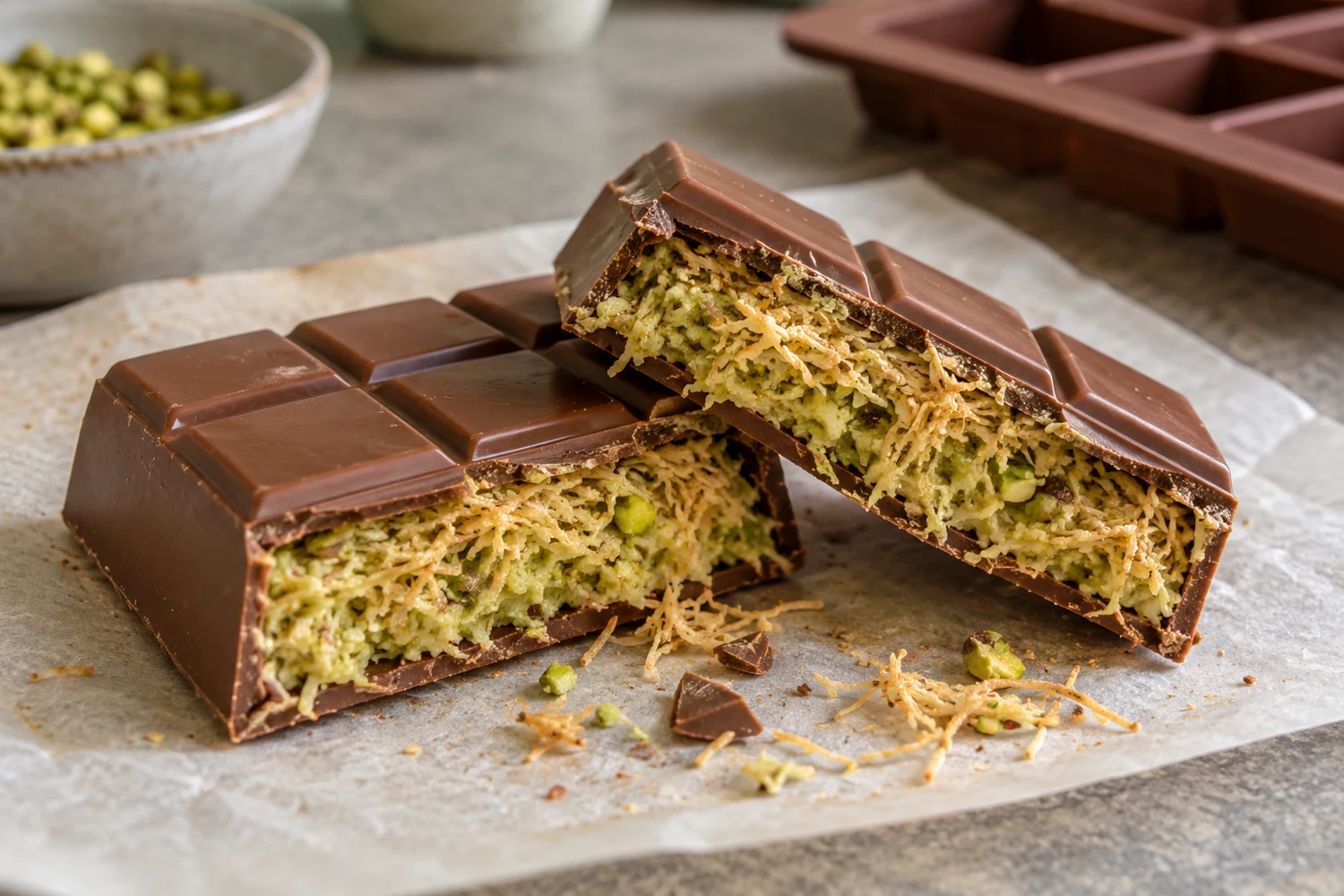
Dubai-style chocolate combines a chocolate shell with a pistachio filling containing crisp strands of kataifi pastry. Making a home version involves two separate jobs: cooking the pastry evenly and getting the chocolate to set around the filling. This guide explains a researched approach; The Press has not kitchen-tested it or verified a particular bar yield.
For an Irish home kitchen, ingredient labels matter as much as the appearance of the finished bar. Raw pastry, ready-to-use toasted pastry, sweetened pistachio spread and pure nut paste are different products. Choose a complete method suited to the ingredients you buy rather than treating them as automatic substitutes.
Plan the filling before the mould
Pastry manufacturer Antoniou’s pistachio-kataifi filling method, dated 8 July 2024 and checked on 21 October 2026, uses 100g kataifi pastry and 230g pistachio crema or paste, with optional tahini. It describes this as one heaped cup of filling, rather than a fixed number of bars.
Check the pastry packet’s storage, thawing and cooking instructions first. For the manufacturer’s dry-pan approach, shorten the strands to roughly 1cm, loosen clumps and spread them without crowding the pan. Keep them moving over medium heat until evenly deep golden and crisp, then transfer them out of the hot pan. The published guide gives about five to ten minutes, but that is a guide to its method, not a guarantee for every pastry or hob. Combine with the pistachio ingredient and optional tahini as directed.
Do not skip cooking raw pastry. Equally, do not assume a ready-to-use toasted product needs exactly the same treatment. Match the packet and recipe before starting.
Give the chocolate a separate plan
Choose chocolate suitable for the moulding method and use the amount required by that method and mould. Filling volume alone cannot tell you how much shell chocolate you need.
Callebaut’s tempering guidance explains why tempering helps chocolate set with a firm snap and release from a mould. Melting and tempering are different operations. Follow the chosen chocolate’s stated temperature curve and the full technique; a single temperature copied from a dark-chocolate recipe may not suit milk or white chocolate.
Coat the mould, let the shell set, add filling while leaving space for the base, then seal and allow it to set before releasing it. Avoid packing in so much filling that the closing layer cannot meet the shell’s edges. For a version without a bar mould, Antoniou publishes a separate mini chocolate-cup method using paper liners, a set chocolate coating, filling and a final chocolate layer. Use that recipe’s quantities and format rather than assuming a bar mixture produces the same number of cups.
Check every allergen label
The FSAI’s allergen guidance identifies pistachio nuts, sesame, milk and cereals containing gluten among the allergens that require attention. Here that means checking pistachio spread, sesame-based tahini, milk chocolate and wheat-based kataifi, as well as any soya or other allergens declared on the actual packs.
Keep the ingredient packaging if sharing the chocolates. Changing to dark chocolate does not establish that the whole recipe is milk-free, and leaving tahini out does not establish that other ingredients are free from sesame cross-contact. Do not describe the finished food as suitable for an allergy based only on the recipe name.
Store according to the ingredients, not a viral shelf-life claim
Follow each ingredient’s after-opening instructions and any finished-recipe storage directions. A long shelf life stated for a professional formulation does not validate a different homemade mixture, especially after adding fresh cream or other perishable ingredients.
Safefood’s household fridge guidance says to keep the fridge at 5°C or below and use clean, covered containers to prevent cross-contamination. Its general advice is to refrigerate cooked leftovers within two hours and eat them within three days. That is not a tested shelf life for this chocolate: do not keep it beyond a shorter ingredient instruction or use-by date.
Check recall notices before using or eating a product. The FSAI’s 29 September 2026 Alyan chocolate recall covers the named 100g Dubai Style Crunchy Knafeh and Pistachio Milk Chocolate, all best-before dates, because of Salmonella. It advises consumers not to eat the implicated product. This concerns that identified product; it does not establish that all pistachio spreads or homemade chocolate are affected.


Join the conversation
Keep it kind, relevant and constructive. Comments are reviewed before they appear.
Be the first to share a thought.