

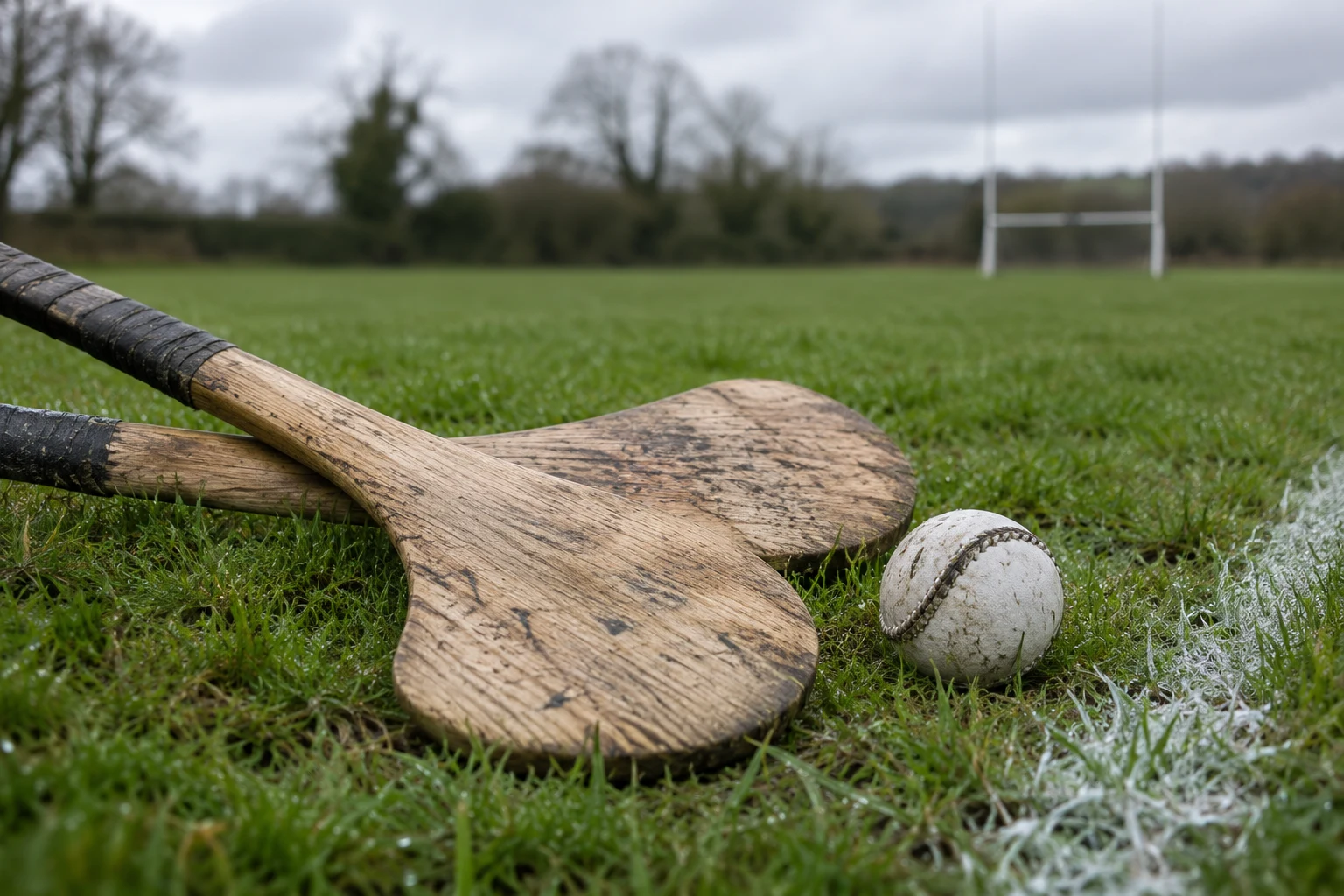
Loughrea won a third successive Galway senior hurling championship on Sunday, 1 November, after two late Tiernan Killeen points turned a one-point deficit into a 0-17 to 0-16 victory over Tommy Larkins at Pearse Stadium in Salthill.
The champions had been six points behind during the first half and were still trailing as the contest moved towards its conclusion. Jamie Ryan finished with eight points and Killeen with five, giving Loughrea the scoring platform to retain the county title despite a sustained challenge from their opponents.
The result is confirmed in the GAA’s county-final report, published on Sunday afternoon. The Press checked that account against independent reporting and scoring records on Monday, 2 November. This report includes analysis of the published figures rather than claiming first-hand attendance at the match.
Six points down, with the title defence under pressure
RTÉ’s report from Pearse Stadium describes a strong Tommy Larkins start, with Jason Flynn and Conor Gardiner supplying early points. Kevin McHugo’s two scores helped the challengers build a 0-9 to 0-3 advantage before the interval approached.
Loughrea goalkeeper Gearóid Loughnane also made important interventions as Larkins created goal opportunities. The absence of a goal on the final scoreboard should not be mistaken for an absence of chances: the match accounts describe opportunities at both ends that did not become goals.
Loughrea reduced the damage before half-time, reaching the break 0-10 to 0-7 behind. That distinction matters to the shape of the game. Their recovery did not begin with a single late intervention; they had already cut the deficit in half before returning for the second period.
For Tommy Larkins, the interval brought an advantage but less separation than their best spell had threatened to produce. For Loughrea, it left a championship still within reach rather than a six-point chase to undertake from the restart.
A level finish became a one-point decision
Galway Bay FM’s contemporaneous score updates record the sides level at 0-15 apiece before Flynn’s late free moved Tommy Larkins ahead. Killeen then supplied the equalising point and the score that established the winning margin.
Ryan’s second-half contribution had helped bring Loughrea into that position. The GAA account identifies his sequence of points as central to the champions moving from behind into contention for the lead. The final was therefore shaped by two complementary contributions: Ryan’s sustained accumulation and Killeen’s decisive finish.
It would oversimplify the result to describe the last score as the whole comeback. The first-half reduction, the second-half levelling and the final pair of points were separate stages. Tommy Larkins repeatedly remained capable of answering, which is why the title was still unresolved so late.
The outcome nevertheless comes down to a clear scoring fact. With neither team registering a goal, Loughrea’s seventeenth point was enough. The final margin was the minimum possible in this contest, and Tommy Larkins could not find another score to cancel it.
A 10-6 second half changed the balance
The interval and full-time scores allow another straightforward comparison. Loughrea went from seven points at half-time to 17 at the finish, adding ten. Tommy Larkins went from ten to 16, adding six. The champions therefore won the second-half scoring by four points, enough to erase a three-point deficit and finish one ahead.
That is a measure of the whole second period, rather than proof of uninterrupted control. The documented exchanges included level scores and a renewed Tommy Larkins lead. Loughrea’s advantage across the half was assembled in a contest that continued to change direction.
It also distinguishes this win from the 2025 final, when Loughrea had a five-point interval lead and finished one ahead. In the two most recent deciders, the same final margin followed opposite half-time positions. The historical comparison supports a narrower conclusion than a claim of dominance: the champions have found ways to finish ahead from both a position of advantage and a position of pressure.
Ryan and Killeen supplied 13 of the champions’ 17 points
The local broadcaster’s published scoring list agrees with the GAA and RTÉ on the principal contributions. Ryan scored 0-8, including four frees, a 65 and a sideline score. Tiernan Killeen contributed 0-5.
Anthony Burns, Vince Morgan, Cullen Killeen and Caimin Killeen added a point each. Those six scorers account for the full Loughrea total. Ryan and Tiernan Killeen together supplied 13 points, or approximately 76.5% of the champions’ scoring, calculated from the published breakdown.
Flynn matched Ryan’s eight-point total for Tommy Larkins. McHugo added two, while Conor Gardiner, Conor Slattery, Éanna Murphy, Cian Daniels, Adrian Moran and Ronan Murphy scored one apiece. Flynn’s contribution was exactly half of his side’s 16 points.
These proportions describe scoring concentration, not the complete contribution of any player. They do not measure defending, possession won, saves, assists or the work that created an attempt. They do show how strongly each attack depended on its leading scorer, and how Killeen’s additional five points distinguished Loughrea’s final tally.
More attempts did not bring more scores
The GAA report records 17 successful scores from 33 Loughrea attempts, against 16 from 37 for Tommy Larkins. On those figures, the champions converted approximately 51.5% of attempts and their opponents approximately 43.2%, a difference of about 8.3 percentage points.
Loughrea therefore produced one more score from four fewer attempts. The useful comparison is between opportunity and return: Tommy Larkins generated a larger recorded total of attempts, but that advantage did not survive the conversion into points on the scoreboard.
This is a calculation from reported match figures, not a separate shot-by-shot study by The Press. It does not establish that every attempt had equal difficulty, that every unsuccessful effort was a wide, or that shooting alone explains the result. Goal chances, blocks and the circumstances of individual attempts cannot be reconstructed from the aggregate totals.
Even with those limits, the figures help explain why a team could spend important periods in front yet lose narrowly. Creating a lead and making it secure are different tasks. Loughrea’s late points mattered because the challengers’ earlier opportunities had not produced a decisive gap.
The group-stage result had favoured Tommy Larkins
The finalists had already met during the championship. Galway Bay FM’s preview, published before Sunday’s match, records a 3-17 to 1-16 group-stage victory for Tommy Larkins. In points equivalents, that was 26 to 19, a seven-point difference.
The final reversed the winning team and reduced the margin to one point. It illustrates why an earlier meeting provides context rather than a forecast that can be carried unchanged into a decider. Sunday required a fresh result, and the champions found it after having previously lost this particular matchup.
The same preview outlines Loughrea’s passage through Castlegar, Athenry and Craughwell in the knockout stages. Tommy Larkins came through Turloughmore and then an extra-time semi-final against Clarinbridge, won 2-26 to 1-27.
Those routes explain why both teams reached Salthill with substantial championship evidence behind them. Tommy Larkins’ challenge was supported by results rather than simply by the possibility of an upset. Loughrea’s defence of the title had already required them to negotiate additional knockout opposition after the group phase.
Three county finals, four points between the teams in total
The current sequence began with Loughrea’s 2024 final victory over Cappataggle. They won 1-15 to 0-16 at Kenny Park in Athenry on 10 November 2024, ending a wait for the county crown that stretched back to 2006.
That report identifies a late Anthony Burns goal and a Loughnane penalty save among the important moments. It was a two-point victory after converting the goal into its three-point value: 18 points against 16.
In the 2025 county final against St Thomas’, Loughrea won 1-15 to 1-14. They had led by five points at half-time, but their opponents narrowed the margin and the championship was retained by one point.
Add Sunday’s one-point win and the three successful finals have winning margins of two, one and one. Combined, Loughrea scored the equivalent of 53 points against 49. That four-point aggregate is The Press’s arithmetic comparison of three distinct matches, not a combined competition result.
The sequence demonstrates sustained success without implying that the finals were comfortable. Different opponents, different venues across the run and different decisive moments produced the same county champion. This time, the necessary intervention came through points rather than the goals that featured in the two earlier winning scorelines.
County success after January’s national final defeat
Loughrea’s recent history also includes the All-Ireland club final against Ballygunner on 18 January 2026. The Waterford club won that Croke Park match 1-20 to 1-14. It belongs to the previous club campaign and is separate from Sunday’s Galway final.
That distinction prevents a misleading reading of the latest achievement. Loughrea have retained their county championship; Sunday’s result does not itself award an All-Ireland title. Nor does a comparison with January establish how a future national-stage match will finish.
What is settled is the county result and the continuation of the title-winning run. Tommy Larkins took the champions into a final that remained open to the last exchanges. Loughrea emerged with the trophy because, after recovering from an early six-point deficit, they finished one point ahead when there was no time left to change the outcome.

Join the conversation
Keep it kind, relevant and constructive. Comments are reviewed before they appear.
Be the first to share a thought.