

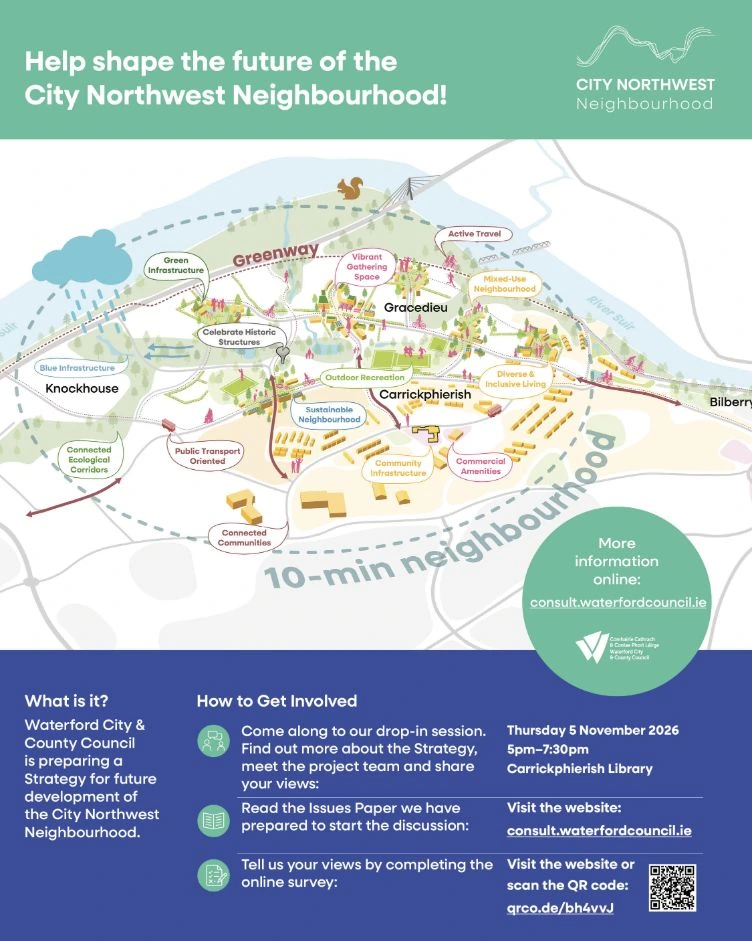
Waterford residents can now comment on two separate neighbourhood strategies covering the city's Northwest and Southwest, ahead of public drop-in sessions on Thursday, 5 November. Both consultations close at 4pm on Friday, 11 December 2026.
The Northwest process covers Carrickphierish, Gracedieu, Bilberry, Knockhouse and surrounding areas. The Southwest process concerns Ballybeg, Kilbarry and surrounding areas. Waterford City and County Council announced the arrangements on 30 October, after the two consultation portals opened on 29 October.
This is an early opportunity to influence the proposals. The council is gathering views before preparing draft strategies; it has not adopted either neighbourhood strategy. Residents do not have to wait for the November sessions to participate, and those unable to attend can use the separate online consultation routes.
Two sessions on the same evening
According to the council's announcement, both drop-in sessions run from 5pm to 7.30pm on Thursday, 5 November:
City Northwest: Carrickphierish Library, Carrickphierish Road, Gracedieu, Waterford City.
City Southwest: BRILL Family Resource Centre, Ballybeg, Waterford, X91 YT38.
The sessions overlap completely. Anyone planning to attend should choose the venue for the neighbourhood they want to discuss. A person with interests in both areas can also read both issues papers and use the appropriate online routes rather than relying on attending both events.
The council's invitation extends to people living or working in the neighbourhoods, community groups and others with an interest in their development. It concerns how the areas should grow, rather than a single building application. That makes everyday experience of local streets, facilities and journeys relevant to the discussion.
What is open for consultation?
The City Northwest consultation page and City Southwest consultation page each identify a pre-draft consultation. Both record an opening time of 4pm on 29 October and a closing time of 4pm on 11 December.
Each process has its own issues paper and survey. The documents set out background information and questions to help people identify priorities. They are a starting point for discussion, rather than the final wording of the strategies.
The distinction matters when reading their maps and illustrations. A diagram showing a possible connection or a neighbourhood vision should be read alongside its explanation and the document's consultation status. It should not be treated as evidence that a particular project has been approved or that a delivery date has been fixed.
People who want to comment on a specific location should check the relevant study-area map first. The neighbourhood names are useful signposts, but the documents provide the more detailed geographic context needed for a submission about a street, site or connection.
Northwest: connecting existing communities with future growth
The Northwest issues paper identifies the future development potential of the Gracedieu whitelands as a particular focus. It says the strategy will recommend zoning for that area and consider residential, transport and social infrastructure.
It also emphasises integration with existing Carrickphierish neighbourhoods and stronger connections between Gracedieu and the city. These are proposals to be developed through the planning process, rather than a new zoning decision announced through this consultation.
The paper describes an area with existing homes, employment and community facilities alongside land with development potential. It identifies limited connections between some existing cycling routes and neighbourhoods as an issue for consideration.
For someone preparing feedback, the useful question is how a particular connection would serve daily life. A comment could distinguish a missing link to a school or library from a recreational route, explain who would use it and identify what currently makes the journey difficult. That is a way to make a suggestion specific; it does not imply the council has agreed to build it.
Southwest: regeneration and access within an established area
The Southwest issues paper puts particular emphasis on brownfield regeneration, the needs of existing and future communities, and improved accessibility and mobility.
It places the neighbourhood in the context of Kilbarry Nature Park, SETU's expanding campus and the emerging Glassworks campus. Those references explain the council's wider planning context. They do not turn the present consultation into a fresh announcement that any of those separate developments has been completed.
The paper identifies limited internal east-west connections, with Ballybeg Drive and Lacken Road acting as important routes between neighbourhoods. It also discusses the relationship between growth, public spaces and existing community facilities.
Residents can therefore consider connections across the neighbourhood as well as routes into the city centre. A useful account might describe whether a destination is physically close but difficult to reach, or whether a route works for a confident adult cyclist but presents different difficulties for someone walking with children or using a mobility aid. These are examples of the detail a reader could provide, not findings from interviews conducted by The Press.
Four themes, with room for other concerns
The papers organise discussion around land use and sustainable growth, public spaces and amenities, movement and connectivity, and the environment and climate resilience. They also welcome relevant observations beyond their suggested questions.
A practical way to approach those themes is to separate the place from the outcome. For a public-space suggestion, identify the location and explain what it should enable: somewhere to meet, a more accessible route, recreation or a connection to another facility. For housing-related feedback, explain the community need and the services or infrastructure that should be considered alongside it.
For movement, describe a complete journey rather than only one junction. The start, destination and point where the route becomes difficult can help explain why a proposed improvement matters. For environmental concerns, identify the feature or connection that should be considered and explain its relationship to the wider neighbourhood.
These examples are ways to organise feedback. They are not additional requirements imposed by the council, and readers should follow the instructions on the official consultation they choose.
How to send views without attending
The council links to a Northwest online survey and a separate Southwest online survey. Check the neighbourhood heading before completing either, particularly if following a forwarded link.
The issues papers also list written submission options. The Northwest email address is citynorthwest@hubplanning.ie; the Southwest address is citysouthwest@slrconsulting.com. The different addresses are another reason to check that feedback is going to the intended project.
Both papers give the postal address as Planning Department, Waterford City and County Council, 1st Floor, Menapia Building, The Mall, Waterford, X91 PK15. When writing, clearly identify whether the submission concerns City Northwest or City Southwest.
For any route, keep a copy of what was sent and any confirmation received. Someone posting a response should allow time for delivery before the closing deadline. The council's live consultation pages remain the place to check current submission instructions and any changes before sending.
Preparing a useful response
Start by reading the paper for the correct area, then list the two or three issues you most want the future strategy to address. A focused response can explain the practical effect of each issue without attempting to answer every prompt.
For each point, a clear structure is:
1. Locate it. Name the street, route, public space or part of the neighbourhood.
2. Describe the present experience. Explain what works or what creates difficulty, keeping observations distinct from assumptions.
3. Explain who is affected. Describe the type of journey or activity involved without identifying another person's private circumstances.
4. Suggest an outcome. State what an improvement should achieve, while leaving room for the project team to consider design options.
5. Identify a priority. Explain which change would make the greatest difference and why.
A group response can use the same structure while explaining which shared concerns it represents. It should avoid presenting an individual's experience as the view of an entire neighbourhood unless there is a basis for doing so.
There is no need to turn a planning submission into a technical design document. Clear locations, reasons and priorities are more useful than an unsupported claim that a particular scheme is guaranteed to succeed. Equally, observations about a facility that already works well can explain what should be retained as an area changes.
What happens after this stage?
Both papers describe the strategies as non-statutory. They say the work will inform future statutory plans and contribute to a variation of the Waterford City and County Development Plan 2022–2028. The current exercise should therefore be understood as part of a longer planning sequence.
The indicative schedules place the issues-paper consultation and initial findings in the July–December 2026 stage. Preparation of draft strategies and further consultation is shown for January–May 2027, followed by a June–July 2027 stage involving any required material amendments and final strategy adoption. These are the documents' planned stages, not a promise that building work will begin in July.
Both also describe transport planning and environmental work alongside the strategies. The present papers do not establish that every future intervention has passed all assessments or secured funding. When later drafts appear, readers can compare them with the issues they raised and check how priorities, routes and proposed land uses have developed.
For now, the immediate dates are straightforward: the two drop-ins are on 5 November, and written or online participation remains open until 4pm on 11 December. The practical next step is to open the correct neighbourhood's consultation page, review its paper and choose the feedback route that suits.

Join the conversation
Keep it kind, relevant and constructive. Comments are reviewed before they appear.
Be the first to share a thought.