

An “excellent” bathing-water classification and an old sample date can appear together without either being a mistake. They answer different questions. Confusing them is particularly unhelpful in October, after Ireland’s designated bathing season has ended.
We compared the EPA’s public explanation with its open-data documentation. A useful local water-quality note has three separate entries: the annual classification, the most recent sample and any relevant warning or restriction. None should silently stand in for the others.
The annual grade looks backwards
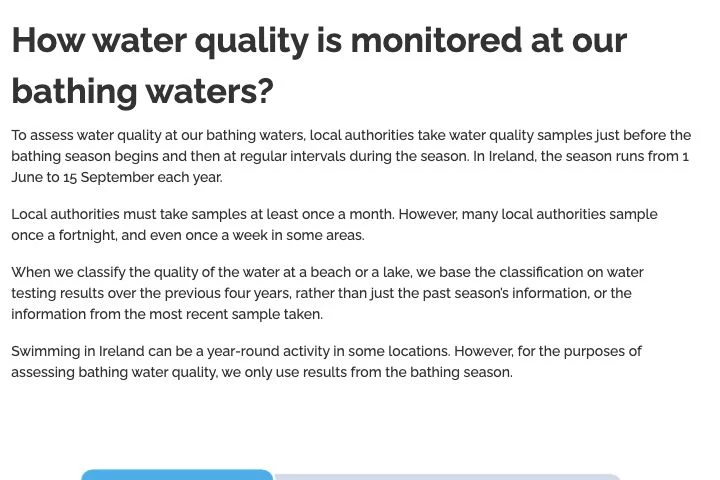
The EPA’s bathing-water explanation says classifications use results over the previous four years, rather than only the most recent sample or season. The categories are Excellent, Good, Sufficient and Poor.
Ireland’s designated season runs from 1 June to 15 September. Local authorities arrange monitoring and investigate pollution incidents; the EPA regulates their performance under the bathing-water rules. A historical classification is not a guarantee of conditions on the day someone intends to enter the water.
A sample has its own date and scope
The EPA’s open-data caveats distinguish Locations, Measurements and Alerts. Locations include annual classifications for identified bathing waters. Measurements describe individual samples, including tests for E. coli and intestinal enterococci.
The documentation separates in-season and out-of-season measurements. It says out-of-season reporting, for dates from 16 September to 21 May, is voluntary and at the local authority’s discretion. Those results are informational and are not used in the annual classification.
This means “no recent winter result displayed” should not be rewritten as either “the water is clean” or “the beach failed”. It may be an information gap. Equally, a recent sample is a sample from a particular point and time, not continuous monitoring of the whole coastline.
Check warnings as a separate layer
The EPA documentation distinguishes a Prior Warning of a possible impact, Advice Not to Swim and Do Not Swim restrictions. Read the actual notice and its dates. A general annual grade should not be used to dismiss a current local instruction.
For a community page, record the classification year, sample collection date and official notice status with the time you checked. Keep a link to the current local-authority information rather than copying a screenshot without its date.
Water-quality information also does not decide whether waves, tides, cold, access or other physical conditions are safe. Check those independently and follow local safety instructions. This article does not recommend entering the water at any particular site; it explains how to read the evidence without turning a historical grade into a present-day assurance.
Join the conversation
Keep it kind, relevant and constructive. Comments are reviewed before they appear.
Be the first to share a thought.