

Finding an animal in difficulty creates an immediate practical question: who needs the information? A rescue service, disease-surveillance team and local authority do different jobs. Sending a message to one does not guarantee that another has been contacted.
We compared Kildare Wildlife Rescue’s current helpdesk instructions with the Department of Agriculture’s wild-bird guidance. The resulting reporting record keeps those routes separate and avoids asking the public to diagnose or handle an animal.
Observe safely before contacting help
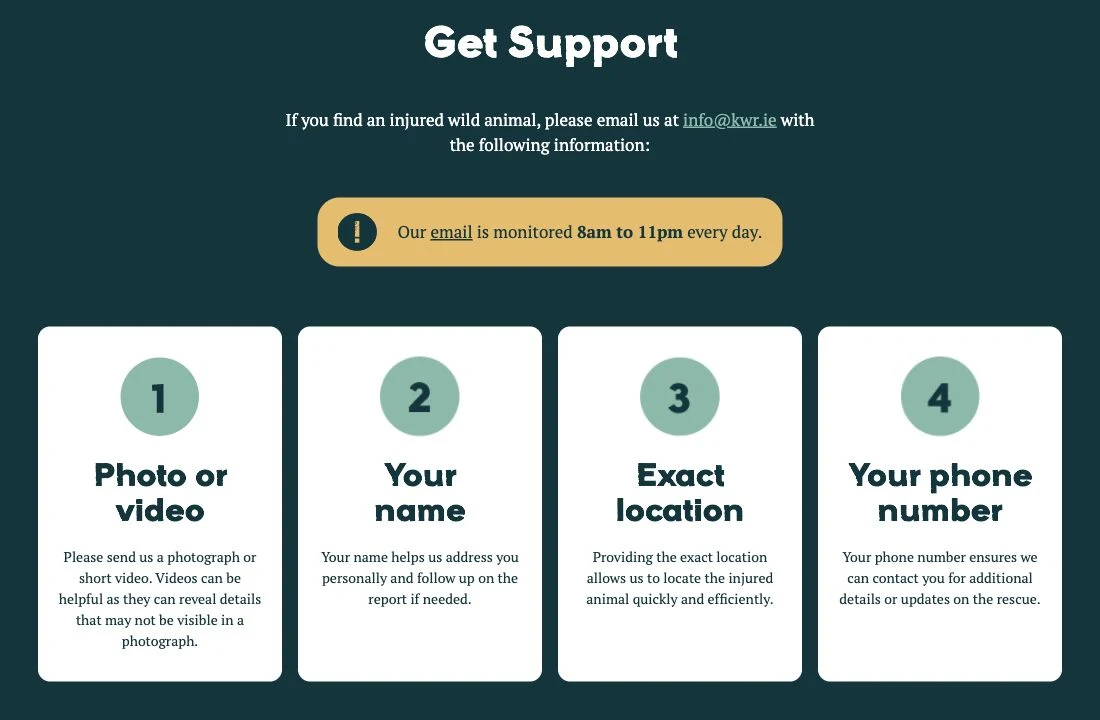
Kildare Wildlife Rescue’s emergency page asks for a photograph or short video, the observer’s name, exact location and a phone number. Its email helpdesk is monitored from 8am to 11pm daily. It says social-media messages are not monitored and it does not have a public phone number.
Photographs and video should be taken only from a safe position. Do not enter traffic, approach a dangerous animal or disturb wildlife to improve a picture. Record what you can actually see, such as an animal being unable to move away, rather than inventing a diagnosis.
The rescue’s guidance says not to feed an animal unless instructed. Large birds and predatory mammals require trained responders. Contact a suitable rescue or vet for instructions before attempting containment or transport; do not arrive unannounced assuming every facility can accept every species.
Sick or dead wild birds require extra care
The Department’s avian-influenza guidance advises the public not to pick up or touch sick, dead or dying birds and to keep pets away. Dogs should be on a lead where sick or dead wild birds are present. Do not bring sick wild birds home.
Its Avian Check route supports targeted disease surveillance. Reporting a bird does not mean it will be collected for testing, and the Department says it cannot provide treatment for sick wild birds. A disease report therefore does not replace a request for professional rescue advice.
We are not reporting a new outbreak or identifying disease in any pictured animal. These are the standing public reporting distinctions in the current guidance.
Keep three outcomes on the record
Write the observation time and location, then record separately: rescue advice requested; disease report made where relevant; and removal enquiry if a dead animal is on public land. The Department identifies the local authority’s role in disposing of dead birds on public land.
Keep the responder’s instructions and any reference number. For an urgent problem outside a rescue helpdesk’s hours, check the local vet’s published out-of-hours route. Do not assume that an unanswered social-media message has been assessed or that a report guarantees attendance.
Join the conversation
Keep it kind, relevant and constructive. Comments are reviewed before they appear.
Be the first to share a thought.