

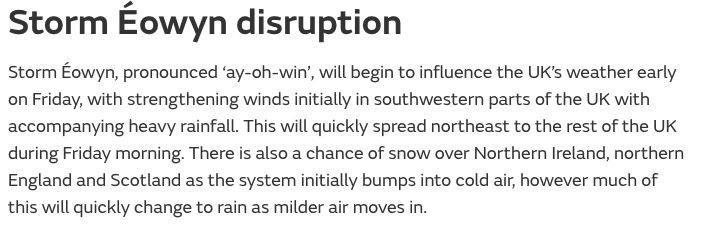
Éowyn is pronounced “ay-oh-win” in the Met Office’s own storm announcement. That spelling comes from its original notice of 21 January 2025, rather than a pronunciation guessed from the written name.
This is a language and storm-naming guide, checked on 20 October 2026. Éowyn belongs to the January 2025 event; the old notice and the historical excerpt pictured here are not forecasts for this week.
Use the dated original for the pronunciation
The original notice supplies the three-part spelling directly. Read it as ay, oh, win. Keeping the original source beside a pronunciation answer matters because a familiar-looking name can invite different guesses, and an old weather announcement can circulate again without its date.
If someone shares an Éowyn forecast, check when it was issued before acting on its references to “Friday” or “Saturday”. Relative days in a January 2025 notice do not describe the coming weekend in October 2026. A pronunciation explanation and a live warning answer different questions.
The names come from a shared programme
Met Éireann’s current storm-naming explanation, published on 1 September 2026, describes its partnership with the UK Met Office and the Netherlands’ KNMI. Each partner contributed seven names to the 21-name list for the season running from 1 September 2026 to 31 August 2027.
The Irish selections include names connected with the service’s history, alongside public suggestions. Austen recognises the first director of the Irish Meteorological Service, Austen Nagle; Heather, Laoise and Phelim came from public nominations. The list is therefore more than a catalogue of familiar Irish spellings.
A storm is named when it could have medium or high impacts in one of the partner countries. The service expecting the greatest impact, or likely to be affected first, names it. The purpose is to keep public communication consistent; a name can help people recognise that forecasts and safety messages concern the same weather system.
A name does not replace the warning details
Met Éireann’s warning-system explanation says impacts depend on factors including location, timing, ground conditions and the duration of the weather. Its colour levels distinguish localised danger at Yellow, dangerous or disruptive conditions at Orange, and extremely dangerous or destructive conditions at Red.
Knowing a storm’s name does not tell a reader the affected counties, the hazard or the hours when a warning applies. Equally, a warning can matter to a person’s plans even if the name is unfamiliar. Read the actual message rather than using the name as a severity score.
For plans now, open Met Éireann’s current warnings and check the relevant place, validity period and any updates. Keep the dated Éowyn notice for the historical pronunciation; use the current warning service for current decisions.
Historical screenshot: Met Office pronunciation passage from 21 January 2025, captured and cropped on 20 October 2026, then converted to WebP. © Crown copyright. Contains public sector information licensed under the Open Government Licence v3.0, under the Met Office’s website reuse terms. It is an archival excerpt, not a current forecast or an endorsement of The Press.
Join the conversation
Keep it kind, relevant and constructive. Comments are reviewed before they appear.
Be the first to share a thought.