

A house deposit is one part of a home-buying budget. The mortgage a lender is prepared to offer, the cash needed to complete the purchase and the ongoing cost of owning the property are separate checks. Starting with an advertised price and multiplying it by 10% leaves important questions unanswered.
This guide checks published rules and official price data on 20 October 2026. It explains the general framework, rather than deciding a reader’s eligibility or recommending a mortgage.
Deposit and income limits work together
The Central Bank’s current mortgage measures normally require first-time and subsequent home buyers to provide at least a 10% deposit. Buy-to-let buyers normally need 30%. For ordinary home-purchase lending, the loan-to-income ceiling is four times gross income for first-time buyers and 3.5 times for subsequent buyers.
A simple illustration shows why the deposit alone is not enough. On a hypothetical €300,000 purchase, 10% is €30,000, leaving a €270,000 mortgage. Four times an illustrative gross income of €60,000 is €240,000. The resulting €30,000 gap would remain even before purchase costs. This is arithmetic to explain the two limits, not a loan offer or an assessment of any household.
The Central Bank allows a limited share of lending above its limits, and some loan types have exemptions. Its current page also explains the 2026 treatment of qualifying principal-home bridging loans. Do not assume an exception applies to an ordinary purchase or build a budget around receiving one. A lender’s own assessment still matters.
The price is not the complete cash requirement
The CCPC’s mortgage guide identifies additional costs including legal work, stamp duty, registration, valuation, insurance and moving expenses. It also distinguishes a lender’s valuation from a structural survey assessing the building’s condition.
Get written estimates for the services relevant to the property and check what each includes. A deposit calculation does not reveal repair needs, shared-building charges or the cost of making a home usable. Keep a separate allowance for those enquiries and for moving, rather than treating every euro available as part of the purchase deposit.
When comparing mortgages, look at total repayments, the term and the conditions alongside the initial monthly payment. The CCPC explains that fixed-rate loans can have early-repayment charges and that cashback should be considered against the borrowing cost. Its public guidance is a starting point for questions to a lender or regulated broker, not a substitute for a personalised assessment.
What “cheaper county” means in the CSO figures
The CSO’s August 2026 property-price release, published on 13 October, reports these median prices for household dwelling purchases over the 12 months to August 2026:
The State median was €400,000. In Dublin it was €500,000, compared with €480,000 in Wicklow, €450,000 in Kildare and €199,000 in Longford.
Longford had the lowest county median in that period. This is a selected comparison, not a complete county ranking. These figures combine houses and apartments, and new and existing dwellings; they are not estimates for the same type of home in every place.
A median is the midpoint of recorded purchases, not the cheapest property currently on sale. The CSO cautions against using median prices to measure price trends because the mix of properties sold changes. Its Residential Property Price Index serves that separate purpose. The latest three months of index results are provisional.
Compare a property and a journey, not just two medians
Use county data to organise a search, then compare actual addresses. Ask whether the home’s condition, size and access suit the intended use. Check the journey to work and essential services, including the cost of any additional travel. A lower purchase price can still come with substantial work or transport spending.
The useful next document is a full purchase budget: the agreed price, confirmed lending position, cash contribution, itemised completion costs and known work on the home. Keep assumptions visible and ask the appropriate lender, solicitor or surveyor to resolve the parts that depend on the individual transaction.
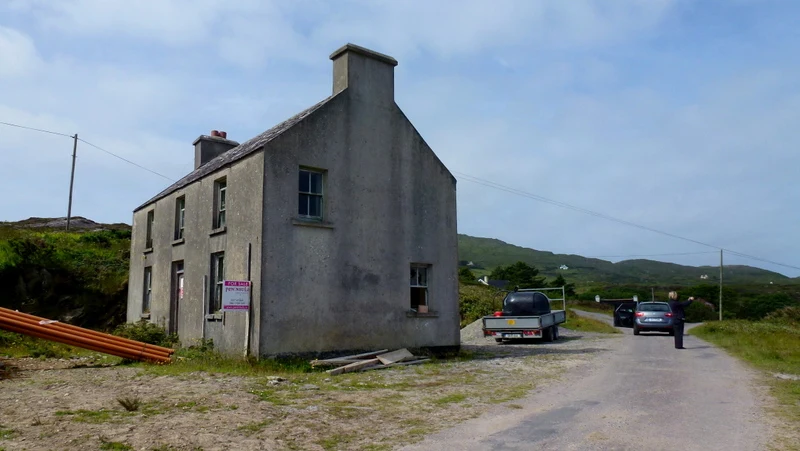
Archive photograph: Jonathan Billinger’s house-for-sale photograph at Gortduff, Goleen, County Cork, taken on 1 July 2013, under CC BY-SA 2.0. Converted to WebP; the same licence applies. It illustrates a specific dwelling and the need to assess condition, not a current listing, valuation or example of a county median.
Join the conversation
Keep it kind, relevant and constructive. Comments are reviewed before they appear.
Be the first to share a thought.