

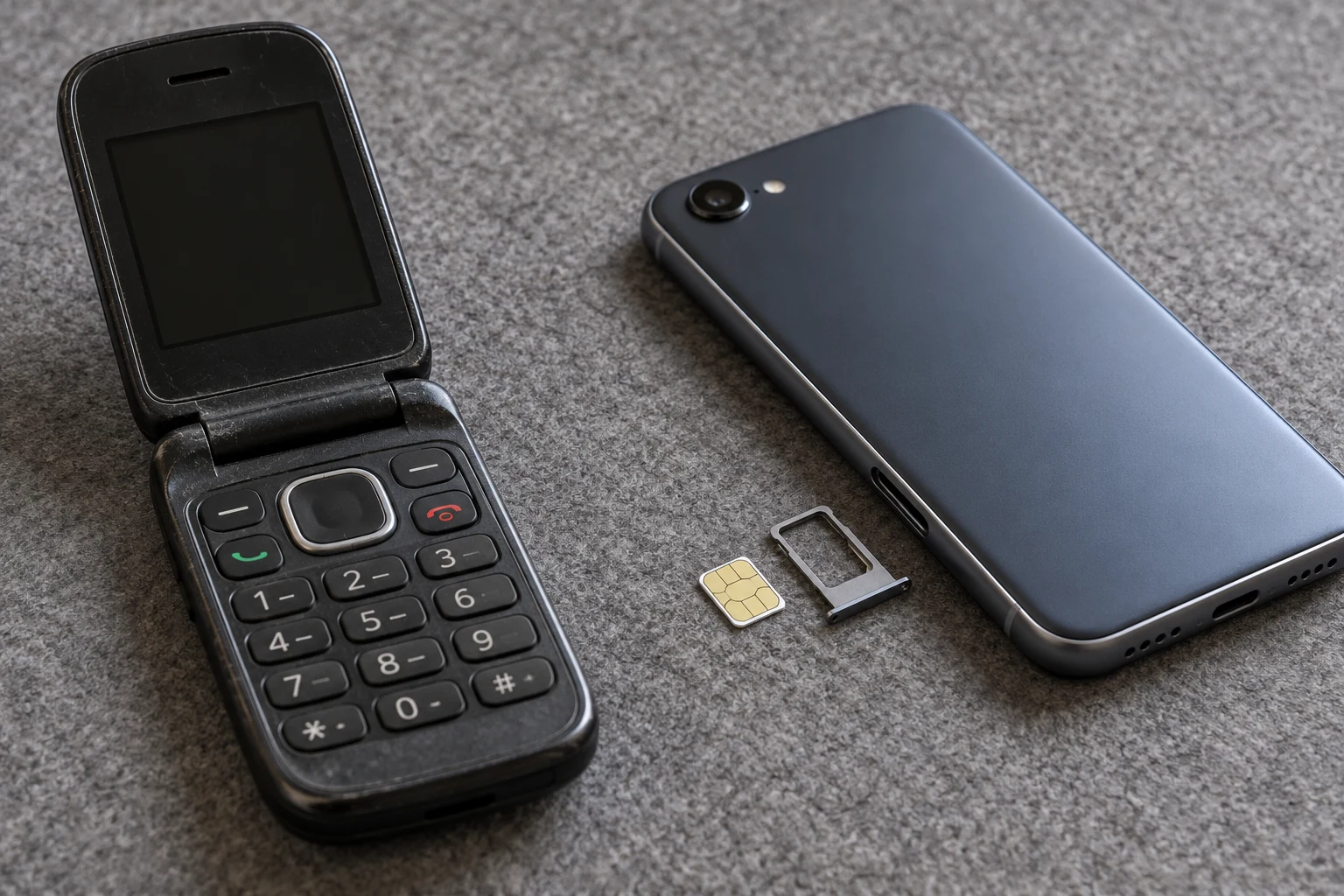
Eir’s phased 3G retirement has reached its southern-county stage, according to a new ComReg notice dated 29 October 2026. The regulator says that stage began on 28 October and that complete retirement is planned for November. Eir, GoMo and Lyca Mobile customers using older phones or connected equipment should check the device and SIM with their provider rather than assume that every service will continue unchanged.
For people already using a suitable 4G or 5G phone, the change is unlikely to require a replacement handset, ComReg says. The more important checks concern older equipment, older SIMs and devices whose mobile connection is less obvious, including payment terminals, security systems and monitored care alarms.
This guide was checked on 30 October against the regulator’s new notice, its broader retirement guidance and operator information. It explains what is confirmed, where the published timetable is inconsistent and how to ask a supplier the right questions. It is not a report of live network testing or a compatibility verdict on any individual device.
What has changed, and when?
ComReg’s notice describes a sequence beginning in Donegal on 1 October. The north, west and east regional phase followed from 14 October, with Dublin, Meath and Louth from 21 October. Southern counties followed from 28 October. These are the dates of the phased programme, not events that all happened on the date this article was published.
The regulator’s general 3G retirement guide gives 6 November as the end of the phased period. Eir’s own switch-off information page also says in its introductory timetable that the process runs until 6 November. However, the same operator page’s 28 October entry says the southern counties are retired and all 3G services are switched off.
Those statements do not provide one consistent confirmation of the exact nationwide completion date. The reliable practical approach is to treat the retirement as under way, check the current operator advice for the service you use and avoid relying on an assumed final grace period. This article does not claim that every eir 3G service has already ceased everywhere, or that any particular device will remain connected until 6 November.
Why GoMo and Lyca customers are included
ComReg identifies GoMo and Lyca Mobile as services using the eir network. A customer does not have to receive a bill carrying the eir name for this particular network change to matter. Check the service provider associated with each SIM, including a SIM installed inside equipment rather than a phone.
That does not mean all Irish mobile networks are following the same timetable. ComReg’s general guide records that Vodafone retired its 3G network in October 2024 and says providers undertake retirement on their own schedules. The current notice concerns the eir network and the services ComReg names as using it.
If you have more than one mobile service, assess them separately. A working personal phone is not proof that a tracker, business terminal or relative’s handset uses the same network or has the same technical capabilities. The useful starting point is a short list of the devices and the provider serving each one.
Check the handset, the SIM and the settings separately
Eir’s advice identifies several possible actions: enabling 4G or 5G in the device’s network settings, installing current software, replacing an older SIM or moving to a compatible device. These are different issues. Buying a newer phone is not automatically the answer to all of them.
Start by finding the exact model in the device information or its documentation. Ask the mobile provider whether that model and the SIM you are using are suitable for the service after retirement. Check both mobile data and calls in that conversation, rather than treating a general statement that a phone is “4G” as a complete explanation of how every function will operate.
Where the provider recommends a settings or software change, use the instructions for that model. Menu names differ, so a generic online walkthrough may not match the handset in your hand. If you cannot identify the relevant setting, ask for guidance rather than making unrelated changes or assuming the phone must be replaced.
Eir says an older eir SIM may need replacing and offers a replacement free of charge through its listed store or online routes. Use the links on the operator’s own switch-off page for that process. A SIM replacement and a handset purchase are separate matters; establish which action the provider says is needed before accepting a new purchase or contract.
Will calls and texts still work on an older phone?
The distinction between voice and mobile data matters. ComReg says older devices supporting 2G and 3G can continue making and receiving calls over 2G, while data performance is affected. That is not a guarantee that every application or connected service will remain usable.
GoMo’s switch-off booklet describes calls and texts moving to 2G for affected older devices, with quality potentially varying. It says 3G data services stop and directs customers whose phones do not support 4G or 5G to a compatible device if they need continued data access.
For someone who mainly uses calls, the questions may differ from those of someone who relies on messaging apps, maps or a browser. Explain the functions you actually use when seeking support. A successful ordinary call does not establish that the mobile data connection or an app-dependent feature is working as before.
Likewise, a phone that looks old is not enough evidence to decide compatibility. Nor does a modern appearance prove that the SIM, software and settings have been checked. The model and service details are more useful than the shape of the handset.
Look beyond the mobile phone
ComReg’s general guidance lists equipment that may be affected, including some vehicles, monitored care alarms, security and fire alarms, card payment terminals, inventory and GPS trackers, smartwatches, e-readers, automated gates and heating systems. This is a list of possible device types, not a statement that every product in each category depends on 3G.
For each relevant item, ask the supplier or maintainer how it communicates, whether it uses a mobile SIM and whether it relies on the retiring service. Give the exact model through the supplier’s normal support channel and ask whether an update, SIM change or equipment replacement is needed. A device that appears to be operating locally may have a separate communication function that needs checking.
For monitored care or safety equipment, seek confirmation from the organisation responsible for supplying or maintaining it. Do not infer continued monitoring from the fact that another phone in the home can make a call. The supplier is the appropriate source for its supported testing procedure and any action required; a general telecoms guide cannot certify that system.
A business using a payment terminal should similarly check the specific terminal and connection with its service supplier. Ask what action is needed for that installation and how completion will be confirmed. The aim is a device-specific answer, not a blanket assumption that all terminals require replacement.
What GoMo says customers should do
GoMo’s booklet says most customers should see no impact and that it will contact people who need to act. Its suggested checks include enabling 4G or 5G where supported and keeping device software current. It also directs customers with alarms, trackers, medical devices or cars relying entirely on 3G to their equipment provider.
The booklet says using 4G or 5G does not add a usage cost once the customer has a compatible phone and SIM. That statement should not be turned into a promise of a free replacement handset or a particular offer. If an equipment purchase is proposed, ask what it costs and whether it changes the existing service commitment.
The booklet’s references to starting on 1 October describe the beginning of the programme. Read them alongside the current phased information rather than treating that introductory date as proof that the entire national change occurred on one day.
A useful record to make before contacting support
For a household, keep a private note of the device model, mobile provider, the function you need and any message received from the provider. Record whether the issue is a settings question, an older SIM or a device the supplier says is incompatible. Keep the answer and any agreed action together so that you can follow up without starting again.
For equipment maintained by another company, include who is responsible for the mobile connection and who is responsible for the hardware. They may need to coordinate. Ask which organisation will confirm that the required change has been completed, rather than assuming that receiving a new component settles the whole issue.
There is no need to publish account numbers, SIM identifiers, an address or medical information to understand this guidance. Use the provider’s official support routes for details it genuinely needs to identify the service. The public information establishes a reason to check equipment; it does not establish the outcome for every reader.
The immediate priority is to confirm what the device uses and what its provider recommends. For many 4G and 5G users, that may amount to checking settings and software. For an older SIM or equipment that depends entirely on 3G, it may require a specific change. Act on that confirmed advice rather than a general assumption based only on the retirement headline.
Join the conversation
Keep it kind, relevant and constructive. Comments are reviewed before they appear.
Be the first to share a thought.