

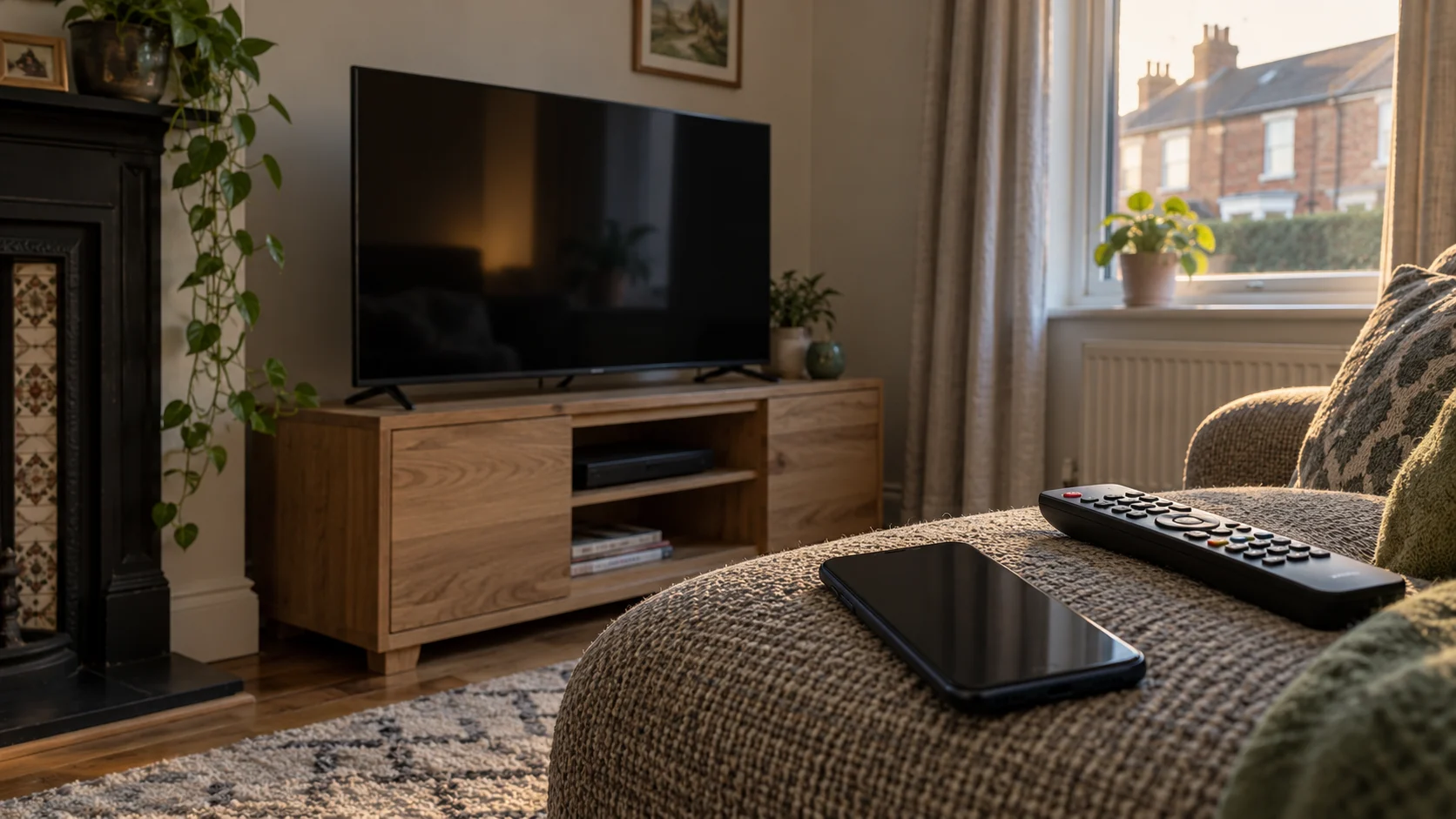
A television licence in the Republic of Ireland currently costs €160. The main question is whether you have a television set or other equipment that falls within the licensing rules, rather than which channel you prefer. Watching only streaming apps on a television is different from watching website streams on an internet-only laptop.
This guide explains the equipment distinction, payment choices, renewal records, moving address and the official route to a free licence. It covers the Republic's system, administered by An Post. Northern Ireland has a different licensing system. The official information linked below was checked on 29 October 2026; this is a practical guide, not an announcement of new legislation.
Start with the equipment, rather than your viewing habits
Section 142 of the Broadcasting Act makes possession of a television set subject to a licence, with exceptions for classes of equipment covered by ministerial orders. Saying that you do not watch a particular broadcaster does not, by itself, answer that equipment question.
The Act's definition of a television set includes apparatus capable of receiving and exhibiting broadcasting services, including arrangements that work with other equipment. A display's marketing name is therefore less helpful than its actual capabilities and connected receiver.
If you are buying a screen for a home office, distinguish a computer display from a television receiver. Keep the product specification so that you can describe the setup accurately if you need clarification. A seller calling something a monitor does not establish what the complete arrangement can receive.
What about Netflix, phones and laptops?
The 2009 exemption order and its explanatory note distinguish devices accessing website streams from equipment receiving conventional television broadcasts. The note gives internet-connected computers and laptops as examples of the former. It also explains that a larger-screen computer equipped with a television tuner or related receiving device is not exempt simply because it can access the internet too.
That is why an internet-only laptop used for streaming and a television used only for streaming apps are different cases. Choosing Netflix or another app does not remove a television set's ability to receive broadcasts. Conversely, watching a programme through a website does not automatically turn an ordinary internet-only computer into a television receiver.
For an unusual setup, identify the model, any tuner and any connected receiving box before contacting the records office. Do not decide from screen size alone: the order's definitions also address the type of reception and the equipment used together.
An Post's general licence FAQ specifically says a monitor connected to a Sky, Virgin Media, Saorview or other digital receiver requires a licence. It also identifies television programmes delivered through services such as Eir TV or Vodafone TV on a monitor. Ordinary website streaming should not be confused with every service delivered over broadband.
Is it one licence per person or per home?
An Post says each separate apartment needs its own licence, and a holiday home containing a television needs a separate licence too. Having paid at your main address does not establish coverage for a second property.
For a shared home, first establish the address and existing licence record. Agree who holds the record, who handles renewal and how the household will divide the cost. These are practical household arrangements; do not assume that one person's streaming subscription is evidence that the premises is licensed.
If accommodation is divided into separate dwellings, ask the records office about the actual arrangement. The Act's definition of premises includes a part of a building occupied as a separate dwelling even where some facilities are shared. A shared entrance or kitchen is not enough information on its own to settle every accommodation question.
Keep the licence fee separate from television subscriptions
The official TVLicence.ie homepage lists the current fee as €160. This is a separate household cost to broadband, a pay-TV package or streaming subscriptions. When comparing entertainment costs, include the services you actually pay for as well as the licence where required.
As a budgeting calculation, €160 divided across twelve months is about €13.33 a month. That calculation is a way to reserve money for an annual bill; it does not mean that setting aside the amount creates a licence or establishes a payment agreement.
An Post also explains how receipts are distributed: after its collection commission, 7% of the net revenue goes to Coimisiún na Meán's Broadcasting Fund and the remaining revenue goes to RTÉ. Those arrangements do not make the obligation depend on your personal channel choices.
How can you buy or renew?
The official payment-methods page lists online card payments, post-office payments, direct debit and telephone payments, alongside other options including licence saving stamps. Use the official route that suits how you manage bills. If paying at a post office, bring the renewal reminder so its barcode can be scanned.
First-time purchase and renewal are different options. An Post says a first-time licence runs from the grant date to the end of the eleventh month following the month it was granted. A genuine first licence bought during October would therefore run to the end of September the following year.
Do not select first-time purchase merely to try to reset an existing renewal date. An Post says it may amend the licence, including the expiry date, where renewal was the appropriate route. If a record is overdue or unclear, resolve the existing reference and expiry date rather than treating a different online button as a fresh start.
Find the current reference, PIN and transaction record
According to the online-service FAQ, online renewal uses a 17-digit reference number and a five-digit PIN from the reminder. New details are generated each year, so last year's saved numbers may not work.
Keep the latest reminder with the payment confirmation and expiry date. These records serve different purposes: the reminder identifies the record, while the transaction summary records what you paid. An Post says the online summary can be printed and an email version is sent if an email address was supplied.
The FAQ says an online purchase should arrive within ten working days. Keep the payment summary while waiting for the paper licence. If a reminder has been mislaid, contact the records office to establish which existing record needs attention.
Direct debit: check the first payment, not just the monthly amount
An Post's direct-debit guidance lists annual payment of €160, two six-monthly payments of €80, quarterly payments of €40, or monthly payments listed as €13.33. It says there is no additional charge for paying by direct debit.
The first collection may nevertheless be higher than the ordinary instalment where arrears are included. Setting up instalments for a renewal does not change the existing expiry date. Read the acknowledgement's first amount, first debit date and remaining schedule before budgeting around a regular payment.
A completed application and mandate go to the local records office. The published guidance sets processing cutoffs, so posting a form should not be assumed to create an immediately active arrangement. Confirm the start date in the acknowledgement.
For bank-account changes or a change in payment frequency, use the specific instructions on that page. Frequency changes are tied to the expiry period. Cancelling a bank instruction is not the same thing as settling the outstanding licence fee; resolve the licence agreement as well as the banking instruction.
Moving home: update the licence record as a separate task
An Post's general FAQ allows address changes through the existing licence details. If you lack the reference and PIN, it directs you to write or email the local records office requesting a transfer, identifying the licence holder and the old and new addresses.
Put that task beside broadband, electricity and other moving arrangements. A bill arriving at your new home is not proof that every other organisation has updated its records. Retain the transfer request and confirmation so you can follow up without reconstructing the move from memory.
The online FAQ asks users to allow ten working days for personal-detail amendments to appear in the database. If you receive correspondence during that period, explain the transfer and refer to the existing record. Check which premises the correspondence concerns before paying again.
Who handles a free TV licence?
The Household Benefits Package application service is run by the Department of Social Protection. The package includes a free television licence and an electricity or gas allowance. It is a household scheme, with only one member of a household able to qualify, and residence requirements apply.
The service describes routes for older people and some people receiving qualifying pensions, disability or caring payments. Those categories are starting points for checking the conditions, not a decision that every person in a category qualifies. Read the circumstances relevant to the household before applying.
Online applications require a verified MyGovID account. The service explains which household, relationship, energy and existing licence details may be needed. Prepare these for the official application rather than sharing them in a public comment or sending them to a publisher.
Does an application remove the need to keep paying?
An Post's free-licence information addresses two easy-to-confuse situations. Applying for a free licence does not remove the obligation to have a valid licence while awaiting the award decision where a television is present.
It also says that someone already paying an annual licence by instalments must complete those instalments even if a free licence is awarded during the year. The free licence takes effect when the paid licence expires. An award is therefore not a reason to assume the existing direct debit can immediately be stopped.
Keep the award, the paid licence's expiry date and the final payment schedule together. If the dates appear inconsistent, ask the Department about entitlement and An Post about the licence and payment record. That separates an eligibility question from an administrative payment question.
What if a notice arrives but there is no television?
Use the official forms page for the statutory declaration rather than treating a payment reminder as a statement that you definitely own a set. An Post says a person without a television at the premises should complete the declaration and return it to the local records office. It says the declaration will be checked by an inspector.
Describe the actual equipment accurately, including any connected receiving device. Keep a copy of the completed declaration and a record of when it was sent, then follow up with the records office if the record remains unresolved. A declaration is an official statement about the circumstances, not a substitute for checking whether the equipment falls within the rules.

Join the conversation
Keep it kind, relevant and constructive. Comments are reviewed before they appear.
Be the first to share a thought.