

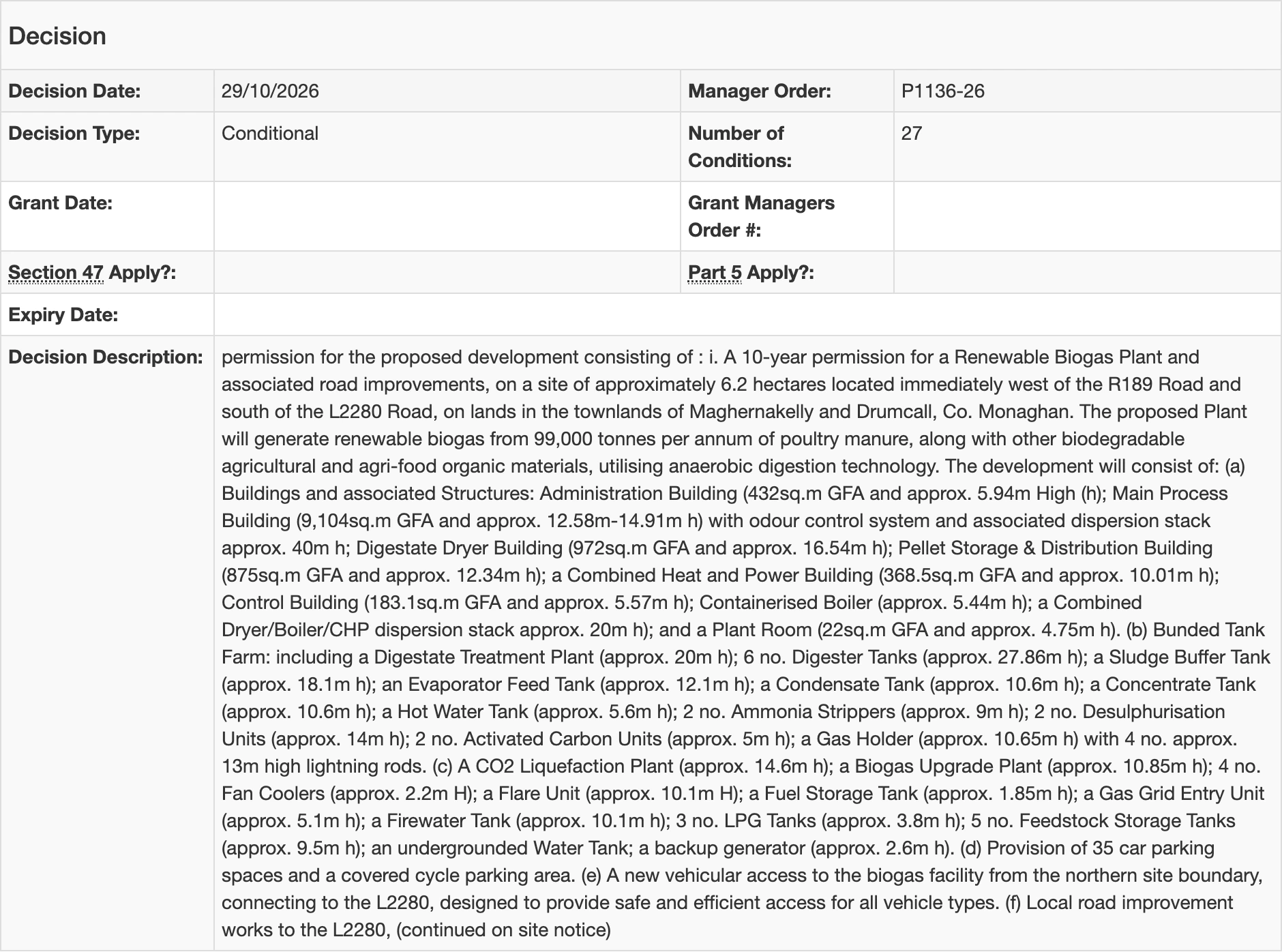
Monaghan County Council has decided to grant permission for Stream BioEnergy Ireland Limited’s proposed renewable biogas plant at Drum, subject to 27 conditions. The decision is dated 29 October 2026 and covers the application identified as 26/60018, also displayed as 2660018 on the public planning system.
The proposal is on lands in Maghernakelly, Drumcall and Drumgole, west of the R189 and south of the L2280. The council’s application record lists an overall site area of approximately 8.8 hectares.
This is a conditional decision, with an appeal stage still relevant. The council’s notification expressly says that works cannot commence on the strength of the notification alone: a final grant must issue. Before the facility could operate, the conditions also require an Environmental Protection Agency Industrial Emissions licence and specified local road improvements.
The Press checked the public record and original decision in the early hours of 31 October. No final grant date was displayed at that check.
The waste limit is 99,000 tonnes in total
One important detail is clearer in the conditions than in the lengthy description of the application. That description refers to renewable biogas generated from 99,000 tonnes of poultry manure annually, alongside other agricultural and agri-food materials. Condition 3 caps all waste accepted for treatment at 99,000 tonnes per year.
The distinction matters for anyone assessing the scale of deliveries or the material the facility would handle. The description should not be read as permission for 99,000 tonnes of poultry manure plus an unspecified additional quantity of other waste. The operative condition sets an overall annual ceiling.
The original notification and its full schedule of conditions provide the wording against which later developments can be checked. Condition 4 also requires the development to follow the submitted Environmental Impact Assessment Report’s details, mitigation measures and implementation times, except where the conditions require otherwise.
The application description refers separately to a plant site of about 6.2 hectares and the overall 8.8-hectare site including associated works. Both figures appear in the council documentation; they should not be treated as interchangeable measurements of the same boundary.
What is proposed at the site
The application seeks a ten-year permission for the renewable biogas plant and associated road works. Its listed components include a main process building, digester tanks, digestate drying and treatment equipment, fertiliser storage, gas upgrading equipment and a gas-grid entry unit. It also includes administration facilities, parking and a new vehicular entrance connecting to the L2280.
Stream’s description of the proposed development explains that anaerobic digestion uses micro-organisms to break down organic material in oxygen-free tanks. It proposes upgrading the resulting biogas to biomethane for injection into the gas grid, with fertiliser products also produced.
Those are proposed activities. The decision does not establish that equipment has been installed, that gas production has begun or that a connection is operating. The council record checked for this article did not display a commencement date.
Road improvements must precede operation
Condition 10 requires widening and realignment works on the L2280 and reconfiguration of its junction with the R189 before the facility operates. This creates a specific requirement affecting the local road network, rather than leaving the associated works as an optional later addition.
Before development starts, a construction traffic management plan must be submitted and agreed in writing. It must address access, construction traffic routing, delivery times, signage, speed limits, road cleaning and condition, working hours, emergency arrangements and communication. Monitoring must test whether the traffic mitigation measures work.
Separate conditions require professional road-condition surveys, including video, before construction and after completion. Any immediate works needed to facilitate haulage must be completed before development proceeds. Roads damaged along the haul routes must be repaired or reinstated at the developer’s expense, to the council’s satisfaction, within the period specified by the condition.
The entrance requirements include 90-metre visibility splays along the L2280. Boundaries and planting must preserve those sightlines. These are concrete features residents and road users can follow as later compliance documents appear.
Delivery hours and construction hours differ
The conditions set separate schedules for building work and deliveries. Construction is restricted to 7am–7pm Monday to Friday and 8am–2pm on Saturdays, unless the planning authority agrees otherwise in writing. Construction works are prohibited on Sundays, bank holidays and public holidays.
Deliveries taken at or dispatched from the site are limited to 7am–7pm Monday to Saturday, unless otherwise agreed in writing. The decision prohibits deliveries on Sundays, bank holidays and public holidays.
These are not a statement that every activity at a future operating plant would stop at 7pm. They are the specific construction and delivery restrictions in conditions 20 and 21. The distinction is useful when reading a general reference to “operating hours” in discussion of the project.
External lighting has another schedule: 6am–9pm unless otherwise agreed with the planning authority. Lights must be cowled and directed away from homes and public roads, and designed to avoid nuisance at sensitive locations.
Environmental licensing is a separate requirement
Condition 2 requires the applicant to obtain an EPA Industrial Emissions licence before the anaerobic digestion facility begins operating. The plant may operate only in accordance with that licence or a subsequent review of it.
The council’s planning decision therefore does not itself establish that this separate licensing requirement has been satisfied. No claim that an EPA licence has already issued is made here.
The construction conditions require an updated, site-specific resource and waste management plan, including a dust management plan, to be agreed before development. A suitably qualified environmental clerk of works, or equivalent, must oversee implementation of the relevant construction and environmental plans.
The developer must also agree a construction-phase surface-water monitoring programme with the council and Inland Fisheries Ireland. It must specify monitoring locations, frequency, parameters, trigger levels and reporting. Measures must prevent polluting material or sediment-laden water reaching watercourses, and accidental spillages threatening water quality must be reported immediately to both bodies.
Drainage, water services and material records
Before works, the conditions require a survey of the existing downstream storm-drainage system to establish its condition and capacity. That includes manhole studies, CCTV inspection and flow-related surveys, with details agreed before construction. Surface-water and foul-water systems must remain separate.
Other requirements cover drainage testing, notices to the planning authority before drainage works, and the necessary consents before work on the public road. Discharge connections to the public system depend on evidence that pipelines have passed the relevant tests.
The developer must contact Uisce Éireann before development about any water and sewerage services needed and the acceptability of the proposal in relation to source and network infrastructure. This condition should not be mistaken for confirmation that a particular connection has already been approved.
For the material moving through the plant, a register of incoming feedstocks, digestate products and exported digestate products must be kept on site and available to the council for inspection. Arrangements for using those products must meet Department of Agriculture, Food and the Marine requirements and other applicable statutory requirements.
Archaeology and landscaping are also conditions
The decision requires archaeological excavation of an area around a fulacht fia site identified in the submitted testing report. The specified area is approximately ten metres by ten metres, with features to be recorded under the appropriate licence and agreement with the National Monuments Service.
Groundworks across the development must be archaeologically monitored. If archaeological material is found, the archaeologist may stop work pending a decision on preservation or excavation. Reports must be supplied to the relevant department and the planning authority.
Landscaping must be implemented within the timing set by condition 18 and retained thereafter, with failed planting replaced. Roadside hedgerow removal is limited to what is needed for sight distances; other boundary trees and hedges are to be retained, reinforced and protected during building work.
Vegetation clearance during the March–August bird-nesting period requires advance checks by a suitably qualified ecologist and a report agreed by the council before removal takes place. These requirements concern how works would proceed; they are not evidence that clearance has begun.
Contributions and security deposits
Condition 1 sets a development contribution of €263,040, or another amount agreed in writing, under the council’s contribution scheme. It is subject to the specified indexation provisions. Works cannot begin until it is paid or a phased-payment schedule is agreed in writing.
A separate €271,970 cash security is required before development to ensure satisfactory completion of landscaping. The condition provides for its retention through completion and a further three years, unless the council agrees otherwise.
These figures serve different purposes. The contribution is towards public infrastructure and facilities under the council scheme; the landscaping security is a safeguard for completing the approved works. Neither should be presented as money already received or spent locally without evidence of payment.
Company forecasts and local concerns
Stream’s project material puts the proposed capital investment at about €120 million and forecasts 30 on-site operational jobs and 75 supply-chain roles. These are the developer’s projections, rather than confirmed vacancies or independently verified employment outcomes.
Its project FAQ describes sealed handling of feedstock and extraction systems intended to contain odours. Those are proposed controls; their description does not establish future measured performance.
Northern Sound’s report published on 30 October describes local concerns about possible odour and noise and reports Cavan councillor Stiofán Conaty’s call for a pause in the local rollout of biogas facilities. These are reported concerns and a political position, not findings that the Drum proposal will cause harm.
The developer’s project homepage still described the application as under consideration when checked. The council’s later, dated notification establishes that a conditional decision was made on 29 October.
How to follow the next stage
Residents can use reference 26/60018 to find the council’s decision, submitted plans and later entries. The notification provides for a four-week appeal period beginning on the decision date, rather than the date a reader encounters a news report.
An Coimisiún Pleanála’s current appeal guidance explains the strict time limit and the usual requirement for a third-party appellant to have participated at the application stage and retain the council’s acknowledgement. It also explains limited alternative routes and provides a deadline calculator. Readers considering participation should check those official requirements directly; this article does not determine anyone’s individual right to appeal.
The next substantive developments to watch are a recorded appeal or final grant, the required compliance agreements, and environmental licensing. The verified change now is the council’s conditional decision. A construction start, opening date and operational results remain unconfirmed.


Join the conversation
Keep it kind, relevant and constructive. Comments are reviewed before they appear.
Be the first to share a thought.