

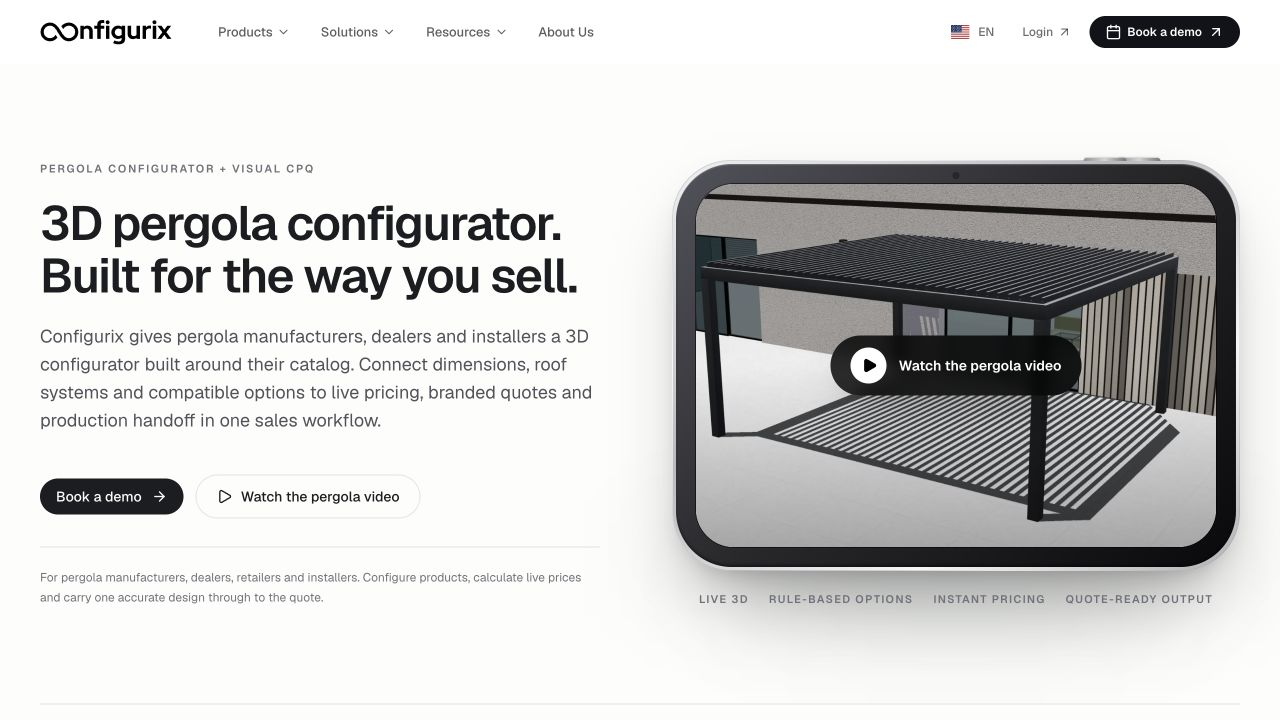
A pergola configurator becomes useful to a seller when a changed dimension produces a coherent specification: the selected roof still fits the structure, side options remain compatible, and the quotation describes the same design the buyer saw. A convincing image alone cannot establish any of those things.
Configurix says it builds pergola configurators around manufacturers’ catalogues, linking permitted dimensions and options with quotation workflows. For an Irish manufacturer, dealer or installer evaluating that offer, the practical starting point is an approved product range and a set of examples that expose its limits. Configurix’s Irish website provides a local-facing entry to the company’s offering; the exact products, outputs and connections still need an implementation agreement.
This guide examines the specification work behind that agreement. The suggested tests are The Press’s illustrative buying scenarios, not results from a Configurix installation. They are intended to help a business ask for observable evidence rather than assume every advertised capability is included.
Publisher’s note: The Press’s publisher requested this article and links to Configurix’s websites. It draws on public company material checked on 2 November 2026. The Press has not carried out hands-on software testing or audited customer results.
Begin with one product range and its measurement language
Before choosing controls or screen layouts, ask the product owner to define what width, projection and height actually measure. Is width the overall outer frame, the distance between posts or a nominal catalogue size? Is height measured to the beam or the highest part of the roof? A model can display a plausible number while different teams attach different meanings to it.
A useful specification names the reference points, input units, allowed increments and rounding. It should also distinguish a customer’s early estimate from a surveyed dimension approved for manufacture. Those may be related values, but overwriting one with the other removes useful evidence of what changed.
For example, imagine a fictional dealer whose customer enters a width of 4.2 metres. During survey, the installer records a different usable opening. The acceptance exercise should follow both records: what the customer originally requested, what was measured, who approved the revised size, and which version now appears on the proposal. Neither number is a recommended pergola dimension.
Ask for boundary cases as well as the ordinary middle of the range. Enter the approved minimum, the approved maximum, a value just outside each limit and a number between permitted increments. The expected response should come from the manufacturer’s catalogue, not from a designer guessing what looks reasonable.
Treat the structure and roof as a connected choice
Configurix’s pergola product page describes catalogue-controlled structures, roof systems and accessories, including screens and glazing. Those are company-described capabilities. They do not establish that any particular roof or accessory can be combined with another manufacturer’s frame.
A buyer should prepare a small compatibility schedule before a demonstration. For each structure in the first release, identify the roof families allowed, any dimensional restrictions and the combinations that require technical review. A review-required result is useful when a catalogue genuinely contains exceptions; it should have an owner and a next step rather than look like a completed standard order.
Consider a hypothetical range with two different roof mechanisms. Changing between them might affect the support arrangement, available finishes or control equipment. The test is whether the resulting specification remains internally consistent. A polished animation of the roof opening would answer a different question.
Also establish the behaviour of a change. If switching roofs makes an existing option invalid, should the system remove it, ask the user to replace it or stop the configuration pending review? The interface should explain the consequence before the customer requests a quote. Silent substitutions make it difficult to know what the buyer intended.
Check every side, not merely an accessory count
Screens and glazing introduce questions about location as well as quantity. “Two screens” does not say which openings they occupy. A seller evaluating the configuration record should be able to reconcile the selected sides with the displayed design and the written specification.
In a fictional test, a customer selects a screen on the front opening and glazing on one side. The customer then changes from freestanding to wall-mounted. The product owner should specify what happens to the opening next to the wall and whether the earlier side assignments remain valid. This is a test proposal, not a claim about how Configurix currently handles a particular supplier’s products.
Use names that survive a conversation between customer, salesperson and installer. Front, left and right may be clear only when everyone shares the same viewing direction. A labelled plan or stable opening identifier can make that direction explicit. The quotation needs enough context to prevent a correct accessory from being ordered for the wrong opening.
Finish selections deserve the same treatment. Confirm whether a colour applies to the entire frame, a roof component or a specific accessory. A business should not assume that selecting a frame finish automatically changes every visible part unless that is the catalogue’s actual rule.
Test dimension changes after the design is almost complete
An early demonstration often starts with dimensions and adds options afterwards. A more demanding buying exercise reverses the sequence: prepare a fully specified example, then alter a size or structural choice near the end.
For a hypothetical customer project, save the design with its roof, side options and finish. Increase the projection within the approved range. Compare the before-and-after specification and ask the product owner to identify every expected consequence. Some selections may remain unchanged; others may need new quantities, a different assembly or technical review. The approved catalogue determines the answer.
Repeat the exercise after reopening the saved project. Check that the visible geometry and specification refer to the same revision. A screenshot made before the dimension change should not quietly become the evidence for a later quote.
The business can make this exercise manageable without testing every theoretical combination. Start with representative standard products, a few meaningful boundaries and known conflicts. Record why each example matters, the expected result and who is qualified to approve it. That becomes a reusable acceptance pack when the catalogue changes.
Make the quotation traceable to the specification
The quotation should allow a customer to recognise the proposed product without deciphering internal codes. For a pergola, that means meaningful dimensions, structure and roof descriptions, selected opening treatments, finishes and clearly described included services. A project identifier and revision connect that customer-readable record with the more detailed internal specification.
Configurix’s Elite Aluminum project account says its work included pergola and sunroom configurators and automatic quotations containing item SKU numbers. That is a useful example of the output the company describes. It is not an independent verification of accuracy, delivery speed or results for another seller.
During evaluation, ask a salesperson and an operations colleague to review the same sample quote separately. Can each identify the exact proposed design? Are exclusions and unresolved measurements obvious? If one person needs to reconstruct the order from an email conversation, the quotation has not yet become a reliable handoff.
Keep commercial approval separate from technical readiness. A customer may agree to a proposal while a survey or engineering check remains outstanding. The saved record should make that status understandable. An attractive PDF or accepted price does not, by itself, establish that installation or manufacture may begin.
Define what production output really means
A component summary, a purchasing list and a released manufacturing instruction serve different people. Before adding a bill of materials to the scope, ask the receiving team for a worked example of the exact output it needs.
A hypothetical acceptance case might require each accessory to map to an approved stock code and each dimensional component to carry an explicit unit. It might also require a reviewer to release the final revision. The exercise should compare expected quantities and identifiers against the generated result, rather than accept a document because it contains a table headed “BOM”.
Configurix’s general software description presents configuration, documents and operational data as connected parts of an implementation. The practical procurement question is which of those outputs is being purchased now, which is a later phase and who accepts each one.
If the business only needs a qualified enquiry and a reliable sales specification initially, describe that smaller scope clearly. If it needs factory data immediately, provide the receiving format and approval process before agreeing to delivery. A project should not acquire a production-ready label merely because it exports a file.
Prepare a handover that can survive a catalogue change
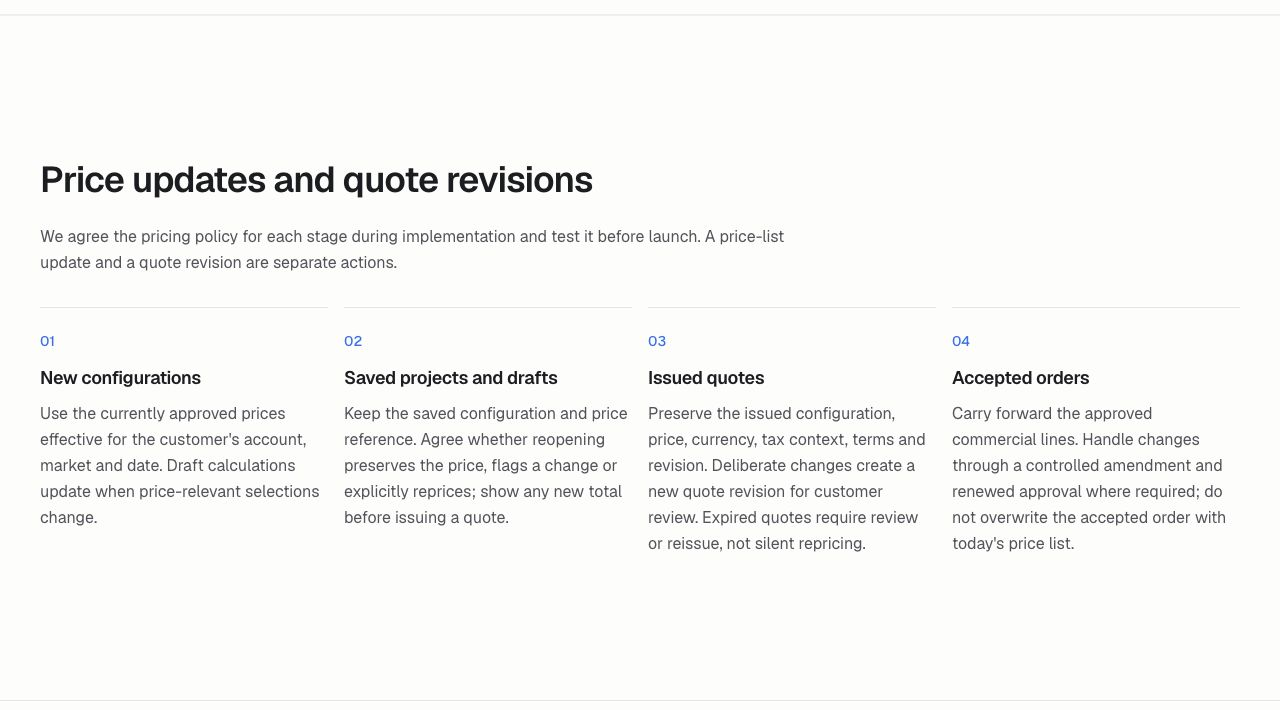
The launch catalogue will eventually change. A finish may be withdrawn, an accessory replaced or a permissible size revised. Ask what happens to an unfinished customer project when that occurs and how staff will recognise that it needs attention.
Take a fictional saved design containing an option later removed from sale. The acceptance exercise should establish whether the old project remains readable, whether it can still be quoted, and how a revised proposal points to the replacement choice. The customer should not discover a substitution only after accepting a document.
Name the person responsible for approving catalogue changes and the person responsible for publishing them into the software. These may be different roles. Keep a record of the examples rerun after an update, particularly those involving roofs, dimensions and side compatibility.
For the first supplier discussion, bring one ordinary pergola specification, one difficult configuration, one rejected combination and one quotation your team trusts. Ask the supplier to trace each through selection, save, revision and the agreed handoff. That evidence gives an Irish seller a more concrete basis for a decision than a broad feature list or an untested promise that every design will be quote-ready.
Join the conversation
Keep it kind, relevant and constructive. Comments are reviewed before they appear.
Be the first to share a thought.