

CPQ software should make it possible to explain which product was quoted, how its price was calculated, who authorised an exception and what the customer ultimately accepted. For an Irish business buying such a system, those commercial records matter as much as the speed of generating a proposal.
CPQ stands for configure, price and quote. Configurix describes a custom approach built around a seller’s catalogue and commercial process. Configurix’s Irish website presents its software to businesses evaluating configurable-product sales. A useful assessment needs to go beyond the acronym and establish the rules applying to a particular seller, account and quotation.
This guide concentrates on price ownership, permissions, approval and revisions. The scenarios below are proposed buyer tests, not observed Configurix customer outcomes. They contain no assumed software fee, achieved saving or recommended discount.
Publisher’s note: The Press’s publisher requested this article and links to Configurix’s websites. Public company documentation was checked on 2 November 2026. The Press has not tested the software hands-on or audited its customers’ results.
Decide who owns each part of the price
A commercial calculation can involve several distinct decisions: the catalogue amount, account adjustment, optional service, delivery charge and tax treatment. Before automating the total, a buyer should name the authority for each decision. Two systems applying different versions of the same adjustment can create a plausible-looking answer that nobody intended.
Configurix’s pricing-engine documentation says calculations can use approved lists and formulas, with price ownership and integration responsibilities agreed for implementation. Its public examples are demonstrations of an approach, not a tariff for installing the software or buying the illustrated products.
Bring a small set of commercial examples already accepted by the business. Each should identify the inputs, calculation sequence and expected line amounts. Ask finance or the responsible commercial owner to sign off those examples before using them to judge a demonstration. Otherwise, the evaluation risks measuring consistency with an unreviewed spreadsheet error.
For a fictional equipment supplier, a configured assembly might carry an account price while delivery remains a separate service. The proposed acceptance test should establish whether a discount applies to both, one or neither. The correct answer is the supplier’s documented policy; a neat final total is insufficient evidence.
Separate price visibility from permission to change it
A person may need to see a customer’s selling price without being allowed to change it. A dealer may need a trade price while a public website visitor should see a different commercial presentation. An approver may require information that should never appear in the customer-facing document.
Configurix’s visual CPQ description discusses role-specific experiences and commercial controls. Treat those as capabilities to scope and demonstrate. A buyer should not assume that a role name automatically gives the precise access boundaries its own organisation needs.
Write the intended permissions in plain language before translating them into screen controls. Who may select a private price list? Who can alter a service charge? Who can disclose a margin? Who can export the proposal? Who can issue it to a customer? Reading and editing are separate questions, and issuing a document is a separate action again.
In a hypothetical test, a salesperson prepares a proposal and a dealer opens the project through a different account. The demonstration should show only the information and actions authorised for that account. Ask the implementation team to explain how the restriction is enforced, rather than accepting a hidden button as the entire permission model.
Define the event that starts approval
“Discounts require approval” leaves many unanswered questions. Approval may depend on the size of an adjustment, a margin floor, a particular product, a service exception or the user’s authority. An organisation needs a decision rule that staff can apply consistently, including what happens at the exact boundary.
Configurix’s custom CPQ page describes approval workflows and distinguishes a price-list update from an issued quote revision. The implementation discussion should turn that advertised workflow into a concrete release condition for the buyer’s business.
For an illustrative test, prepare three otherwise identical proposals: one inside a permitted discount range, one exactly at the agreed limit and one beyond it. The business supplies those limits; no example here establishes a suitable commercial threshold. Ask which document may be issued, which reviewer receives an exception and what evidence records the decision.
Then remove the reviewer’s availability from the scenario. Is there an authorised substitute, an escalation route or a clear pending state? Staff need to know whether an approval request is waiting, rejected or completed. A message saying “sent” does not answer whether anyone has permission to release the quote.
Tie the approval to the exact commercial revision
An approval is meaningful only in relation to what was approved. If a salesperson changes the product, quantity, account or service package afterwards, the business needs an explicit policy on whether the previous decision still applies.
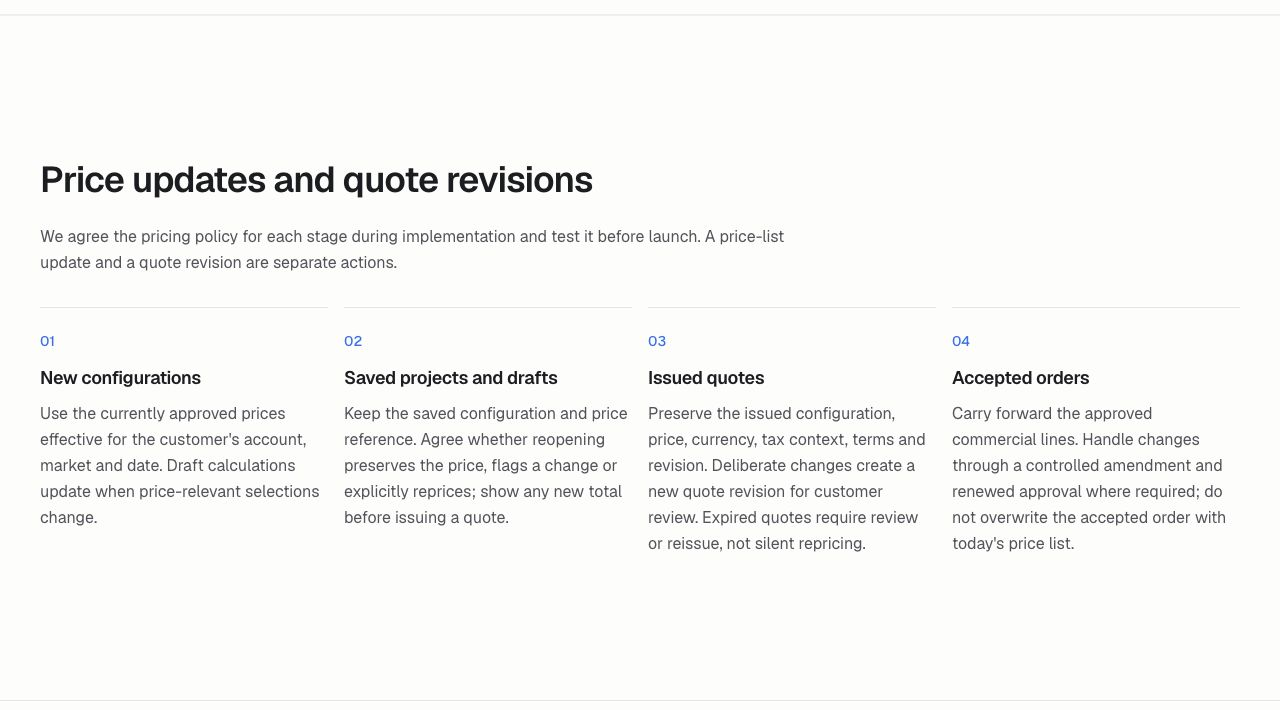
Consider a fictional order that receives a discount approval and then gains an additional service. The acceptance exercise should preserve the earlier proposal, identify the changed lines and determine whether the new proposal returns to review. It should also show which version the customer can accept. This is a proposed test, not evidence of a particular Configurix installation’s behaviour.
Ask to inspect the record of the decision: the proposal revision, the person or role authorising it, the time and the reason. The customer document may need only the approved selling terms; the internal record should still explain how those terms were reached.
Keep commercial sign-off separate from engineering release. An authorised discount does not prove that an unusual product can be manufactured, and a technically valid configuration does not authorise every selling price. The purchase specification should identify both decisions when both are required.
Give drafts, issued quotes and accepted orders different rules
A saved draft can reasonably need a new calculation when someone changes its selections. An already issued proposal needs a readable history of what the customer received. An accepted order introduces another responsibility: preserving the agreed commercial record while recording any subsequent amendment.
Configurix’s published CPQ policy describes retaining issued terms and handling accepted-order changes through controlled amendments. Ask for the precise behaviour to be written into the project scope. Do not assume that reopening a record, copying it and revising it mean the same thing.
For a hypothetical supplier, a salesperson saves a draft before a price-list change and reopens it afterwards. The demonstration should reveal whether the draft retains the old calculation, requests a deliberate recalculation or highlights a difference. The agreed policy should make the status clear before a new proposal is issued.
Repeat the scenario with a proposal already sent to the customer. Compare the original document with any revised document and the saved record behind each. A later catalogue update should not make the historical document impossible to interpret. This is a procurement requirement to agree, not an individual verdict on the legal effect of a customer contract.
Make expired proposals understandable
A quote expiry date is useful only if the workflow explains what staff and customers should do next. A buyer evaluating CPQ should ask whether an expired proposal can be viewed, accepted, revised or reissued, and who controls the next step.
In an illustrative exercise, reopen a proposal after its stated validity period. The customer should be able to understand its status without guessing from an unchanged total. Staff should have a defined route to review availability, pricing and terms before sending a replacement.
Also test the old link after a new revision is issued. Does it identify the earlier version clearly? Can the team distinguish a customer viewing an old proposal from accepting the latest one? The required behaviour should be decided before staff start sharing links in normal sales conversations.
A business need not prescribe one universal answer for every product. A repeat service and a made-to-order assembly may have different review needs. The important purchasing discipline is to name those differences and attach an expected result to each example.
Check the document and the receiving order together
A correct calculation is only part of a successful quotation workflow. The proposal must communicate its included items, services, currency, validity and relevant conditions. The accepted result must then reach the next team without losing the commercial revision.
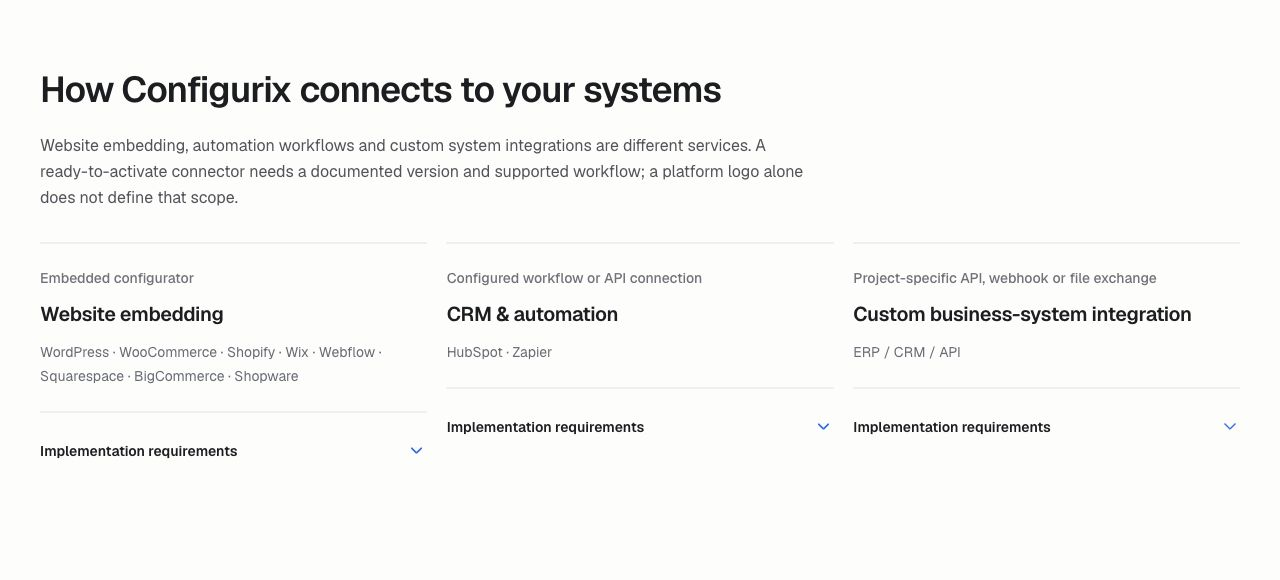
Configurix’s integration documentation makes downstream connections dependent on agreed data flows. A logo for an accounting or order system is not evidence that a particular edition, field map or approval status has been implemented for a buyer.
For a proposed end-to-end test, take one approved quote into the receiving order workflow. Compare the line identifiers, quantities, currency, adjustment and external reference. Have sales and the receiving team review the same example. If a rejected line leaves the source record appearing complete, the process needs a clearer exception state.
Test a missing price as well. The team should establish how an unavailable calculation is represented, who resolves it and whether issuance is held. An empty value should not accidentally look like an approved free item. This is a suggested acceptance condition, not a claim about a fault in Configurix.
Build a commercial acceptance pack before rollout
The first review pack can remain small: a normal quotation, a boundary approval, an unauthorised action, a revised approved quote and an accepted order amended later. Add a price-list change and one unavailable input. Each case needs an owner, expected result and retained evidence.
Use that pack again when permissions, price lists or templates change. A passing demonstration at launch cannot establish that a later commercial policy has been represented correctly. Keep the current rule owner visible to the staff who maintain the system.
For an Irish seller considering Configurix, the next useful step is to bring its own trusted quote examples and commercial policy to the scoping discussion. Request a traceable journey from the original calculation through authorisation, issuance, customer acceptance and the agreed next record. That makes the buying decision about demonstrable commercial control rather than an unsupported claim that automation alone will improve margins or close more sales.
Join the conversation
Keep it kind, relevant and constructive. Comments are reviewed before they appear.
Be the first to share a thought.