

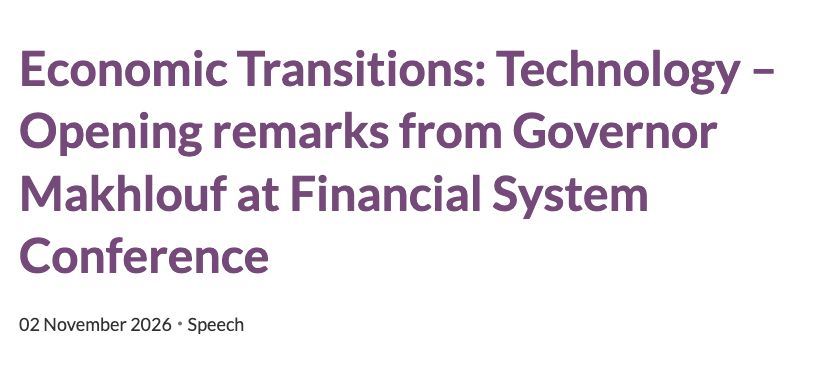
The Central Bank of Ireland has announced that its next Innovation Sandbox Programme will focus on using artificial intelligence to improve outcomes for financial consumers, with applications due to open in January 2027.
Governor Gabriel Makhlouf set out the new theme, Advancing AI for Consumer Good, at the Bank’s Financial System Conference in Croke Park, Dublin, on Monday, 2 November. The announcement identifies four practical concerns: supporting vulnerable customers, explaining automated decisions, tackling fraud and preserving accountability when AI systems act on someone’s behalf.
The Bank also published a new work programme on tokenisation, including a dedicated route for firms to raise questions about the technology. Together, the developments show how the Irish regulator intends to engage with changes already taking place in financial services, while testing whether the promised benefits reach customers.
The details are set out in the Bank’s announcement and Makhlouf’s published opening remarks. This report draws on those official records; it does not claim independent observation of the conference or results from a programme that has yet to open.
Applications open in January, rather than today
The new AI theme is for the third sandbox programme. Successful participants will receive structured regulatory advice and specialist support from the Central Bank. January 2027 is the announced application-opening month, not a deadline for consumers to enrol in a financial service.
The Bank’s existing sandbox overview explains its established approach: selected initiatives work in a cohort over six months, with regulatory engagement intended to inform development. It identifies financial crime as the first theme and payments as the current one.
That background explains the programme’s format, but it should not be used to invent dates or entry requirements for the next round. Monday’s announcement does not provide a full application timetable, selection list or catalogue of products that will emerge from the AI programme.
For firms considering applying, the immediate task is to develop a credible consumer problem and explain what their proposed use of AI would improve. The detailed published terms, once available, will determine how an application should be made. For customers, there is no new personal application or payment obligation arising from the announcement.
The consumer questions behind the AI theme
The four questions highlighted by Makhlouf concern consequences that can be obscured by a broad claim that a service is becoming smarter. A tool may produce an answer quickly while leaving the customer unable to understand the answer, challenge it or identify who is responsible for it.
The emphasis on consumers in vulnerable circumstances raises a different test from speed or convenience alone. A service needs to work for people whose circumstances make a standard interaction difficult. The speech does not announce a particular solution or identify individual customers; it sets out the issue the next programme is intended to explore.
Fairer, more explainable automated decisions are another stated focus. In practical terms, an explanation has to communicate something useful about a decision rather than merely confirm that software was involved. That is an implication of the programme’s stated goal, not a claim that the Bank has approved a particular decision system or established a new appeal procedure today.
The fraud and scam question also has two sides. AI can be considered for detecting harmful activity, while the same broad family of technologies can be misused. A proposed consumer benefit therefore needs evidence about both what the system catches and how it treats legitimate users.
The fourth question concerns systems moving from giving information to carrying out actions. As more steps are delegated, responsibility can become harder for a customer to follow. Clear records of the instruction, the action and the responsible firm would be relevant tests of whether a service is delivering the accountability the programme seeks. These are analytical examples, not newly published application criteria.
Makhlouf says people remain responsible for deployment
In the speech, the Governor said most firms regulated by the Bank are already using AI in forms ranging from machine learning to newer generative and agentic systems. He also reported that about half of the engagements coming through the Innovation Hub are now AI-related, compared with roughly one in five a few years ago.
Those statements describe the Bank’s experience and assessment. They do not mean that half of every Irish firm’s business is conducted by AI, or that all customers are using the same technology. The measure concerns the subject of engagements through a particular regulatory channel.
Makhlouf’s position on responsibility was direct: people deploy the tools and remain accountable for them. The policy significance is that a firm cannot treat the technology’s sophistication as a substitute for governing its use.
The Bank also intends to deepen its ability to assess AI systems in financial services. That is relevant to consumers because assessing a provider’s conduct requires more than understanding the label on its technology. It requires an account of what the system does, where its risks sit and how the firm controls them.
A warning about the investment cycle, with limits
The Governor linked technological change to the wider Irish economy, pointing to data-centre activity and semiconductor manufacturing as channels through which AI-related investment affects domestic activity. He also warned about stretched valuations, debt financing and connections within the financing of the global build-out.
His view was that a market correction would not be surprising. That is a risk assessment, not an announcement that a correction has occurred, a forecast with a stated date or advice about an individual investment.
Keeping those distinctions matters. The same speech can recognise potential productivity benefits and warn that financing structures may transmit shocks. Neither proposition proves what a particular company, worker or household will experience next.
The news for Irish firms is the regulator’s intended response: continued analysis, stronger supervisory capability and engagement aimed at identifying problems before a technology becomes deeply embedded. The speech does not promise that all technological risks can be removed.
Tokenisation moves into a more specific work programme
Alongside the AI announcement, the Bank released its feedback statement on distributed ledger technology and tokenisation. It follows Discussion Paper 12, issued in March, and records 42 written responses from across financial markets and related services.
Tokenisation concerns representing assets or money on digital ledgers and using those records within financial processes. The Bank’s account looks beyond the technology’s ability to record or move something: legal ownership, settlement, governance, operational resilience and connections between systems also matter.
The new work programme includes a Tokenisation Access Point through the Innovation Hub, intended to give participants a clearer route for discussing practical models and regulatory questions. The feedback statement explicitly says engagement through that channel will not constitute regulatory approval, an alternative authorisation route or endorsement.
That boundary is important for anyone reading a firm’s claim about contact with a regulator. Access to a conversation and permission to carry on a regulated activity are different things. The document also proposes focused policy work and further analysis; it does not certify the commercial viability of every tokenised service.
The European connection is financial infrastructure
The Irish work sits within wider Eurosystem initiatives. The European Central Bank describes Pontes as a link between market distributed-ledger platforms and TARGET Services, allowing wholesale transactions to settle in central bank money. Its initial launch took place on 21 September 2026, with further improvements to follow.
This is infrastructure for wholesale financial markets. It is not an announcement that ordinary Irish shoppers must change how they pay or move their savings into a tokenised product. Its relevance is to the systems through which financial institutions settle transactions, and ultimately to how safely and efficiently financial services can operate.
Appia, the Eurosystem’s longer-term initiative, is examining possible structures for an integrated European tokenised financial ecosystem. The ECB says the work aims to produce a blueprint by 2028, involving analysis and engagement with public and private participants.
The two timelines should not be compressed into one claim that the full future system is already available. Pontes has an initial operational stage; Appia is a broader development programme. The Central Bank’s newly published priorities connect Ireland to both, while acknowledging that wider adoption still raises legal, technical and risk questions.
What changes now, and what remains to be demonstrated
Monday’s concrete changes are an announced AI sandbox theme and application-opening month, a published tokenisation feedback statement and a more specific programme of regulatory engagement. They create work for firms and the Bank without establishing that a particular customer product is ready or that claimed savings have been achieved.
For the AI programme, the next useful evidence will be its detailed terms, the selected projects and how their proposed consumer benefits are evaluated. For tokenisation, it will include practical engagement through the new access point, clarification of rules and demonstrable improvements in market processes.
The common test is whether technical capability produces a service that is understandable, dependable and beneficial to its users. The Bank has set out the direction of its work. Outcomes will depend on what participants can show, rather than on the novelty of the technology or the fact that it has been discussed with a regulator.
The source-page screenshot accompanying this report is credited to the Central Bank of Ireland and reproduced under the Bank’s reuse terms and its published public-sector-information licence.


Join the conversation
Keep it kind, relevant and constructive. Comments are reviewed before they appear.
Be the first to share a thought.