

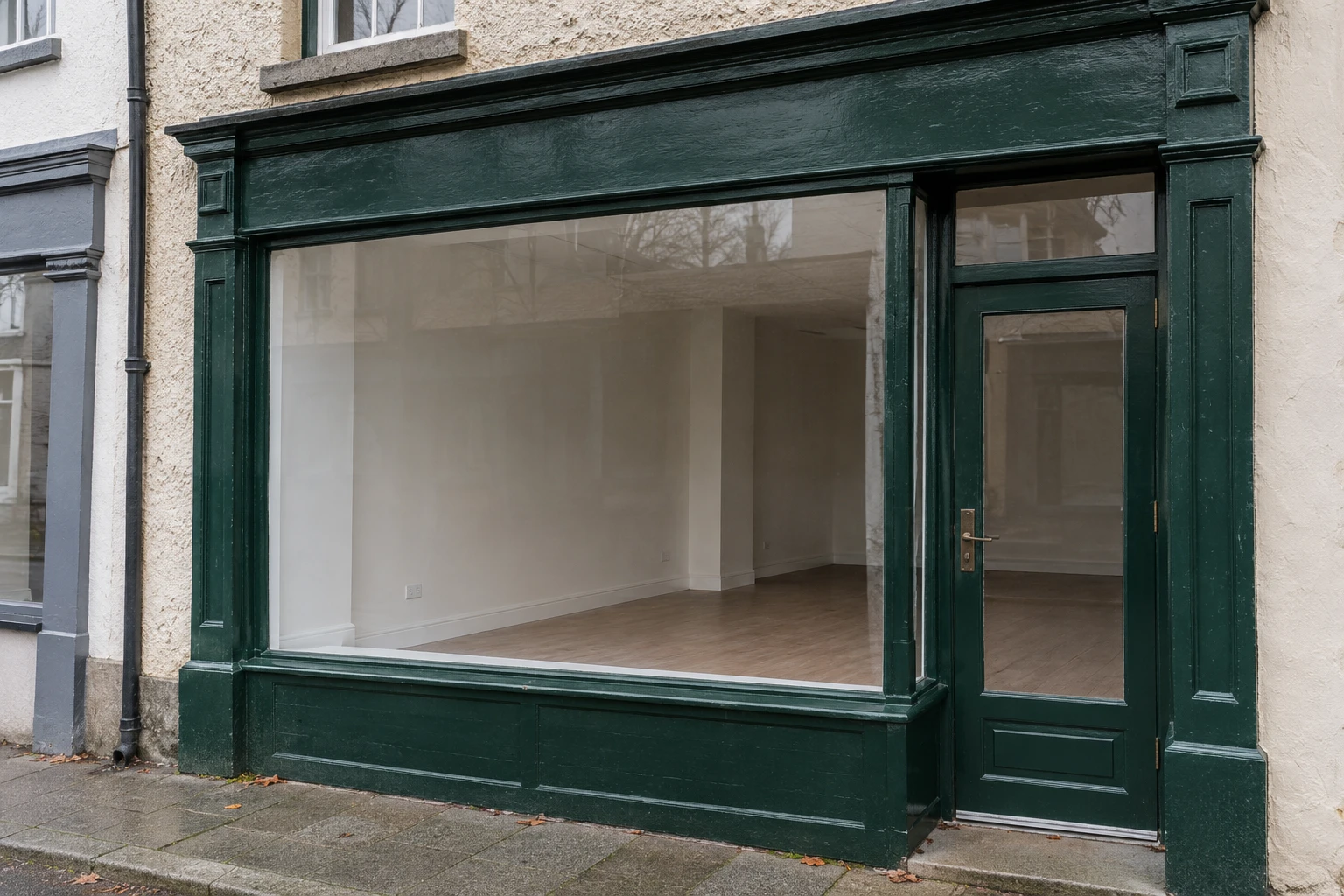
Alan Dillon is proposing a town-centre retail initiative that would match vacant shops with businesses needed locally in 26 towns, according to reporting published on Monday, 2 November. The proposed approach brings local authorities, regeneration officers and Local Enterprise Offices together around the same question: what could make an empty premises a viable trading address again?
RTÉ’s report on the proposal says the Minister of State for Retail envisages practical business advice, financial mentoring and marketing assistance alongside the matching of premises and community needs. Its stated aims are increased footfall and sustainable employment.
This is a reported policy proposal, rather than evidence that shops have reopened or jobs have already been created. The material checked for this article does not establish an application opening date, a dedicated funding total or a cash entitlement for individual businesses. Those details matter before a prospective trader makes a commitment.
The towns named in the proposal
The locations identified by RTÉ span the country. For readers checking their own area, they are:
County Carlow — Tullow; County Cavan — Bailieborough; County Clare — Sixmilebridge; County Cork — Skibbereen; County Donegal — Milford; Fingal, in Dublin — Lusk; County Galway — Gort.
County Kerry — Milltown; County Kildare — Clane; County Kilkenny — Urlingford; County Laois — Rathdowney; County Leitrim — Carrick-on-Shannon; County Limerick — Abbeyfeale; County Longford — Longford town.
County Louth — Dunleer; County Mayo — Killala; County Meath — Enfield; County Monaghan — Carrickmacross; County Offaly — Clara; County Roscommon — Strokestown.
County Sligo — Tubbercurry; County Tipperary — Roscrea; County Waterford — Portlaw; County Westmeath — Moate; County Wexford — New Ross; County Wicklow — Blessington.
Highland Radio’s local report identifies Milford and describes the initiative as “Vacant to Vibrant”. That report and the national account describe the same proposed matching approach; they should not be counted as two separate funding announcements.
A new retail proposal in an established town-planning landscape
The places are familiar from Ireland’s existing town-centre policy work. All are represented on the Town Centre First programme’s town directory. The programme describes a locally developed, plan-led approach that treats town centres as places for services, social life, recreation and work as well as shopping.
There is a useful distinction between a town plan and an occupied retail unit. A plan can identify priorities and organise cooperation. A shop needs an operator, a suitable property and enough customers to support its costs. The matching proposal is directed at that commercial connection, while the wider planning work supplies context for decisions about the town around it.
An earlier departmental Town Centre First progress presentation, dated 7 March 2024, recorded 749 projects identified in the first pilot’s planning process. It also described engagement with town teams and residents. Those are historical planning figures, not a count of completed projects or newly funded retail businesses in November 2026.
That history gives local discussion a starting point. It does not remove the need for new delivery details. The practical test is whether the proposed retail work can turn existing knowledge of a town into a premises match that survives beyond its opening period.
Milford and Clane show why the local market matters
Milford’s official Town Centre First profile describes a market town about 20 kilometres north of Letterkenny, with a 2022 Census population of 1,076. Its central area provides retail, administrative, community, health and education services to residents and a wider rural hinterland. The profile says its plan emerged from engagement between the community and Donegal County Council.
For a proposal built around local needs, that hinterland is significant. A business could serve people who live outside the town boundary or arrive for another service. Equally, the existence of a service role does not prove demand for any particular new shop. The commercial question needs to be tested against what people already buy, where they buy it and what would bring them into the centre more often.
Clane’s programme profile describes a different setting: a compact main-street core, outward residential growth and some retail and commercial development at the edge of the centre. It records a 2022 population of 8,152 and describes independent traders and community participation in planning.
These examples are not evidence that one town will receive more support than another. They illustrate why an identical business template would be a poor substitute for local assessment. A unit’s location within a town, its relationship with existing shops and the journeys customers already make can be as relevant as the town’s population total.
Mentoring and a financial grant are different forms of support
Existing enterprise services help explain what the reported proposal’s language means. Waterford Local Enterprise Office’s mentoring service matches business owners with experienced specialists. It identifies management, financial structuring, marketing and strategic planning among the areas covered, with applications assessed individually.
Its published criteria also address viability, room in the market for another entrant and avoiding an unfair competitive advantage. Those are the Waterford service’s existing terms. They are not a newly announced national eligibility test for Dillon’s proposal.
The distinction is useful because advice can improve a decision without paying the bills associated with it. Financial mentoring may help a trader examine projected sales and costs; it is not, by itself, money for rent or refurbishment. A marketing session may improve how a business reaches customers without guaranteeing additional sales.
Kildare’s existing Retail Grow page similarly describes a business audit and financial, marketing and technology mentoring for current retailers. Its broader list includes routes to other assistance. This is an established local offering, not confirmation that every listed service is automatically available to every applicant under a new nationwide scheme.
For someone considering a vacant shop, the useful first discussion is therefore specific: which support is available now, who delivers it and what decision will it help the business make?
The latest sales figures show a mixed trading background
The proposal arrives against an uneven national retail picture. In its September Retail Sales Index, released on 28 October, the Central Statistics Office reported that seasonally adjusted sales volumes fell 0.4% in the month but were 2.9% higher than a year earlier. Excluding motor trades, monthly volumes were unchanged and annual growth was 2.2%.
Sales value across all businesses rose 4.8% over the year, faster than volume. Clothing, footwear and textiles volumes were down 4.1% annually, while hardware, paints and glass fell 5.1%. Department stores recorded a 2.2% monthly volume increase.
September’s figures are provisional and national. They do not measure the vacancy rate in the 26 towns, establish a cause for an individual closure or forecast what a new shop would earn. Their relevance is narrower: retail activity is not moving uniformly, and higher takings in euro do not necessarily mean the same increase in goods sold.
That supports a cautious assessment of the proposal’s economic ambition. The opportunity is to identify a service or trading gap that can sustain a business. Simply adding another outlet in a category already well served would not, on its own, establish new local demand.
What would make delivery measurable?
The policy’s stated aims can be tested with concrete outcomes. A useful account of delivery would distinguish premises assessed, owners willing to participate, business matches agreed, shops opened and businesses still trading later. These are different stages. Counting an enquiry as an opening would overstate progress.
Employment needs the same care. A projected job is not a filled post, and an opening-day staffing figure does not show whether work is sustained. Existing businesses also matter: increased footfall could benefit neighbouring traders, while sales transferred from one local shop to another would be a different economic result. This is analysis of how to assess the proposal, rather than a claim that either outcome has occurred.
Property readiness is another question for implementation. A unit can be vacant and still require work before a particular business can use it. Matching a trader with an address is only one stage of a decision that also involves the proposed activity, the condition of the space and an agreement with its owner.
Published delivery information should consequently make clear who is responsible for each step. Readers need to know whether they are looking at a council expression of interest, a business-advice appointment, a property opportunity or an approved financial award.
The immediate next step for traders and communities
The National Enterprise Hub’s retail page brings together existing support options, including mentoring, training and finance routes. It offers a practical place to identify the relevant service while the proposed initiative’s operational details are clarified.
A prospective trader can also ask the Local Enterprise Office serving the town about currently available advice and whether any new town-specific process has opened. Property owners can seek the council’s published regeneration contact route. Residents and town groups can use the existing town plans to ground suggestions in documented local priorities.
None of those steps requires assuming that a grant has been approved. Monday’s development is the reported proposal for coordinated retail matching in named towns. Its significance will ultimately depend on the terms published next and the businesses that can turn suitable vacant units into lasting, useful local services.


Join the conversation
Keep it kind, relevant and constructive. Comments are reviewed before they appear.
Be the first to share a thought.