

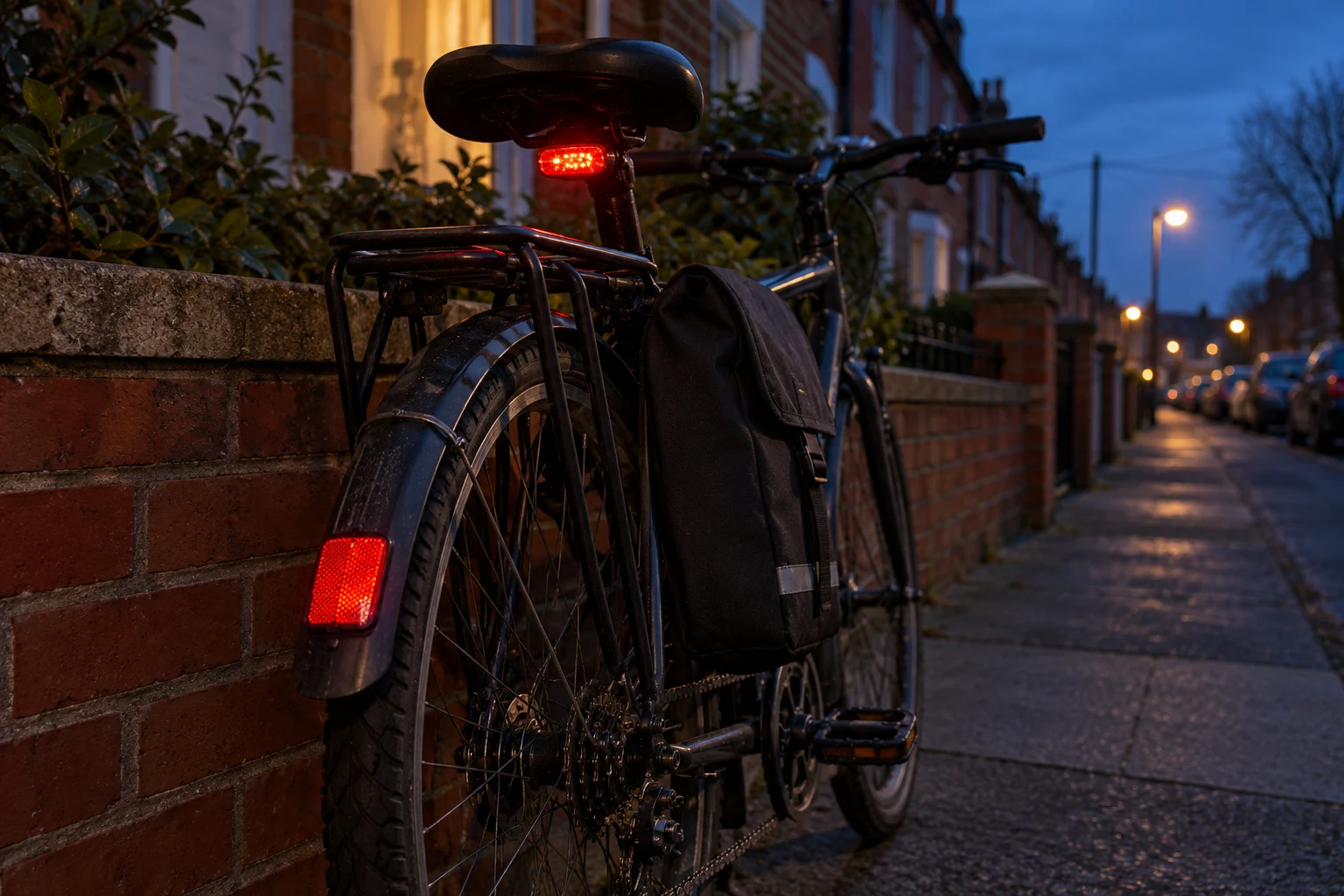
A lamp can work perfectly in the hand and be hidden once a coat, bag or child carrier is fitted to a bicycle. Checking the switch alone misses the configuration that other road users will actually encounter.
This guide combines the RSA’s cycling advice with its equipment booklet and proposes a repeatable loaded-bicycle check. It is not a product test, a guarantee of visibility or a substitute for the rest of a bicycle’s roadworthiness checks.
Lamps and reflectors do different jobs
The RSA’s cycle-safety booklet identifies a white or yellow front lamp, red rear lamp and red rear reflector. A reflector responds to incoming light; it is not a powered rear lamp and should not be treated as one.
The booklet is dated April 2019 and remains linked from the current RSA cycling page. Its equipment guidance is useful here; its older Cycle to Work tax figures should not be used for present financial decisions.
The RSA’s current cyclist guidance also stresses working lights and identifies having no front or rear lamp lit during lighting-up hours as an offence. Reflective clothing can add visibility but does not replace the required bicycle lighting.
Check the bicycle in its journey configuration
Fit the bags and clothing that will be used, then switch on the lamps while stationary somewhere safe. Look from the front and rear and ask whether anything blocks them. Check that a saddle bag has not covered the rear lamp, a pannier does not hide the reflector and loose straps cannot enter a wheel.
Repeat the check after adjusting the saddle or moving an attachment. A photograph can document the arrangement, but camera exposure can exaggerate brightness; it is not proof that the light meets a legal or technical standard.
Plan power for both directions
Record the charging or battery check before the outward trip and allow for the return, delays and the selected lamp mode. Manufacturer runtime figures may depend on settings and conditions. Do not assume a light that survived yesterday’s short trip will cover a longer journey today.
If a lamp, mount or wiring is faulty, resolve the problem before riding in conditions that require it. Use a competent repairer for work beyond a simple owner check, and avoid improvised attachments that can detach or obstruct steering.
A compact repeatable record
Use four checks: lamps operate; mounts hold securely; loaded bicycle leaves lamps and reflector unobscured; and enough power is available for the intended journey. Keep this beside the usual brake, tyre and steering checks rather than treating it as a complete safety inspection.
This method is particularly useful when autumn commuting begins in daylight and ends after dark. Recheck the real bicycle and load each time they change; a photograph of last month’s setup cannot show what is covered tonight.
Join the conversation
Keep it kind, relevant and constructive. Comments are reviewed before they appear.
Be the first to share a thought.