

An accessible rail journey can involve more than boarding the first train. A change of service, an arrival platform or the final route out of a station may need its own arrangements. A ticket alone does not describe all those handovers.
We compared the operator’s current assistance pages with its announcement of a new assistance-management system. The useful planning unit is each leg of the journey, rather than a single generic notice period.
Check the policy for the service and station
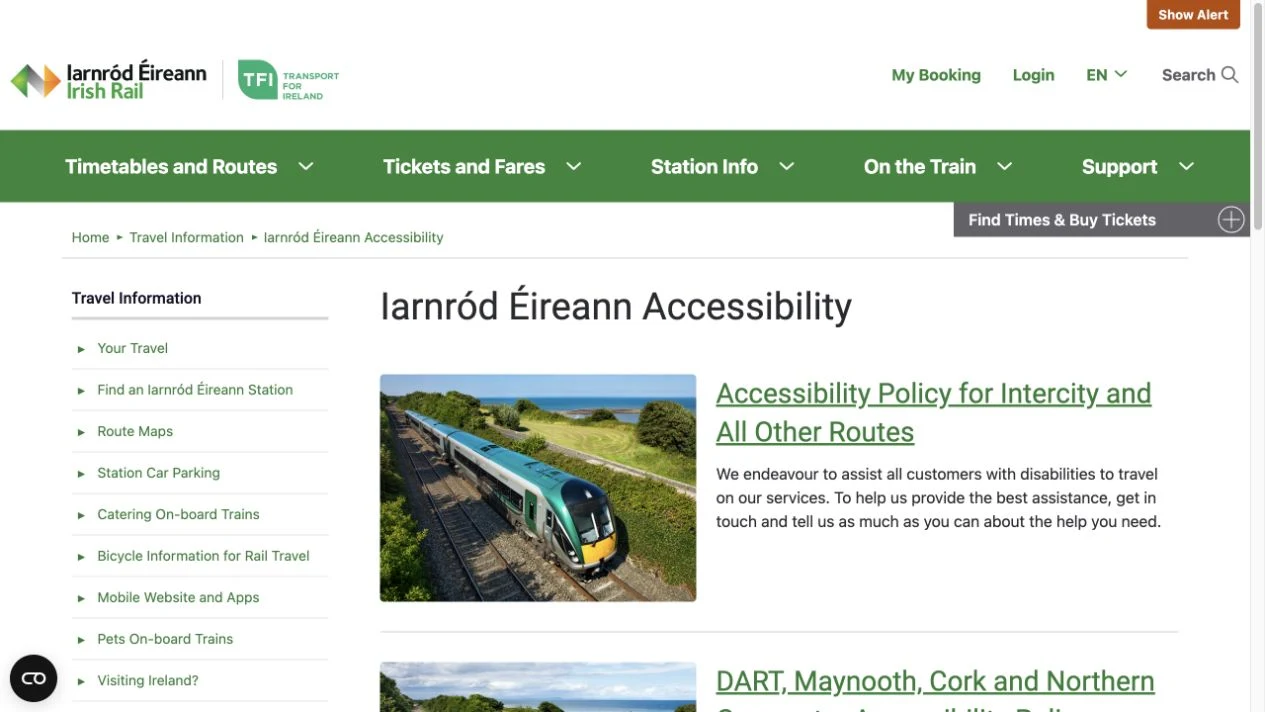
The Irish Rail accessibility hub links separate Intercity and commuter policies, station information and lift alerts. Use the working policy for the route being taken; a notice period copied from an older general guide may not match it.
The current Intercity and other-routes policy lists stations with one-hour notice for staff assistance and says other stations need four to twelve hours’ advance notice. Confirm the requirement for the actual departure, arrival and interchange stations. The page also says staff will do their utmost to assist where advance contact was not possible.
Do not treat the shortest published notice as a guarantee for every combination of services. Check the staffed contact hours when seeking help for an early, late or weekend journey.
Keep three arrangements separate
A travel ticket concerns the journey being purchased. A reserved wheelchair space concerns capacity on the train. An assistance request concerns the help required at the relevant stations and changes. Ask the operator to confirm each part that applies.
Where a mobility device is involved, check the current dimensions and operating requirements directly with the operator. Do not assume a device accepted on one vehicle can automatically be accommodated on every other vehicle or replacement service.
Build a leg-by-leg handover note
For each leg, record the date and service, departure and arrival stations, any interchange, assistance required at each end and the operator’s confirmation reference. Add how the customer will reach and leave the station, and repeat the check for the return journey.
For example, a journey with one interchange has two train legs but three station locations. The shared interchange may require both getting off one service and boarding the next. One label saying “assistance booked” does not explain whether both actions are covered.
Check conditions again before travel
Use station lift and escalator alerts and current engineering-work information. Ask how any replacement transport affects the arranged journey rather than assuming it has identical access arrangements.
Irish Rail’s new-platform announcement describes phased implementation during 2026. An announced system is not proof that every station and request already uses it. Follow the operator’s currently confirmed contact and booking process. If plans change, tell the assistance team so the handover record stays accurate.
Join the conversation
Keep it kind, relevant and constructive. Comments are reviewed before they appear.
Be the first to share a thought.