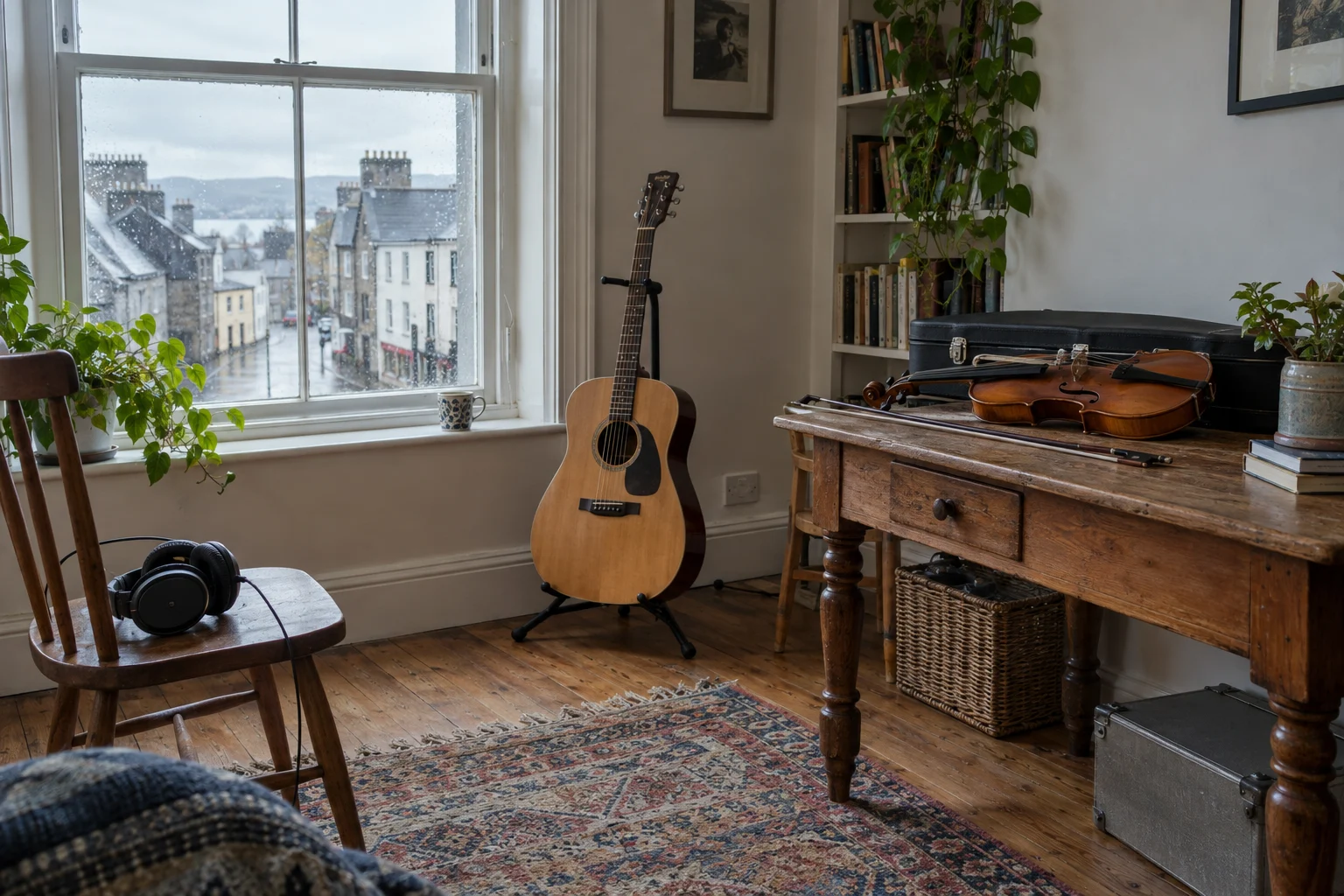
Ask what music is popular in Ireland and there are several useful answers: the songs people are buying and streaming this week, music made by Irish artists, and the traditional tunes and songs heard in local sessions. These overlap, but none is a complete substitute for the others.
For a newcomer building a playlist, the best starting point is to keep those three routes open. A chart can reveal current listening activity; an artist’s catalogue and a live session can take you somewhere quite different.
What the current Irish chart shows
The Official Irish Singles Chart for 9–15 October 2026 places Ashe’s Stop the Wedding at number one, Taylor Swift’s Patient Zero at number two and Olivia Rodrigo’s Stupid Song at number three. Fontaines D.C.’s Marianne appears at number twelve. [1]
The chart is compiled from downloads, physical singles and audio streams. It ranks songs in the Irish market; it is not a list limited to artists from Ireland, a survey of everyone’s favourite genre, or a measure of every live performance. [1]
Use the date range when discussing these positions. A track’s rank can change the following week, and an older chart should not quietly be presented as the latest one. Nor does a chart position tell you whether a song will suit your own taste.
Explore the artists beyond one hit
Ireland’s musical output is wider than one sound. Tourism Ireland’s overview points to rock acts such as U2 and Thin Lizzy, Enya, the pop groups Westlife and Boyzone, and Imelda May. [2] These are examples of a broad musical legacy, not a claim that they lead today’s chart.
An easy listening exercise is to choose one artist you know, then listen to a second album track rather than moving straight to another famous single. Notice the voice, instruments and arrangement. This makes a playlist a route into the music rather than a collection of recognisable names.
Traditional music is another way in
Traditional music remains part of Ireland’s cultural life. Tourism Ireland describes local sessions and a repertoire ranging from lively songs to ballads. [2] A session should not be treated as a guaranteed staged show with a fixed set list.
The Irish Traditional Music Archive offers access to music, song and dance resources, with ways to explore material by places, people, tunes, songs and instruments. [3] That is useful when a sound interests you but you do not yet know what to search for.
Make your own three-part listening plan
Try one track from the dated Irish chart, one recording by an Irish artist and one traditional recording from the archive. Write down what you liked about each. The point is discovery, not proving which style is more authentically Irish.
If you decide to hear music live, check the venue’s actual listing, age policy and booking arrangements. Listening activity, artist nationality and live availability answer different questions; keeping them separate helps you find music you will enjoy.
Sources were checked on 14 October 2026.

Join the conversation
Keep it kind, relevant and constructive. Comments are reviewed before they appear.
Be the first to share a thought.