

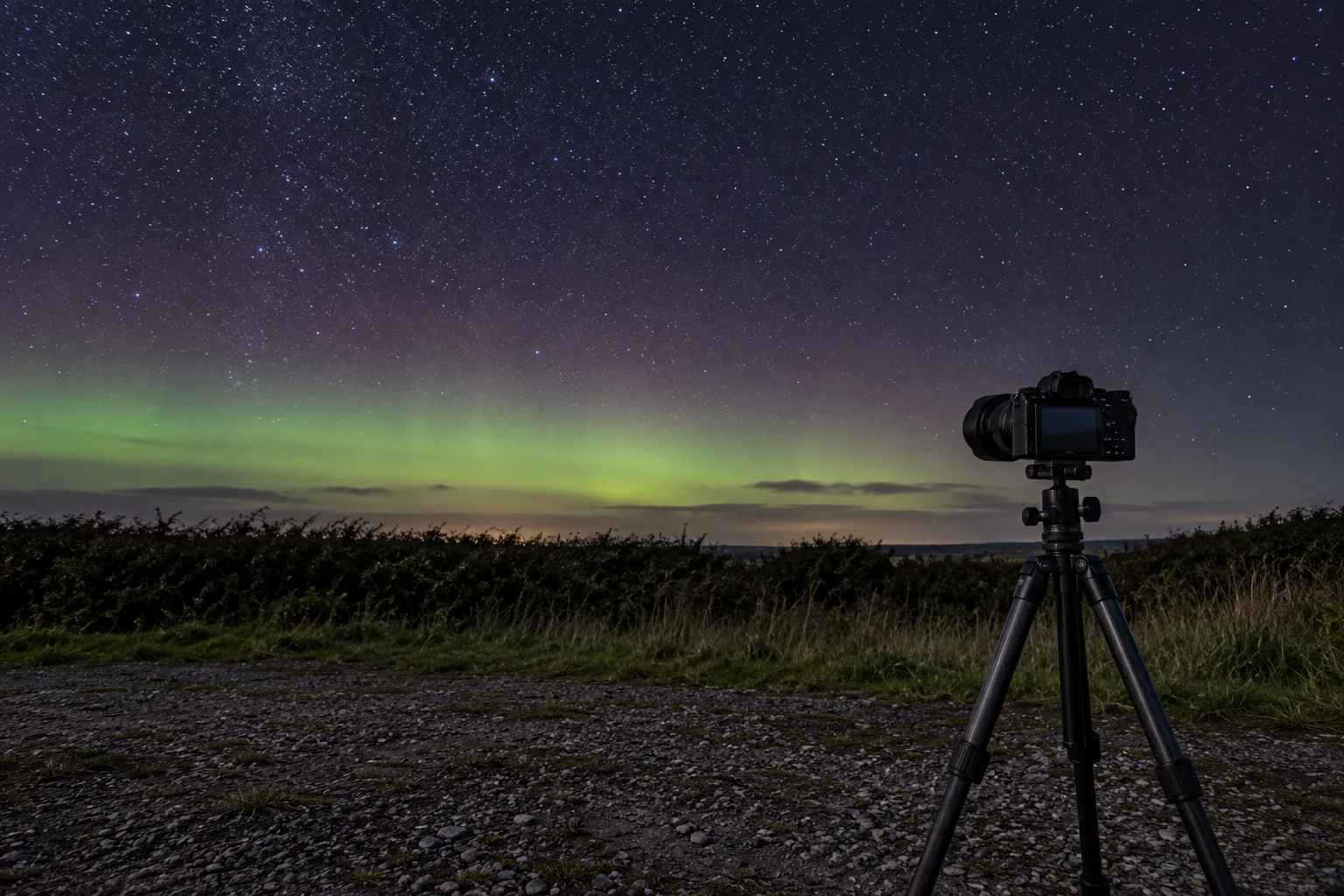
You can see the northern lights from Ireland when geomagnetic activity, darkness, clear skies and a suitable view coincide. November offers long nights, but a dark evening is only one ingredient. No county, date or holiday booking can guarantee a display, and a vivid photograph does not necessarily represent what an observer saw unaided.
This guide was checked on 26 October 2026 for readers planning autumn and winter evenings. It explains where to look, how to read the main forecast products and how to make a safe viewing plan. It is not a forecast for tonight or an announcement that an aurora will occur on a particular November date.
What are the northern lights?
Aurora is light produced through interactions involving charged particles and gases in Earth's upper atmosphere. Met Éireann’s northern-lights explanation describes the role of the solar wind and Earth's magnetic field. Different gases and conditions contribute different colours, which is why aurora photographs can show green, red, blue or purple features.
The process happens far above an observer. A green area on an aurora map is therefore not a weather system travelling along an Irish road, nor does it establish that your view through lower cloud will be clear. For a practical decision, keep the space-weather question separate from the ordinary weather forecast.
Can you see the northern lights in Ireland in November?
Yes, it is possible. November darkness provides time to observe, but darkness does not create geomagnetic activity. A clear November night can pass with no visible aurora, while a favourable display can be hidden by cloud. Avoid interpreting the season as an event forecast.
If you are visiting Ireland, plan an enjoyable evening that remains worthwhile without a display. Choose accommodation and transport for the wider trip rather than paying for a guaranteed outcome that the forecast cannot provide. Keep an aurora outing flexible enough to abandon when access, weather or travel conditions are unsuitable.
Which Irish counties offer a useful starting point?
Met Éireann highlights low light pollution and parts of the west and north coasts. The Irish Federation of Astronomical Societies’ viewing guidance also discusses northern coastal locations and examples in Donegal, Sligo and Mayo. These are broad location pointers, not a ranking of guaranteed viewing sites or a report of current sightings.
The specific horizon matters more than a county label. A dark place with an open northern view can be more useful than a famous location where a building, hill or bright light blocks that direction. An inland site can work; standing beside the sea is not a requirement. Check access and the route before travelling in darkness.
Can I see an aurora from Dublin, Cork or another city?
City lighting can make a faint display harder to see. That does not mean a display is impossible from an urban area, especially during strong activity, but a photograph from another town cannot establish what will be visible from your street. Buildings, local lighting and cloud can change the experience over a short distance.
Start with a nearby safe location before considering a long journey. If you need to travel outside a city, identify an authorised viewing place and parking in daylight. Do not trade a reasonably dark accessible location for an unfamiliar roadside or exposed headland simply because a social post describes the latter as the best spot.
What should I check in a forecast?
Check the product's issue time, the period it covers and whether it shows an observation, nowcast or forecast. A screenshot without a timestamp can describe an earlier event. A forecast for several days ahead and an updated short-term product have different uses; neither should be read as a personal sighting guarantee.
MagIE’s Irish aurora forecast explains its probability maps and their use of solar-wind and magnetometer information. Read the map legend and valid time rather than judging only the colour over Ireland. The map is one part of the decision alongside darkness, cloud, local visibility and whether you can reach a suitable place safely.
What does the Kp index mean?
Kp is a measure of planetary geomagnetic activity on a scale from zero to nine. Higher activity can extend auroral visibility farther from the polar regions. NOAA’s aurora-viewing guidance explains that the relationship between Kp and viewing latitude is approximate, rather than an exact boundary.
A single threshold should therefore not be presented as “Ireland will see the lights”. Your location, horizon, brightness of the display and local sky all remain relevant. A rising index can justify checking current information, but it cannot replace looking at the valid time or assessing the conditions outside. Avoid building a long drive around one number copied from an undated post.
How far ahead can an aurora be predicted?
Different products look at different timescales. Solar activity can indicate possible opportunities, while short-term measurements help refine the immediate picture. Timing and strength can change as new observations become available. A list of supposedly certain aurora dates months in advance does not resolve those uncertainties.
NOAA describes its short-term aurora product as normally covering roughly 30 to 90 minutes, with limitations when input data are unavailable. That is very different from a promise for a future November weekend. Use the description of the product to understand what question it can answer, and check a fresh version close to the proposed observation.
How do cloud and the Moon affect the view?
Aurora occurs above ordinary weather cloud, so cloud between you and the display can obscure it. Check the Met Éireann national forecast and the relevant local forecast before setting out. A national summary is a starting point; a passing clear patch and a completely clear evening are different prospects.
Moonlight and artificial lighting can reduce the contrast of a faint display. Neither automatically rules out every observation. Consider the whole view rather than treating one condition as a switch. If the sky is covered, an impressive space-weather forecast cannot make that cloud transparent. It may be more sensible to keep watching updates from home than continue to a distant location.
What time of night should I look?
Darkness is essential, and activity can occur at different times. NOAA identifies hours around local midnight as often favourable in general viewing guidance, but that does not establish a fixed nightly appointment in Ireland. An active period may develop earlier or later, and cloud can determine which part of the night is usable.
Choose a practical observing window that fits the current forecast and a safe return. A clear twenty-minute opportunity nearby may be more useful than waiting for an arbitrary midnight deadline. Keep track of the time zone used on maps: UTC and the clock on your device are not always the same throughout the year. Check the label rather than silently shifting the forecast by an hour.
Why does a phone show more colour than my eyes?
A camera can record light over an exposure and process an image differently from human vision. A weak display may look like a faint pale glow to an observer while appearing more colourful in a photograph. That difference is a reason to describe both the photograph and the unaided view accurately.
Do not assume that a colourful social image was invented, but do check its date, place and description. An old image, a long exposure and a strong current display are different kinds of evidence. When sharing your own photograph, say when and where it was taken and avoid implying that everyone nearby necessarily saw the same colours with their eyes.
How can I try photographing a display?
Begin with equipment you already own. A stable support, an unobstructed view and familiarity with the camera or phone are more useful than buying a new device for an uncertain event. Test night mode or a suitable manual setting at home before travelling, and review the result without leaving a bright screen shining at other observers.
There is no single exposure setting that fits every phone, lens or display. Follow the equipment instructions, keep the horizon reasonably level and adjust after a test photograph. Avoid treating a pale cloud, reflected local light or processing artefact as proof of aurora simply because it appears greenish on a screen. Compare what you observe with current official information and describe uncertainty honestly.
What should I bring for an autumn evening?
Plan for standing still outdoors, a return in darkness and a change of weather. Bring suitable warm layers, waterproof protection and a torch. Keep your phone charged and retain the route and meeting arrangements. Use equipment so it does not obstruct a path, and avoid shining lights into another person's view.
For children or anyone who needs accessible facilities, check the actual site rather than its reputation for photography. Confirm the walking surface, distance from parking and whether facilities will be open at the intended time. A short, comfortable outing can be a better choice than a remote location that becomes difficult once everyone is cold and tired.
Is a coastal viewing spot automatically safe?
No. A clear sea horizon can be attractive for observing, but darkness can hide edges, slippery ground and changing conditions. Choose established permitted access and stay away from exposed edges or places where water could cut off a return. An aurora opportunity is not a reason to enter a closed site or unfamiliar hazardous terrain.
Keep vehicles in lawful parking spaces and leave roads, gateways and emergency access clear. Do not stop abruptly because you think you have seen a glow. A passenger can check information while the driver concentrates on the road. If the safe viewing option disappears, leave the attempt for another occasion rather than improvising a location in darkness.
How should I decide whether to go out tonight?
Make three checks: whether current space-weather information supports an opportunity, whether the local sky offers a view, and whether the outing is safe and practical. Revisit them before departure. If one fails, keep the plan local, change the timing or stay home. A forecast is useful because it informs a choice, not because it obliges you to travel.
Keep a short observing note afterwards, including date, location, cloud and what was actually visible. It can help you understand future forecasts without turning one successful or unsuccessful evening into a rule for all November nights. The rewarding part of Irish skywatching is learning how the conditions fit together, while accepting that some evenings will end with stars, clouds or no visible display.


Join the conversation
Keep it kind, relevant and constructive. Comments are reviewed before they appear.
Be the first to share a thought.