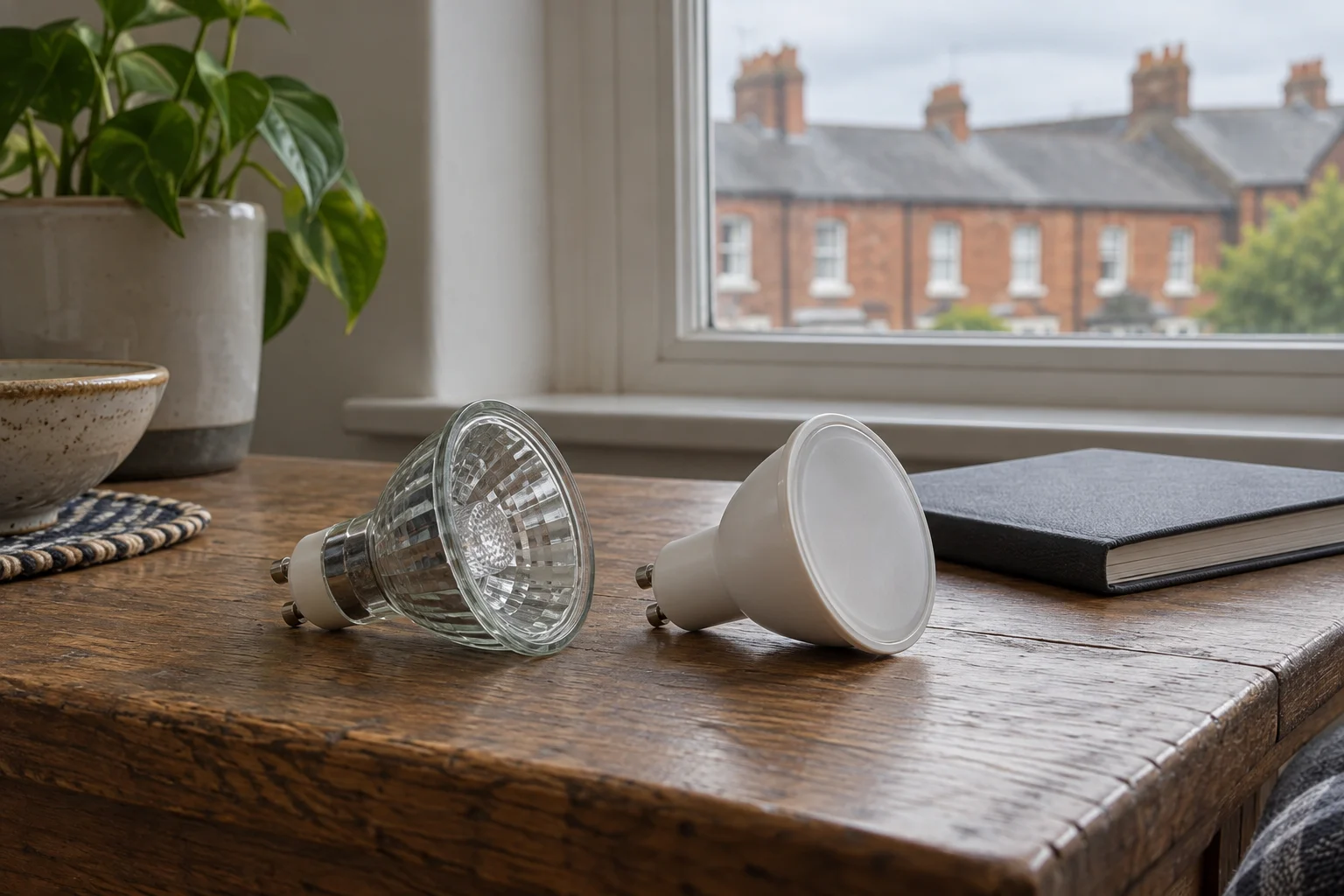
When replacing a halogen bulb in an Irish home, the old wattage is only one piece of information. A useful LED comparison starts with the light needed, the fitting and the controls, then looks at the electricity required to provide that light.
This is a buying comparison, not a guide to modifying a fitting, transformer or electrical circuit. If compatibility is uncertain, ask the manufacturer, supplier or a qualified electrician before making a change.
Brightness and electrical power answer different questions
SEAI's lighting guide explains that lumens describe a lamp's light output, while watts describe electrical power. Its discussion of efficiency compares output with power and distinguishes a lamp from the complete fitting. [2]
For a replacement, record the existing cap or connector, dimensions and stated light output. Compare the proposed LED with the light you actually need rather than searching only for the same wattage. A lower-power product does not need to reproduce the old bulb's wattage to be useful.
For a spotlight, ask about the direction and spread of the light as well as the total output. A room's appearance can change even when two packages give similar lumen figures.
Use the current label for the current product
The European Commission says the rescaled light-source label uses A to G and gives electricity consumption per 1,000 hours. Its QR code leads to EPREL product information, including light output, colour temperature and cap type. [1]
SEAI notes that rescaling can change a product's efficiency letter without changing its actual consumption. [3] Do not compare a remembered old A-plus rating directly with a letter on today's different scale.
Read the product information for the proposed replacement and choose a colour temperature suited to the room. Check whether the manufacturer's specifications permit the intended fitting and any dimmer or other control; physical fit alone should not settle the question.
Put any energy calculation on an explicit basis
Here is a hypothetical calculation, not a product test. If two suitable bulbs provided comparable light and were rated at 35 W and 5 W, running each for 1,000 hours would imply 35 kWh and 5 kWh respectively: a difference of 30 kWh.
That calculation uses power multiplied by hours, divided by 1,000. It does not establish the household's annual saving, which depends on actual products, operating time and the electricity tariff. For a complete lighting system, account for the relevant control equipment rather than treating one bulb rating as the whole system.
The better purchase is a compatible source giving the required light with clearly understood consumption. A cheaper pack price or a familiar wattage cannot answer all of those questions.
Sources were checked on 13 October 2026.


Join the conversation
Keep it kind, relevant and constructive. Comments are reviewed before they appear.
Be the first to share a thought.