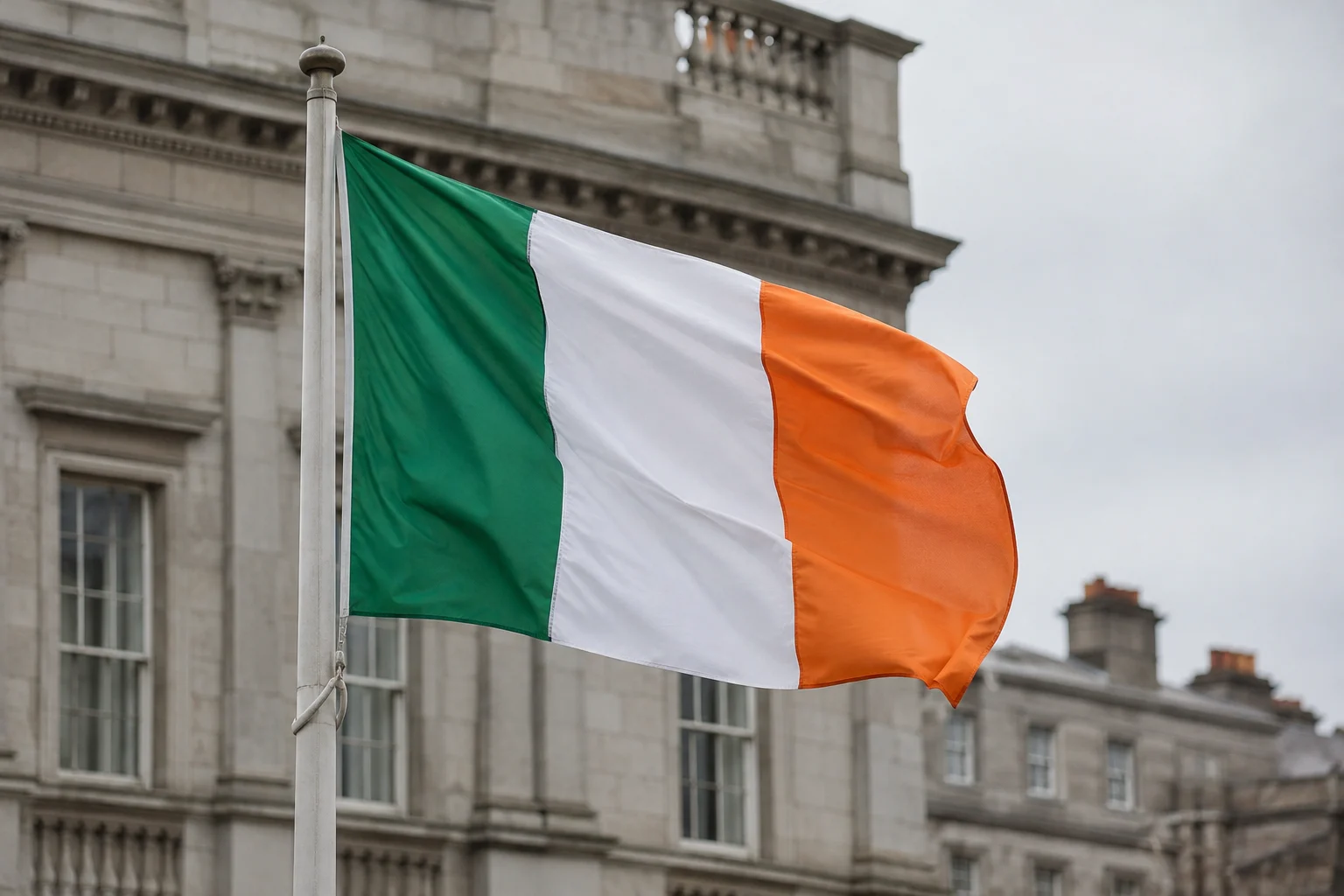
The Irish flag is recognised around the world, but its meaning is easy to flatten into three familiar colours. The tricolour was intended to express inclusion and the hope of unity between different traditions on the island. That is how the Department of the Taoiseach describes the national flag. [1]
The white band is central to that idea. It gives the design a message about the relationship between the green and orange, rather than leaving them as separate symbols competing for space.
Green and orange come from a historical setting
The government's flag guidelines explain that green was already associated with Irish nationalism, including the older green flag bearing a harp. Orange recalls the Protestant tradition associated with William of Orange. The nineteenth-century ambition was to bring those traditions into a peaceful shared future. [2]
Those associations explain the design's history; they should not be used as a test of an individual's identity today. A modern citizen's religion, ancestry or political outlook cannot be read from a preference for one colour. The intended national symbol belongs to a wider public than a simple division into two groups suggests.
White represents the hoped-for relationship
Thomas Francis Meagher explained the white as a lasting truce between orange and green, expressing the hope that Irish Protestants and Catholics could join in brotherhood. His explanation is recorded by both the government and the foundation bearing his name. [1][3]
The important word in understanding this symbolism is aspiration. A flag can set out an ideal without claiming that the ideal has always been achieved. The design asks viewers to think about coexistence, not merely to identify the traditions represented on either side.
That makes the central band useful when explaining the flag to children or visitors. Start with the relationship between the colours, then explain their historical background. Teaching only the outer colours risks leaving out the idea that connects them.
Waterford matters to the story
Meagher raised a tricolour in Waterford on 7 March 1848. The Thomas F. Meagher Foundation also records a tricolour being carried to Vinegar Hill in Wexford that day, and Meagher presenting one brought from Paris at a Dublin meeting in April. [3]
The tricolour was flown during the 1916 Rising, adopted by the Irish Free State in 1922 and confirmed in Article 7 of the 1937 Constitution. [1] Its path into official use took decades. Seeing the flag in an earlier historical scene therefore calls for checking the date and context, rather than assuming it always held its present status.
The design is green, white and orange
The flag is twice as wide as it is high, with three equal vertical bands. Green sits next to the flagstaff, white in the centre and orange at the outer edge. The flag protocol published by the foundation also explains that replacing orange with gold or yellow misrepresents the design. [4]
If you are preparing a school display, an event graphic or a printed programme, check the order, proportions and colour before sending it to print. Do not rely on a mirrored photograph as a design reference: the attachment side of a flying flag helps identify which view you are seeing.
The tricolour's meaning becomes clearer when the history, the three colours and the central ambition are read together. It is a national symbol whose message includes making room for different traditions within a common future.
Sources were checked on 11 October 2026, including the government's September 2025 flag guidelines. This is a historical and design explainer.

Join the conversation
Keep it kind, relevant and constructive. Comments are reviewed before they appear.
Be the first to share a thought.