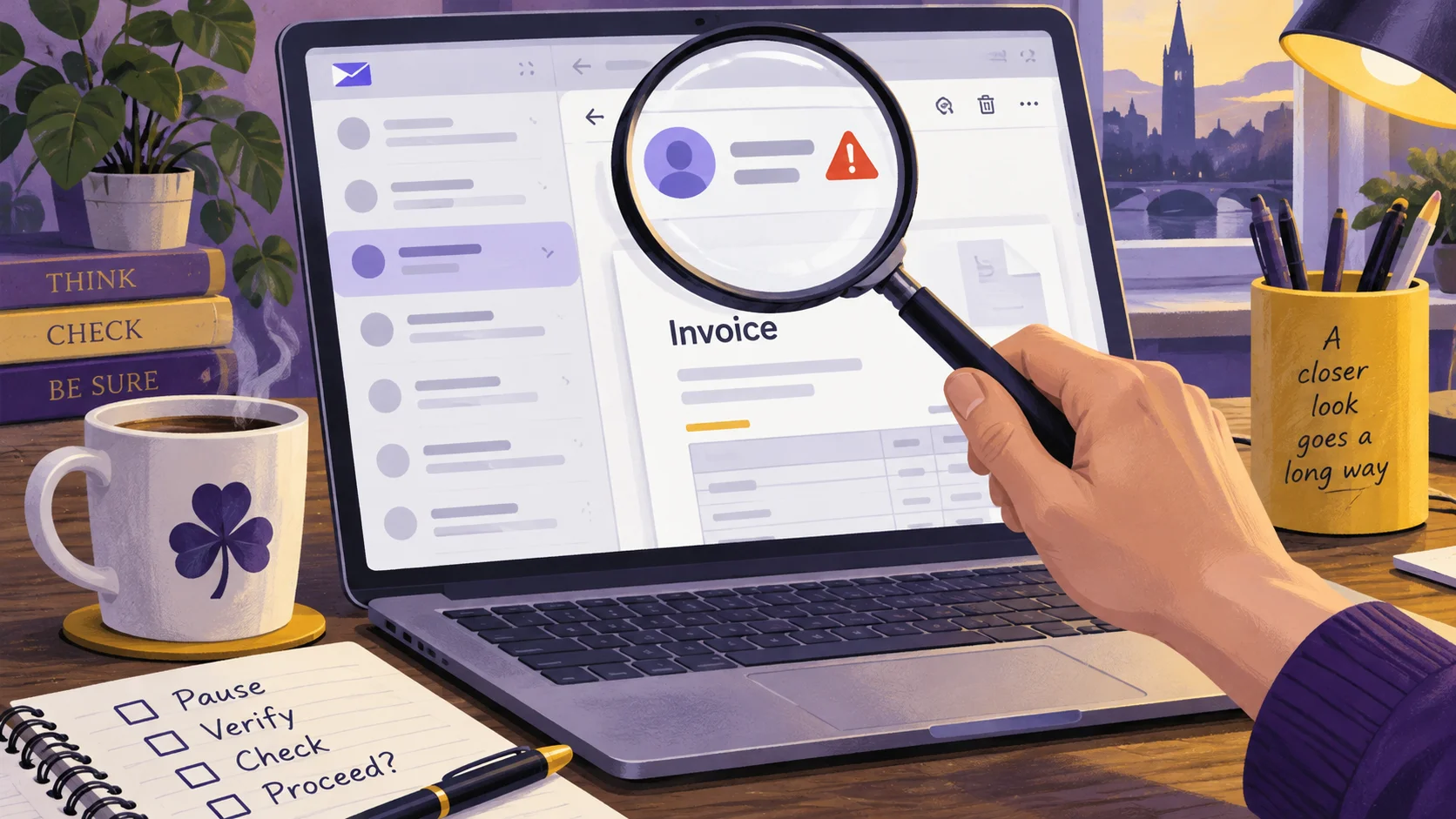
An email about a trade mark application can look credible without coming from the agent it names. The Intellectual Property Office of Ireland’s invoice-scam warning describes emails in English or Irish that use registered agents’ identities. The office says the named agents are not connected with the company details in those messages and that the emails appear fraudulent. [1]
The warning is listed in the office’s news index as 27 July 2026. This is a practical guide using that warning and the National Cyber Security Centre’s February 2025 SME guidance, checked on 10 October. It does not claim a newly discovered attack or identify an individual business as a victim. [2][3]
Check through a separate channel
The IPOI advises recipients not to reply to the suspect email. It recommends comparing the signature details with the official register of trade mark or patent agents and reporting fraudulent emails to a local Garda station. The NCSC likewise recommends contacting an apparently familiar sender separately when a message seems suspicious. [1][3]
In practice, pause the payment or disclosure request and find contact details from an existing trusted record or an official register. Do not treat a telephone number, link or attachment inside the suspect message as independent verification. Ask the real contact whether they sent the request, without forwarding confidential information to an unverified address.
Give staff a clear decision route
A useful office procedure identifies who checks an unusual request and how the result is recorded. It can cover unexpected invoices, changes to payment details and messages asking for account access. Keep the original message for the person investigating it, and avoid opening attachments simply to see whether the document looks convincing.
If someone has already entered credentials or acted on a suspect request, alert the responsible person and use the organisation’s incident procedure promptly. The NCSC guidance directs people concerned about scams to their local Garda station. [3]
The aim is to make verification routine. A familiar name or well-written Irish-language message is a reason to check carefully, rather than evidence by itself that the request is genuine.


Join the conversation
Keep it kind, relevant and constructive. Comments are reviewed before they appear.
Be the first to share a thought.