

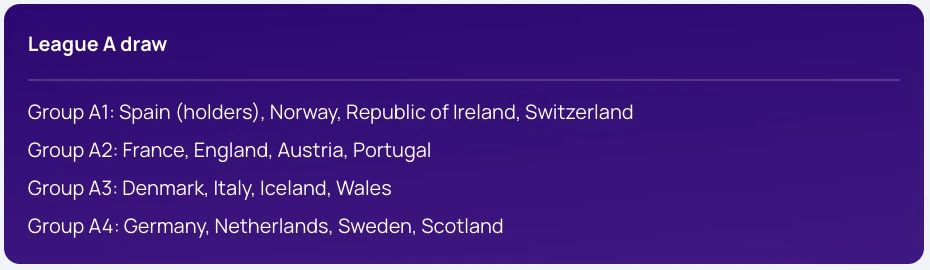
The Republic of Ireland women will face Spain, Norway and Switzerland in the 2027 UEFA Women’s Nations League, following Tuesday’s draw in Nyon. The six-match group campaign begins in February and will help determine Ireland’s position for the next European Championship qualifying phase.
Carla Ward’s team have been placed in Group A1 alongside the reigning world champions and Nations League holders, a former World Cup-winning nation in Norway, and Switzerland. Each opponent will play Ireland both home and away.
The official UEFA draw record confirms the group. The immediate news for supporters is the identity of the opposition and the international windows; the order of Ireland’s fixtures, venues and kick-off times is still to follow.
Ireland also have a separate, nearer commitment. Their World Cup play-off against Poland is scheduled for 1 and 5 December, with the return leg at the Aviva Stadium. Tuesday’s Nations League draw does not change that tie or decide whether Ireland will reach the World Cup in Brazil.
Ward welcomes the chance to face Spain
In the FAI’s announcement after the draw, Ward welcomed the opportunity to measure her side against the strongest opposition. She described the Spain assignment as one requiring exceptional discipline, compact defending and the ability to frustrate a technically strong team.
Her assessment also drew on Ireland’s recent competitive experience against France and the Netherlands. The manager’s message was that Ireland should respect the challenge while retaining confidence in their ability to compete.
Ward highlighted Norway’s standing and the strength of their squad, and welcomed the prospect of facing a team managed by Gemma Grainger. She also described Switzerland as a developing side capable of producing difficult matches.
Those comments set out the manager’s approach to the draw. The footballing question is how Ireland turn that approach into points across the group, with rewards attached to several finishing positions rather than only to winning the competition.
Spain bring a record of winning this tournament
Spain’s status as holders has a specific basis. In UEFA’s account of the 2025 competition, they retained the trophy by beating Germany 3–0 on aggregate in the final. The first leg finished scoreless before Spain won the return in Madrid.
That followed their success in the inaugural 2023/24 edition, when they defeated France 2–0 in the final. Ireland have therefore drawn a side that has won both completed editions of the Women’s Nations League.
The FAI says the forthcoming meetings will be the first between Ireland and Spain in more than a decade. It dates the previous encounter to April 2016, when Spain won 3–0 in qualifying for Women’s EURO 2017.
That history gives context to the fixture without supplying a prediction. Ireland’s task is to prepare for the team they will meet in 2027, across two separate games, while also competing with Norway and Switzerland for their final group position.
Ireland’s ninth-place seeding needs the right label
The FAI’s briefing issued before the draw placed Ireland ninth in the League A order following the European Qualifiers. That put them in the third seeding pot alongside Sweden, Iceland and Austria.
These numbers describe the competition’s qualifying-based order. They should not be presented as a claim that Ireland are ninth in the FIFA world rankings. The two lists measure different things and serve different purposes.
UEFA’s published seeding list placed Spain in the first pot, Norway in the second and Switzerland in the fourth. Ireland consequently drew one opponent from each of the other pots, as required by the draw structure.
The broader point is that Ireland are preparing for a campaign in Europe’s highest division. Their place in League A provides the setting for the matches; the results next year will determine whether that status carries into the subsequent European qualifying phase.
Six matches, three home games and three away
The home-and-away format means Ireland will play Spain twice, Norway twice and Switzerland twice. That produces three home fixtures and three away fixtures across the league stage.
A win earns three points, a draw one and a defeat none. With six games, a team can collect a maximum of 18 points. Every opponent appears on the schedule twice, so the group is decided across a full round of home and away meetings rather than by one encounter with the strongest side.
For supporters, the format offers three opportunities to watch Ireland at home once arrangements are announced. It also means that an individual result must be read in the context of the remaining fixtures and the positions being contested.
A draw against a strong opponent can add a point; a win against another group member affects both sides’ totals. Those are features of the scoring system, rather than forecasts of which games Ireland will target or how Ward will select her team.
What each finishing position would mean
UEFA’s current format and competition calendar gives the group several distinct consequences.
The group winner advances to the Nations League knockout finals. Both the winner and runner-up remain in League A for the European Qualifiers for Women’s EURO 2029.
Third place leads to a two-legged promotion/relegation tie against a League B runner-up. Winning that tie secures a League A place for the European qualifying phase; losing it means competing in League B. Fourth place brings direct relegation to League B.
For Ireland, this creates a clear difference between finishing second, third and fourth, even if another team takes the group’s place in the finals. The standings will affect the next phase of the national team’s competitive programme as well as the outcome of this tournament.
Remaining in League A should also be described precisely. It establishes a place in that division for European qualifying; it does not by itself award Ireland a place at the EURO 2029 finals.
Northern Ireland have a separate League B group
The same UEFA draw placed Northern Ireland in Group B3 with Poland, Finland and Belarus. That is a separate campaign from the Republic’s League A1 programme, with different promotion and relegation consequences.
A League B group winner moves up to League A. A runner-up enters a two-legged tie against a third-placed League A team, with the winner playing in the higher division for European qualifying. Northern Ireland’s group therefore offers a route towards the top tier, while the Republic are seeking to maintain their place there.
Poland’s appearance in both parts of the schedule is worth noting: they are the Republic’s opponents in December’s World Cup play-off and Northern Ireland’s opponents in next year’s Nations League group. The fixture lists belong to different competitions and teams, even though the same opposition name appears in both.
When the games are due to take place
The league stage is spread over three international windows in 2027:
Matchdays 1 and 2 fall between 23 February and 6 March 2027.
Matchdays 3 and 4 fall between 13 and 24 April 2027.
Matchdays 5 and 6 fall between 7 and 15 June 2027.
These are windows covering pairs of matchdays, rather than dates assigned to particular Ireland fixtures. The FAI says the full schedule is to be confirmed later in November, including the details supporters need for attending matches.
The distinction is useful for anyone considering an away trip. A group containing Spain, Norway and Switzerland identifies the countries involved, but it does not yet identify the host city, stadium, match date or kick-off time for each journey.
The confirmed fixture announcement will therefore be the practical next step for supporters looking at travel, accommodation or home-match plans. Tuesday’s draw supplies the opponents; the schedule will make those plans specific.
The knockout stages follow later in the year
The four League A group winners enter the knockout finals. UEFA has scheduled two-legged semi-finals within the 4–12 October window, followed by the two-legged final and third-place play-off between 23 November and 4 December 2027.
A draw is provisionally listed for 18 June to determine the finals ties and first-leg hosting order. The promotion/relegation matches are also scheduled for October, with their draw provisionally listed for the same June date.
For Ireland, those later dates describe possible routes after the group stage. The confirmed commitment established by Tuesday’s draw remains the six league fixtures between February and June. Which additional matches follow will depend on where Ireland finish.
Poland remains the immediate priority
The FAI’s post-draw statement confirms that Ireland travel to Gdańsk for the first leg of the World Cup play-off on Tuesday, 1 December. The second leg is at the Aviva Stadium on Saturday, 5 December, with a scheduled 5pm kick-off.
The association links to the official ticket page for that home match. Supporters should keep those December arrangements distinct from the Nations League home fixtures, whose match-specific details are still awaiting publication.
Independent reporting by the Irish Times also identifies the Poland tie as the squad’s immediate focus after Tuesday’s draw. The two competitions present different questions: December concerns Ireland’s attempt to reach the 2027 World Cup, while next year’s Nations League concerns group points, a possible finals place and league status for the following European qualifiers.
Ireland now know the scale and shape of their next Nations League campaign. Spain, Norway and Switzerland provide the opposition; six home-and-away games provide the test. The next announcements will establish the exact fixtures, while the team’s first competitive task remains the two-legged meeting with Poland.


Join the conversation
Keep it kind, relevant and constructive. Comments are reviewed before they appear.
Be the first to share a thought.