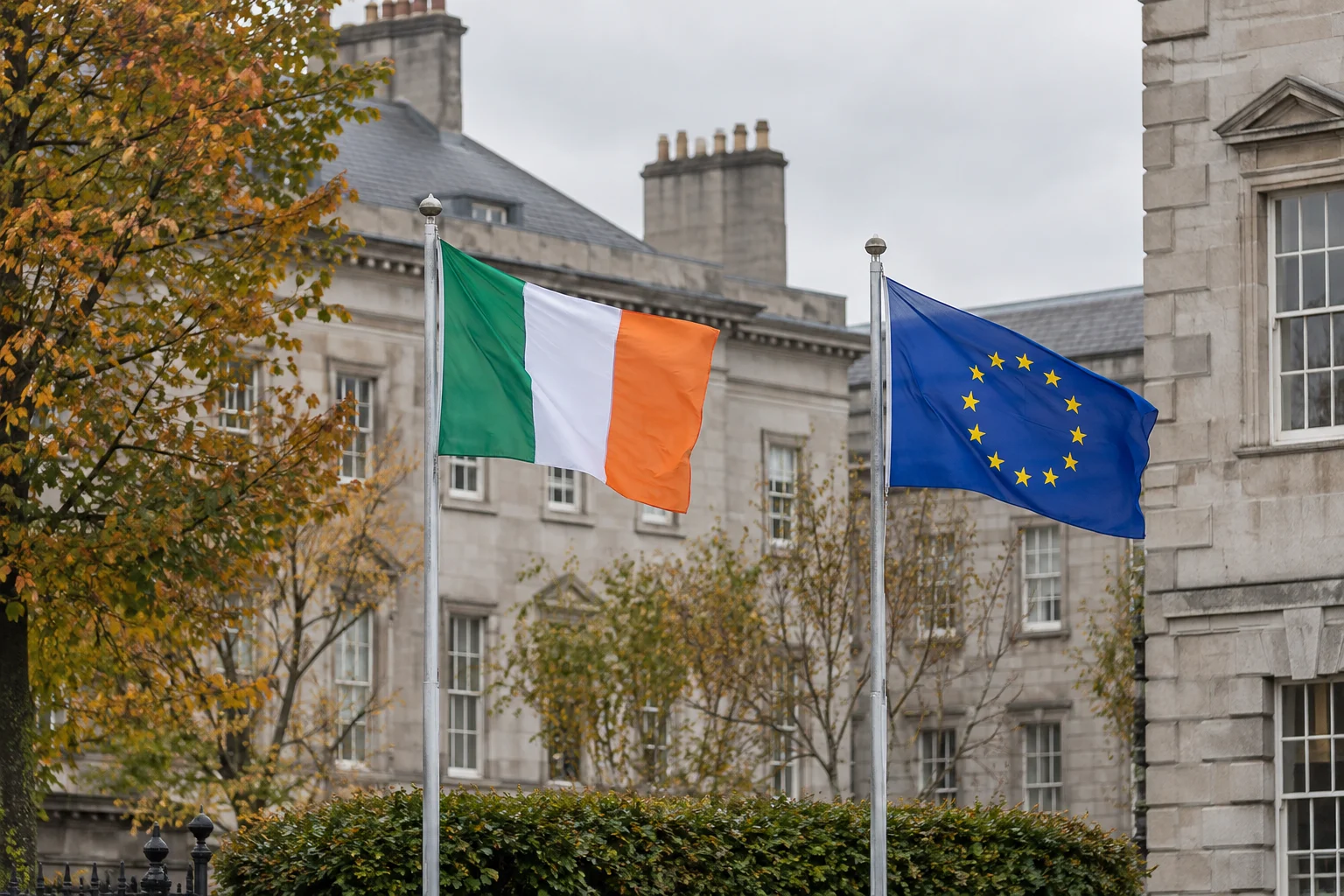
Ireland led the European Union’s delegation at accession talks with Montenegro in Luxembourg on 12 October, where negotiations on three more policy chapters were provisionally closed. Thomas Byrne, Minister of State for European affairs and defence, represented the Irish presidency of the Council of the EU, alongside Enlargement Commissioner Marta Kos. [1]
The agreed chapters concern economic and monetary policy, statistics, and social policy and employment. The result gives Irish readers a concrete example of the presidency’s work in the enlargement process, with an Irish minister representing the EU side at the conference.
What the latest agreement covers
The Council’s 12 October press release identifies the three areas as chapters 17, 18 and 19. It says Montenegro has opened all 33 negotiating chapters and has now provisionally closed 21. The previous accession conference, on 14 July, closed chapters covering competition policy and the customs union. [2]
Reading the policy areas alongside the total helps explain what moved at this meeting. A negotiating chapter records progress on a particular part of the accession process; the total alone cannot describe the reforms still required or set a date for membership.
Why the provisional stage matters
The Council says monitoring of alignment with EU law and its implementation continues throughout the negotiations. Agreements on individual chapters become final only when an overall agreement has been reached, and the EU may return to a chapter where necessary. [2]
That means the latest result should be recorded as progress in negotiations. It does not establish that Montenegro has already joined the Union or that the remaining process is automatic.
Ireland is involved beyond a single conference
The Council’s enlargement guide explains the later steps: once negotiations across the policy areas are complete and the EU is ready to take in the new member, accession terms are placed in a treaty. The European Parliament must give consent and the Council must approve it unanimously before signature. All contracting parties then ratify it under their constitutional rules. Membership begins on the date stated in the treaty. [3]
Ireland therefore has a role as an existing member state as well as through the current presidency. The conference result is one stage in a process involving the EU institutions, all member states and the candidate country.
For a useful follow-up, keep the official conference outcome beside the enlargement guide. Check future reports for the specific chapters agreed, remaining conditions and any treaty developments, rather than treating a forecast of entry as a settled date.
Sources were checked on 13 October 2026. The reported conference took place on 12 October.


Join the conversation
Keep it kind, relevant and constructive. Comments are reviewed before they appear.
Be the first to share a thought.