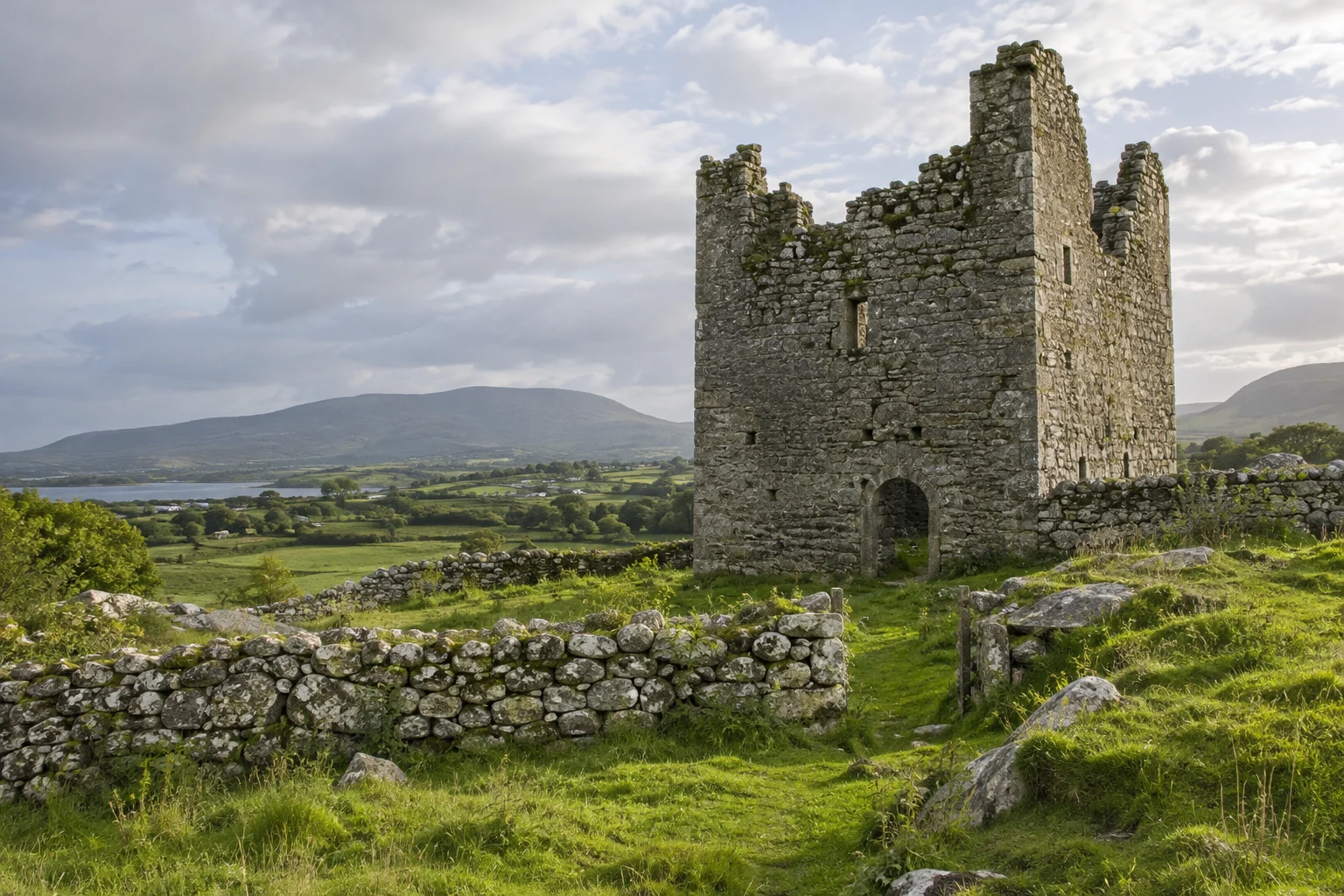
Ireland's history is much older than the modern Irish state. Keeping the island and the state separate is a useful first step: prehistoric communities, medieval kingdoms and many later conflicts belong to the history of the whole island, while the institutions of today's state developed through a more recent political settlement.
This overview offers a route into that history, rather than a complete account. Dates help locate change, but the lives of farmers, craftspeople, migrants and families matter alongside rulers, battles and constitutions.
Before written history: the landscape as evidence
The passage tombs at Newgrange, Knowth and Dowth in the Boyne Valley were built around 3200 BC, according to the Office of Public Works. [1] Their scale is a reminder that complex communities existed in Ireland long before the periods most familiar from school history.
Archaeology is central to understanding those communities. A surviving monument tells us something about the people who made it, but it does not give us their own written explanation of every belief or decision. It is worth distinguishing physical evidence from later stories attached to a place.
Early Christianity and connections beyond Ireland
The National Museum describes Christianity arriving mainly from Roman Britain during the fifth century AD. It brought new influences on craft and social life, with the Church becoming a major institution. Surviving chalices, shrines and carved crosses show the skill of early medieval makers. [2]
This period is easier to understand as one of connections and change than as an isolated golden age. Religious objects were also products of materials, patronage and specialist work. Looking closely at how an object was made can open a different route into history from memorising the name of a saint.
Vikings: raiding, trade and towns
The museum dates the first recorded Viking raids in Ireland to 795 and the establishment of a fortified base at Dublin to 841. Raiding and enslavement were part of this history, but so were trade and urban development. [3]
That combination matters. A label such as Viking can describe outsiders arriving by sea, yet the longer story involves settlement and interaction with communities already living in Ireland. The development of towns changed where goods were exchanged and how power could be organised.
Medieval Ireland was not one uniform society
The Norman invasion of the twelfth century brought colonisation, redevelopment of existing towns and new settlements. The National Museum's account emphasises distinct cultures with different languages, laws and agricultural practices, followed by the development of a mixed Anglo-Irish culture. [4]
Later struggles over English authority, land and religion reshaped that landscape again. The Courts Service describes the consolidation of English law through seventeenth-century conflict, the restrictions of the Penal Laws and the Act of Union of 1800, which dissolved the Irish Parliament. [5] These were changes in who could exercise power, as well as changes on a map.
The Great Famine and a lasting migration story
The Great Famine of the 1840s was a defining catastrophe. In its account of an exhibition marking Black '47, the National Museum estimates approximately one million deaths through starvation and disease, with another million lost through emigration. [6]
An overview should make room for those household experiences. Departure, bereavement and the dispersal of communities are part of the explanation for why Irish history reaches far beyond Ireland. Family records can bring that scale into focus, while individual stories should not be assumed to represent every region or household.
Revolution, partition and the Irish Free State
The Easter Rising took place in 1916. After the 1918 election, Sinn Féin representatives established Dáil Éireann in 1919 rather than taking their Westminster seats; the War of Independence followed. The Government of Ireland Act 1920 provided for partition, and Northern Ireland's parliament opened in 1921. [5]
The Anglo-Irish Treaty was signed on 6 December 1921. The National Archives explains that it provided for the Irish Free State, established on 6 December 1922 and governing 26 counties. Disagreement over the settlement led to civil war. [7] Independence, partition and civil war belong together in this account; none can be explained adequately by treating the settlement as a simple, universally welcomed endpoint.
The modern state, Europe and peace
Voters accepted a new Constitution in 1937. The Republic of Ireland Act 1948 subsequently provided that the state's description would be the Republic of Ireland. [5] These were further stages in constitutional change after the Free State's establishment.
Ireland joined the European Economic Community on 1 January 1973. The CSO's retrospective places that membership within wider social and economic change. [9] The Good Friday Agreement, signed on 10 April 1998, was another major turning point, built through political leadership, civil society and cooperation across traditions and governments. [8]
For a next step, choose one period and follow an original source: a museum object, an archive document or a monument's archaeological account. Ask when it was made, who created it and whose experience is missing. That approach makes Irish history a continuing enquiry rather than a closed sequence of dates.
This historical introduction was researched on 11 October 2026. Historical dates above describe past events, not new developments.

Join the conversation
Keep it kind, relevant and constructive. Comments are reviewed before they appear.
Be the first to share a thought.