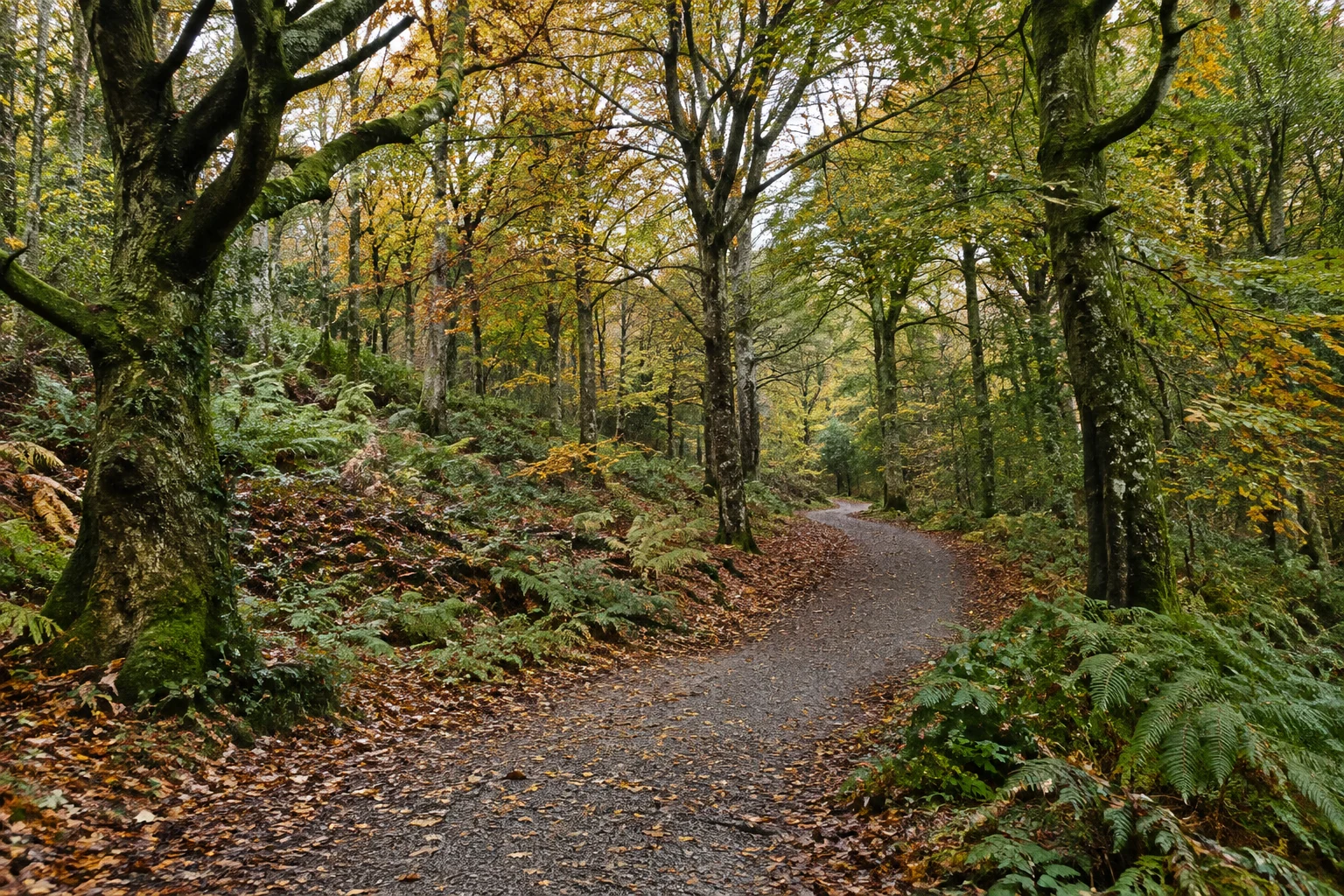
Autumn in Ireland rewards a change of pace. A woodland path, a park near home or a familiar street lined with trees can become the centre of a day out, rather than somewhere to pass through on the way to something bigger. The useful question is what you can enjoy in the daylight and conditions available.
Met Éireann defines meteorological autumn as September, October and November. It also stresses that the transition between seasons is gradual and can reverse for a week or more. [1] That helps explain why the calendar alone is a poor guide to what a particular weekend will feel like.
Look for autumn locally before chasing it across the country
Choose somewhere with deciduous trees and an established walking route. You do not need a dramatic landscape to notice the season: compare leaves still on a tree with those beneath it, look at the canopy from different angles and revisit the same path later in the month.
For a specific Irish woodland option, Coillte describes Knockanacree Woods near Cloughjordan in Tipperary as predominantly beech, with autumn shades of russet, gold and brown. Its listed routes include the 1.4km Ash Loop, graded easy, and the 2.5km Beech Trail, graded moderate. [2] Those are the operator's route descriptions, not a guarantee of today's surface or colour.
Use that information to choose a route that suits your group. A shorter loop with time to stop may work better than a longer walk squeezed between other bookings. Check the current site information before travelling, and treat the published walking time as a planning estimate rather than a deadline.
Plan around the Atlantic, not an ideal photograph
Met Éireann explains that October and November can bring moderate to heavy frontal rain and showers from Atlantic weather systems. Settled spells can also produce pleasant daytime weather, while morning fog may be slow to clear. It cautions that the broad pattern varies from year to year. [1]
For a day out, keep the outdoor part flexible. Check the latest forecast and any official warnings for the place and time you intend to visit. Have suitable footwear and a rain layer ready, and decide where you will turn back if conditions change. A seasonal climate description is not a forecast for your route.
Put one indoor option nearby into the plan: a library visit, a museum or a café you have checked is open. That gives the day some shape if a walk needs to be shortened. Confirm opening times directly rather than assuming a summer timetable still applies.
Give children, cameras and curiosity a small task
A simple observation can make an ordinary walk more interesting. Ask everyone to spot three different leaf shapes, find the same colour in several places or choose one tree to photograph on future visits. Take pictures from the path and leave what you find where it belongs.
Keep wildlife watching quiet and do not make a sighting a condition of a successful outing. Seeing a bird or squirrel is a possibility, not something a woodland visit can promise. Avoid gathering unidentified plants or fungi for food as part of an informal autumn activity.
Make a small autumn map of your own area
Coillte's recreation map is a useful starting point for finding forest recreation sites beyond a single famous destination. [3] Add your nearest park and an indoor alternative, then record access, route length and transport options you have checked. Keep the map modest enough that you can actually use it.
The pleasure of an Irish autumn often comes from noticing familiar places changing. One manageable outing, followed by another a few weeks later, can reveal more than a long list of destinations rushed through in a day.
Source information was checked on 11 October 2026. This is a seasonal guide; it does not report current weather or guaranteed autumn colour at a particular site.


Join the conversation
Keep it kind, relevant and constructive. Comments are reviewed before they appear.
Be the first to share a thought.